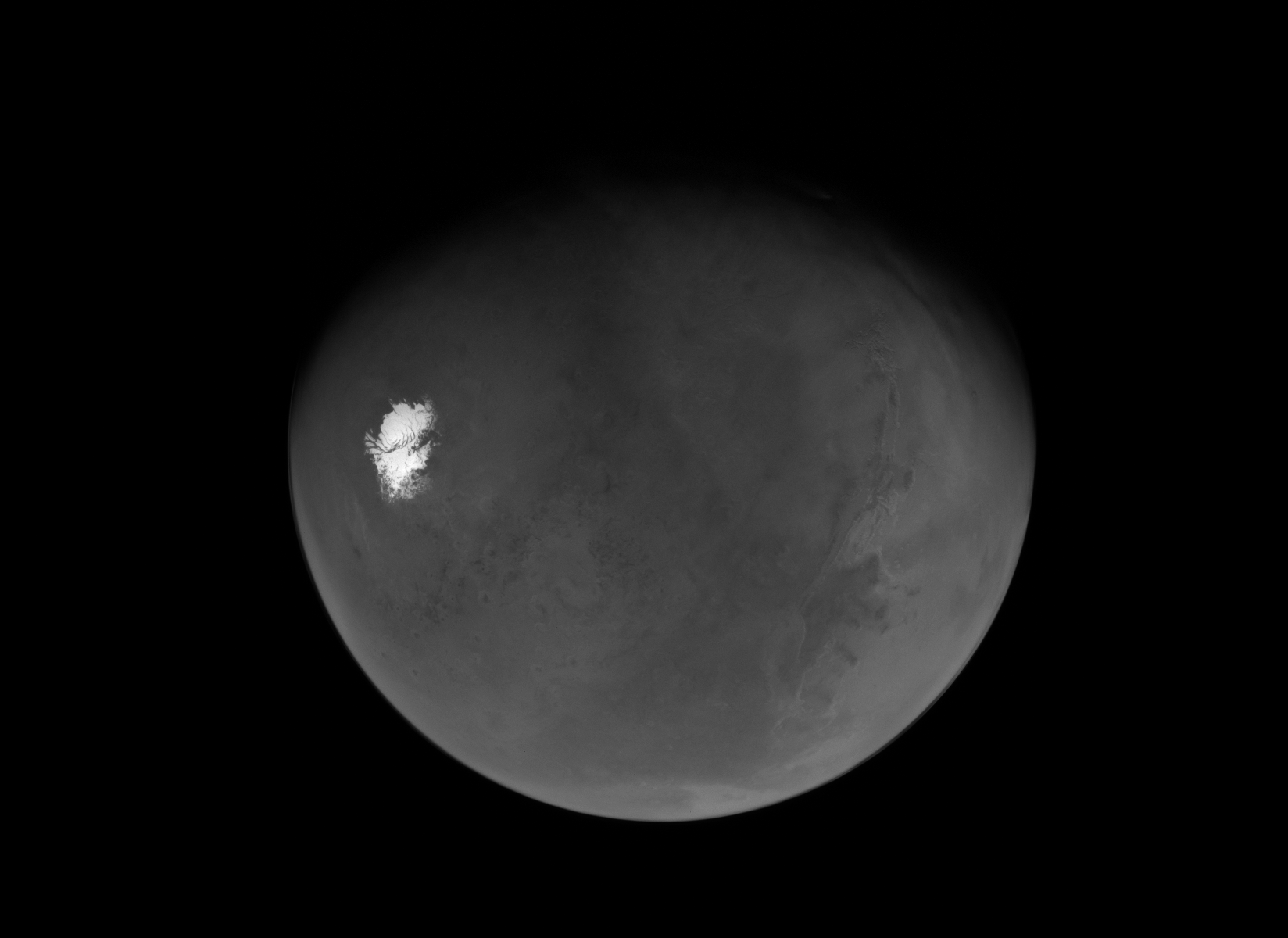
NASA’s Psyche spacecraft has captured its first near-complete view of Mars in the wake of a close flyby on May 15, 2026, offering a sweeping look at the planet from the…
NASA’s Psyche spacecraft has captured its first near-complete view of Mars in the wake of a close flyby on May 15, 2026, offering a sweeping look at the planet from the brilliant south polar ice cap to some of its most dramatic equatorial terrain.
Taken shortly after the probe’s closest approach, the image shows Mars almost fully illuminated in the frame—an uncommon perspective during fast-moving planetary encounters. The vista stretches northward from the southern polar cap and reaches toward the immense Valles Marineris canyon system, a scar that spans thousands of kilometers across the Martian surface, before continuing beyond it into the planet’s northern reaches.
The snapshot marks a brief but significant milestone for a mission whose primary destination lies much farther from the Sun. Mars served as a gravitational stepping-stone, helping adjust Psyche’s trajectory as it heads for the main asteroid belt—the broad ring of rocky bodies orbiting between Mars and Jupiter.
With the red planet now receding behind it, Psyche is preparing to return to the propulsion method that defines its long-distance cruise: solar-electric thrust. Rather than relying solely on short chemical burns, the spacecraft uses electricity generated by its solar arrays to accelerate ions and produce a gentle, persistent push. Over months and years, that steady thrust allows the mission to efficiently reshape its path and continue its journey outward toward its target.
Psyche’s ultimate goal is the asteroid that shares its name. The spacecraft is scheduled to reach the main belt in August 2029, when it will maneuver into orbit around asteroid Psyche. Scientists are keenly interested in the object because it is believed to be the exposed, partial core of a planetesimal—one of the primordial building blocks that collided and merged to form the planets early in the solar system’s history. If that hypothesis is correct, orbiting Psyche could offer a rare opportunity to study material that once lay deep inside a growing world, without having to drill through kilometers of crust.
The Mars flyby imagery is therefore both a striking postcard from a familiar neighbor and a reminder of the mission’s larger ambition: to use modern propulsion to reach an unusual asteroid that may preserve a record of planetary formation processes.
More information about NASA’s Psyche mission is available from the agency’s mission resources online.