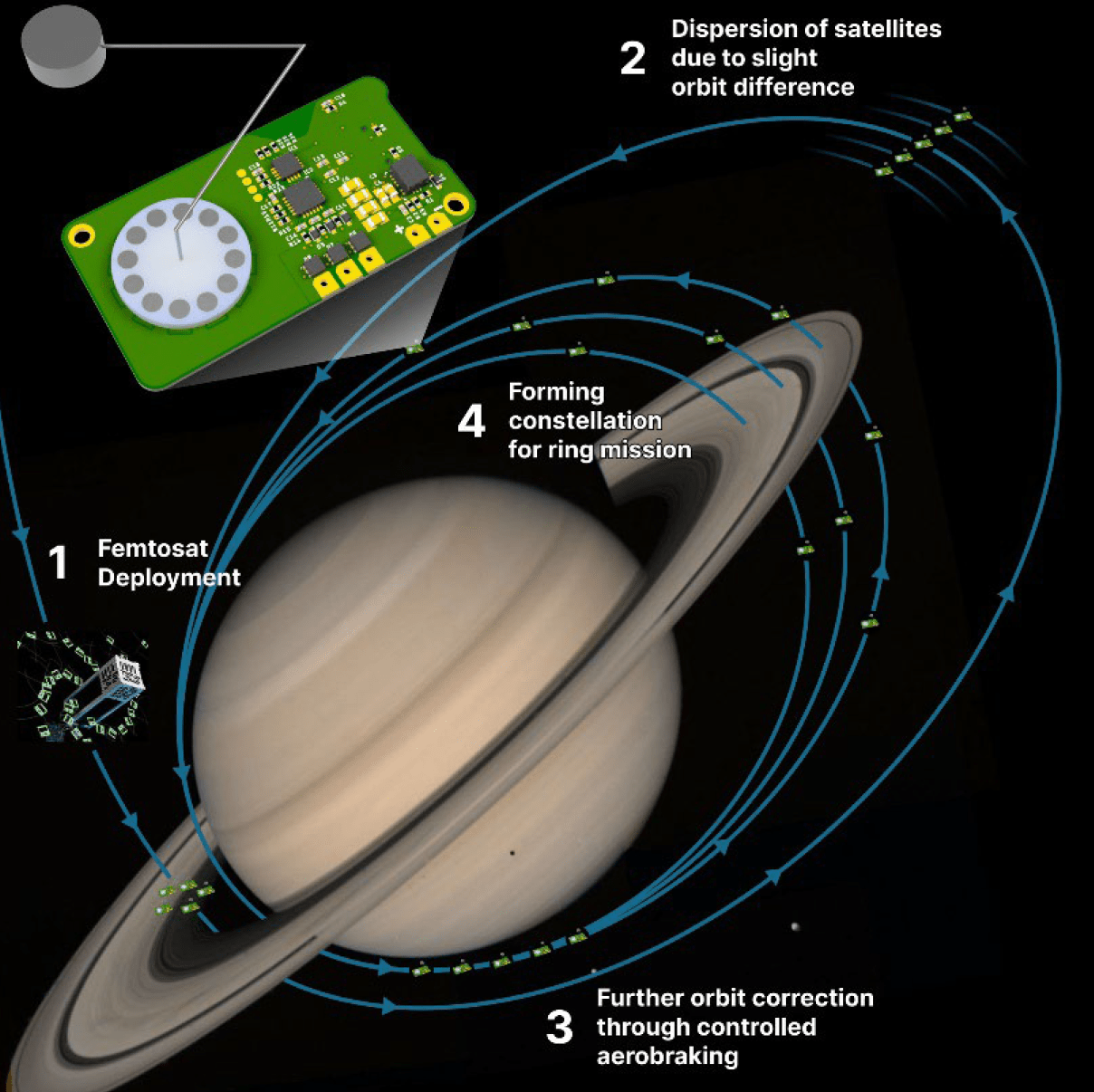
A new mission concept envisions deploying a vast swarm of roughly 10,000 tiny, actively steerable spacecraft—known as femtosatellites—to investigate Saturn up close.
A new mission concept envisions deploying a vast swarm of roughly 10,000 tiny, actively steerable spacecraft—known as femtosatellites—to investigate Saturn up close. The goal is to create detailed maps of the planet’s ring material, measure the composition and density of Saturn’s upper atmosphere, and chart how the magnetic field is distributed across the system.
The proposal targets a long-standing challenge in Saturn science: the danger of flying a single large, expensive spacecraft directly through regions packed with ring particles. A flagship probe in the mold of NASA’s Cassini can deliver extraordinary results, but using one primary vehicle for repeated, in-situ ring surveys would expose the entire mission to a single point of failure. Even a small collision with fast-moving particles could jeopardize critical hardware, potentially ending the mission prematurely.
By contrast, the constellation approach is built around redundancy. Instead of relying on one spacecraft to do everything, the science would be spread across thousands of miniature units capable of adjusting their flight paths. That distributed architecture changes the risk calculation. The mission could tolerate the loss of many femtosats—whether from impacts with ring debris or other hazards—without losing the overall ability to collect data. In effect, what is unacceptable risk for a solitary flagship becomes manageable when the measurement task is divided among a large population of low-mass probes.
If implemented, the swarm would enable direct sampling and localized measurements in environments that are difficult to probe safely with a single craft. Instruments across the constellation would be used to characterize what Saturn’s rings are made of and how that composition varies with location, while also taking in-situ readings of the nearby atmosphere to determine both what chemical species are present and how dense the gas is along different trajectories. At the same time, the fleet’s measurements would be combined to reconstruct the structure of Saturn’s magnetic field across the regions the femtosats traverse.
The concept’s central scientific payoff lies in coverage and resilience. With so many independently steerable units collecting data from multiple points at once, researchers could assemble a richer, more spatially resolved view of Saturn’s rings, atmosphere, and magnetosphere than would be feasible with a single vehicle attempting the same measurements under high collision risk. The proposed mission thus frames massed, steerable femtosats not just as a cost-saving technology, but as an enabling strategy for risky, close-range exploration of one of the solar system’s most complex planetary systems.