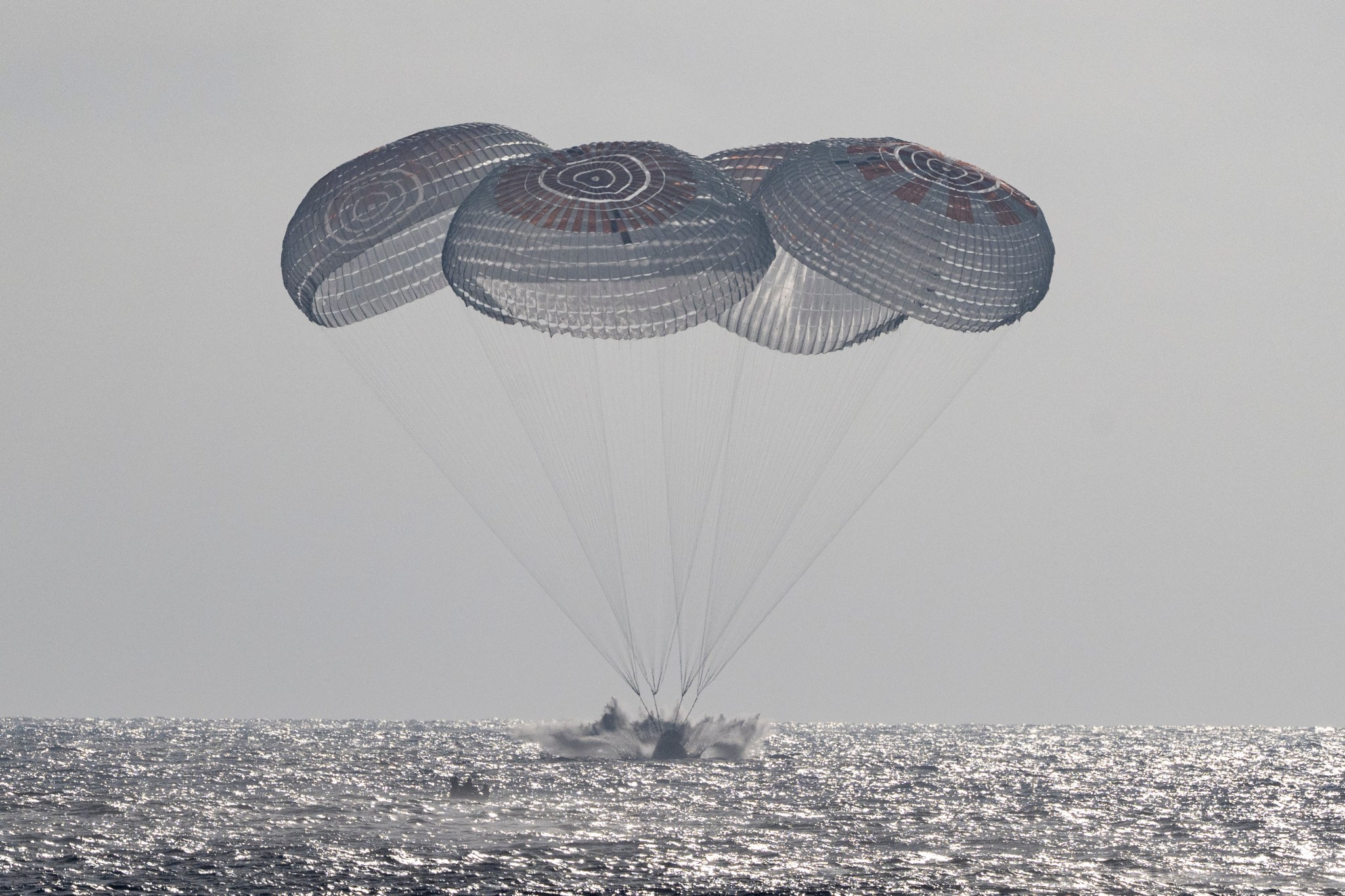
NASA’s SpaceX Crew‑12 astronauts have returned to Earth after more than seven months on the ISS, splashing down in the Pacific off Los Angeles.
After spending more than seven months aboard the International Space Station, NASA’s SpaceX Crew‑12 astronauts have returned to Earth, splashing down Thursday morning in the Pacific Ocean off the coast of Los Angeles.
The crew—NASA astronauts Jessica Meir and Jack Hathaway, European Space Agency astronaut Sophie Adenot, and Roscosmos cosmonaut Andrey Fedyaev—landed at 8:34 a.m. PDT. SpaceX recovery teams, operating from nearby vessels, moved quickly to secure the spacecraft and assist the astronauts once it was brought aboard. As is standard after long-duration missions, the four will undergo postflight medical checks before traveling back to shore and then returning to NASA’s Johnson Space Center in Houston.
NASA plans a post-mission news conference at 3:30 p.m. EDT on Thursday, Oct. 15, at Johnson, where Meir, Hathaway, and Fedyaev will discuss the mission’s scientific work. Adenot will return to Europe and will not participate.
In a statement marking the landing, NASA Administrator Jared Isaacman highlighted the scale of the team effort behind the mission. Meir, Hathaway, Adenot, and Fedyaev spent 237 days living and working in orbit, he said, logging more than 100 million miles of travel as they carried out research and maintenance aboard the station. Isaacman credited “thousands across NASA, SpaceX, and our international partners” with helping the crew return safely, and said repeatedly executing missions like Crew‑12 is central to building the capability and confidence needed to push farther into the solar system.
NASA’s Low Earth Orbit Program manager, Dana Weigel, framed the mission as part of the agency’s broader approach to preparing for deeper-space exploration. Supporting the station—by transporting crew, sustaining a major national asset, and running experiments—provides the science, engineering experience, and risk-reduction that future missions will depend on, Weigel said, adding that the human spaceflight teams were eager to welcome the astronauts home.
Over the course of their stay, the crew circled Earth more than 3,792 times. It was the second spaceflight for Meir and Fedyaev, and the first for Hathaway and Adenot. Crew‑12 launched at 5:15 a.m. EST on Feb. 13 and arrived at the ISS a day later.
Their research portfolio ranged from biomedical investigations to operational demonstrations aimed at sustaining crews farther from Earth. Among the projects were studies of stem cell production techniques intended to support cell-based therapies, a test of generating intravenous fluids on demand—a capability that could reduce resupply needs on future missions—and work examining how the bacterium responsible for pneumonia may contribute to lasting heart damage. The astronauts also carried out nutrition-focused investigations and explored whether physical characteristics influence blood flow in microgravity, research designed to help protect astronaut health.
The mission included major spacewalk activity as well. Meir conducted four extravehicular sorties, bringing her career total to seven—ranking her third among NASA women for spacewalks, behind former astronauts Peggy Whitson and Suni Williams. Adenot completed three spacewalks, becoming the first French woman to perform an EVA outside the station.
NASA said U.S.-based media who want to attend the Oct. 15 briefing in person must contact the Johnson newsroom by 5 p.m. EDT on Tuesday, Oct. 13, while phone participants should request dial-in information by 9:30 a.m. on Oct. 15. Reporters seeking to ask questions must join at least 15 minutes early, and NASA’s media credentialing rules are posted online.
Why it matters
Crew‑12’s return closes another long-duration ISS expedition that advances both Earth-focused biomedical research and the operational know-how needed for missions to the Moon and Mars. The experiments and technology demonstrations—such as medical manufacturing techniques and on-demand supplies—could reduce risk and dependence on resupply during deep-space travel. With commercial providers like SpaceX now routinely ferrying crews, NASA will be watching how reliably these missions can be repeated as the agency shifts focus toward more ambitious exploration.