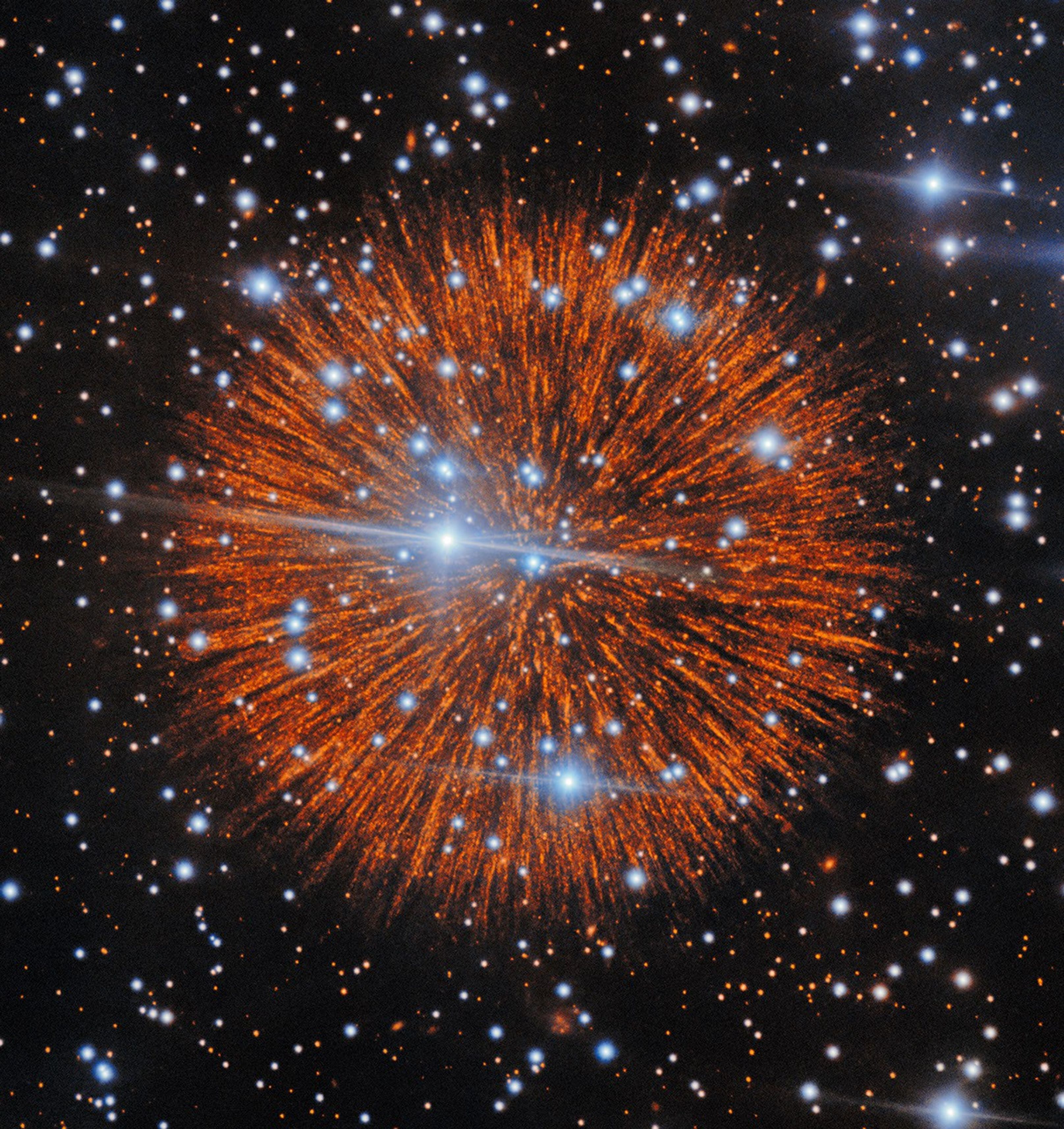
Gemini North images reveal Pa 30, a bizarre supernova remnant likely tied to a long-noted “guest star.” Its hot central star may be shaping the nebula’s filaments.
“Happy New Year!” might be the first reaction to this scene—until you realize it is not a fireworks show but the aftermath of a stellar catastrophe. The image, captured by the Gemini North Telescope in Hawai‘i, features the nebula known as Pa 30, a strangely structured cloud that astronomers think was born in a supernova explosion.
The evidence points back to a striking event recorded nearly nine centuries ago. Separate accounts from Chinese, Japanese, and Arabic observers describe a sudden “guest star” that appeared in the sky in 1181 and remained visible for 185 days. Astronomers now widely suspect that transient object was a supernova, and that Pa 30 is the debris field left behind.
Even with that historical trail, the underlying physics of the blast remains unsettled. Researchers classify the event as a Type Iax supernova—an unusual and less typical branch of stellar explosions. Unlike the more familiar supernova varieties, this class does not fit neatly into standard scenarios, and Pa 30’s peculiar appearance reflects that uncertainty. One leading idea is that the explosion was triggered when two white dwarfs merged. White dwarfs are the dense cores left behind after Sun-like stars exhaust their fuel; a merger can produce extreme conditions capable of igniting a thermonuclear outburst.
At the center of Pa 30 sits an enigmatic star that may hold the key to the nebula’s unusual shape. It is extraordinarily hot and drives a powerful stellar wind. Astronomers think that wind could be sculpting the dramatic radial filaments—streamers that appear to radiate outward from the center like spokes. Embedded along those filaments are compact, bead-like clumps. Each “pearl” is immense: the knots are about four light-days across, meaning light would take roughly four days to traverse a single one.
Pa 30 is therefore more than a striking astronomical portrait. It is a forensic scene: ancient skywatchers’ notes, a modern telescope’s detailed view, and lingering questions about how this specific kind of supernova unfolds all converge in one object. Despite being tied to a precisely dated historical appearance—1181—the remnant is still not fully explained. The effort to understand how such a supernova could produce Pa 30’s structure continues an 845-year-old puzzle, with new observations gradually narrowing the possibilities.
Why it matters
Pa 30 links human records of a bright sky event to a physical remnant that can be studied in detail, offering a rare opportunity to test supernova theories against both history and modern data. Understanding Type Iax explosions—potentially involving white-dwarf mergers—helps astronomers refine models of how stars die and how such events shape their surroundings. What comes next will depend on further observations of the central star and its wind, which may reveal how the nebula’s distinctive filaments and knots were formed.