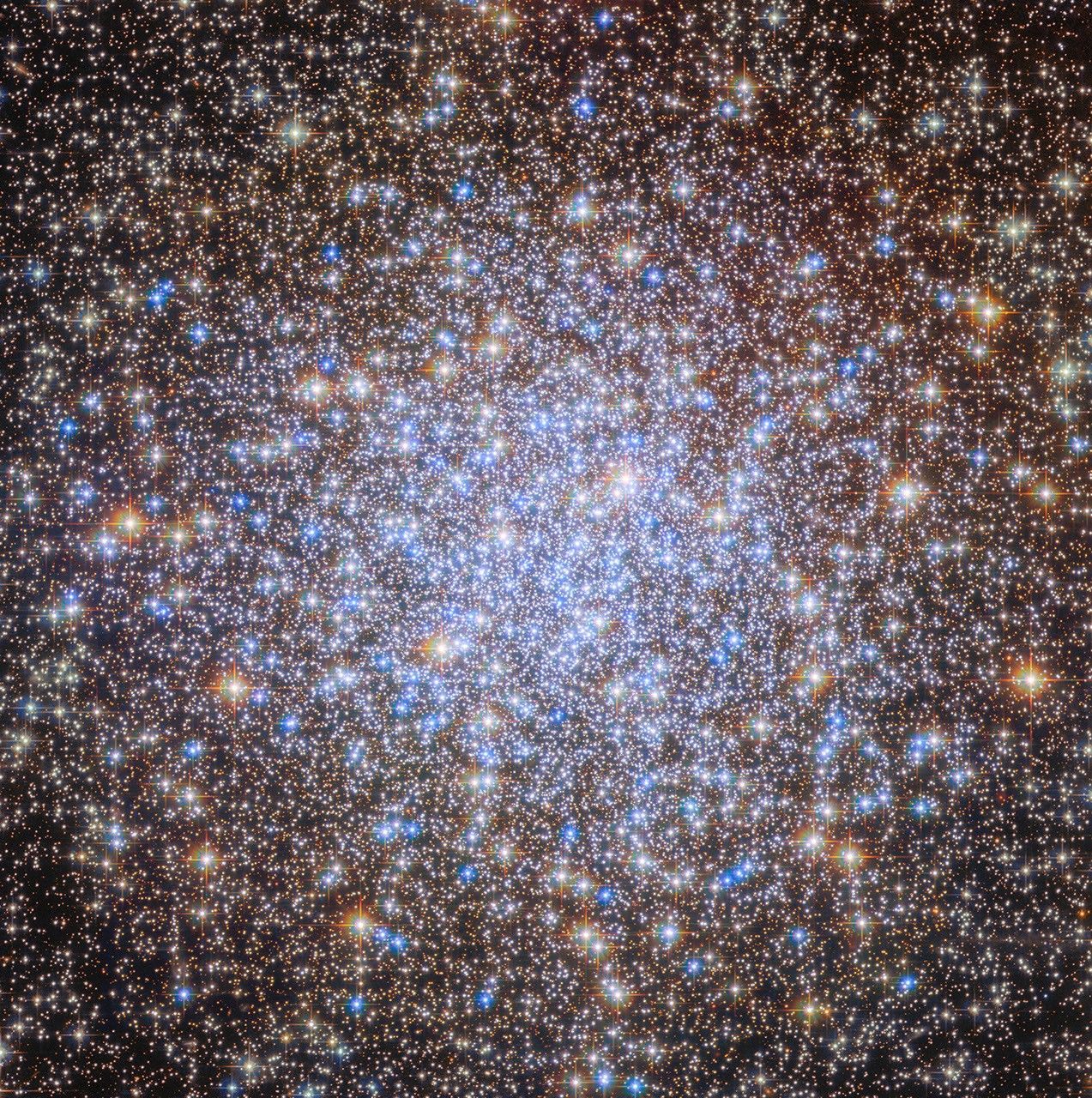
Hubble’s latest portrait turns its gaze toward one of the Milky Way’s most venerable residents: a glittering globular cluster known as NGC 6723.
Hubble’s latest portrait turns its gaze toward one of the Milky Way’s most venerable residents: a glittering globular cluster known as NGC 6723. Sometimes nicknamed the “Chandelier Cluster,” it earns the moniker honestly. The image looks like a spray of lights suspended in space, but every pinpoint is a separate star, packed into a dense, gravitationally bound swarm located about 27,000 light-years away in the constellation Sagittarius.
Globular clusters are among the most striking stellar systems in the galaxy. Each one contains anywhere from tens of thousands to millions of stars, held together tightly by gravity. Astronomers have identified more than 150 such clusters orbiting the Milky Way, and they suspect additional examples remain concealed behind veils of interstellar dust or lost in exceptionally crowded star fields.
What makes these clusters especially valuable to researchers is their age. Many globular clusters are older than 10 billion years, placing them among the earliest stellar populations in the galaxy—some nearly contemporaneous with the universe’s youth. Because of this, astronomers consider them likely relics of the Milky Way’s formative era, possibly assembling long before the thin, rotating disk of stars that includes the Sun had taken shape. Even so, the exact sequence of events that produced globular clusters is still not fully pinned down.
For decades, the conventional view was that globular clusters were simple: all their stars formed in one brief burst, leaving a uniform population with essentially the same age and chemical makeup. Observations from the Hubble Space Telescope and other facilities have steadily undermined that tidy picture. The stars inside these clusters often reveal more complicated origins, hinting at multiple episodes of star formation and subtle chemical differences from one group of stars to another.
NGC 6723 has been part of that scientific reassessment. Hubble first targeted it during a major Milky Way globular cluster survey (program #10775, led by principal investigator Ata Sarajedini). In that effort, Hubble observed 65 clusters using visible and near-infrared light. The resulting dataset enabled researchers to tackle core questions: refining cluster ages and tracking the internal reshuffling that occurs over time, in which heavier stars tend to migrate inward while lighter stars drift toward the outskirts. The survey’s impact has been substantial, providing a foundation for several hundred scientific papers.
A later Hubble campaign returned to many of the same clusters, including NGC 6723, but with a different strategy (program #13297, led by principal investigator Giampaolo Piotto). This time, astronomers exploited Hubble’s sensitivity to ultraviolet wavelengths, which are particularly effective at teasing out small star-to-star differences in chemical composition and constraining whether a cluster’s stars all formed together or over an extended interval.
For NGC 6723, the ultraviolet study uncovered signs of two distinct, closely spaced rounds of star formation, with the second occurring within 634 million years of the first. In human terms that span is immense; against the backdrop of a star system more than 10 billion years old, it is relatively brief—yet scientifically telling. Findings like these are helping astronomers assemble a more realistic account of how globular clusters came into being and evolved, with Hubble’s observations continuing to illuminate these ancient “celestial chandeliers.” Since its launch in 1990, the Hubble Space Telescope has repeatedly reshaped our understanding of the cosmos, and images such as this one show how much it can still reveal.