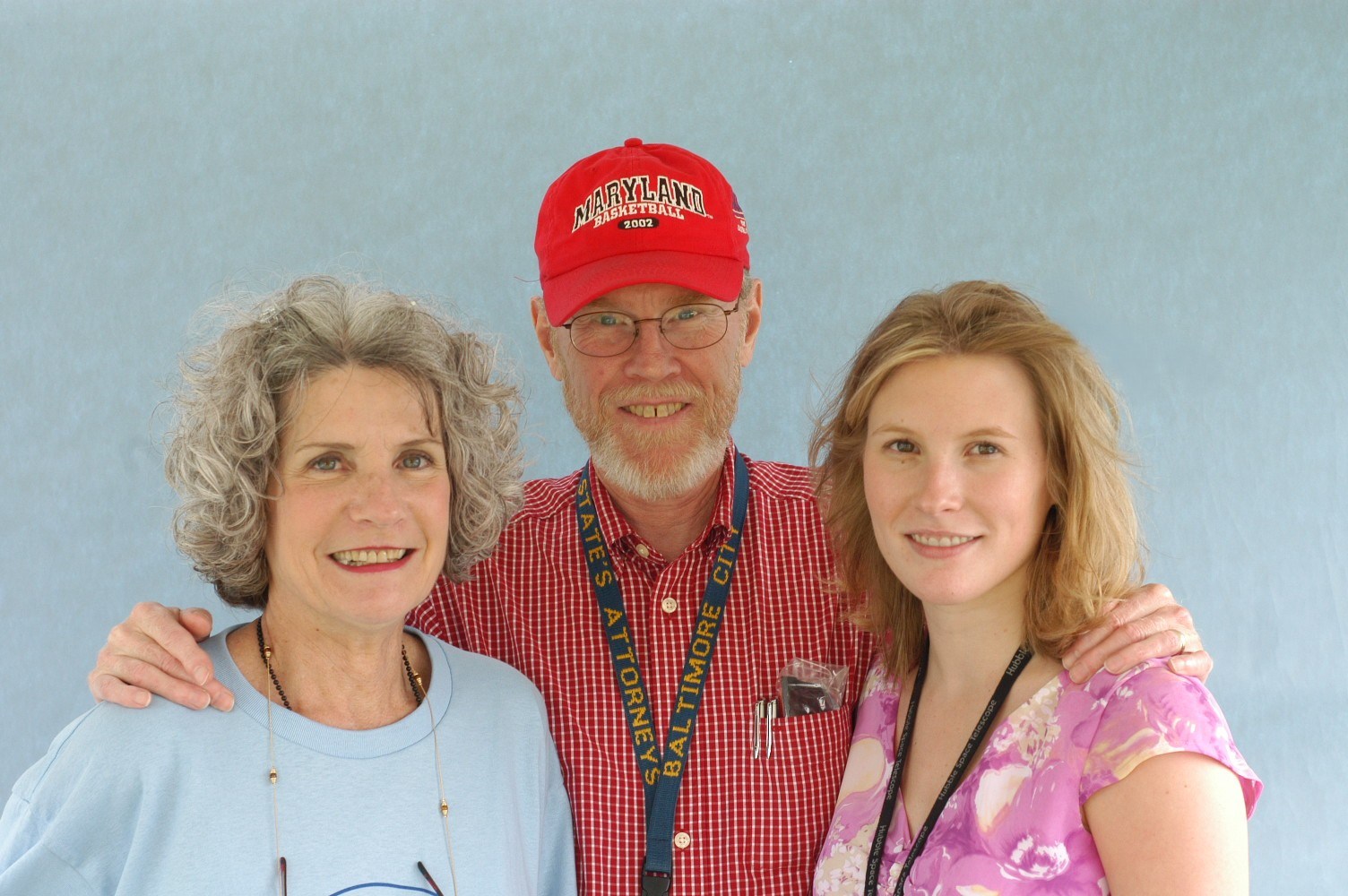
Ashley Knight, raised near NASA Goddard by two center employees, has joined colleagues in transitioning from contractor roles to federal civil service under a workforce directive.
Talk of NASA was a regular part of Ashley Knight’s childhood. Growing up in Greenbelt, Maryland, she listened as her parents—both employees at NASA’s Goddard Space Flight Center—recounted the day’s developments over family dinners. Some moments were heavy, including a conversation she still remembers in the wake of the 1986 space shuttle Challenger disaster. But just as often, the dinner-table updates were about the day-to-day work happening behind Goddard’s gates.
Knight’s father, Lyle, worked as a mechanical engineer; her mother, Julia, spent most of her career in human resources. They also brought their daughter to Goddard for Take Your Child to Work Day and other events, giving her an early window into the world of spaceflight. Knight recalls seeing the specialized facilities where spacecraft and instruments are put through rigorous testing, and watching the energy and teamwork that drive the center’s missions. The experience stuck. As a child, she said, it was captivating.
That early connection to NASA has now come back around. In late August, Knight and several colleagues from the Goddard Office of the Chief Financial Officer took an oath as federal civil servants, transitioning from contractor roles into government positions. The move is part of a broader workforce directive aimed at strengthening NASA’s technical core competencies by shifting mission-essential jobs into the civil service.
Knight’s professional relationship with Goddard stretches back more than 20 years. After graduating from the University of Maryland in College Park, she began looking for work—an effort that naturally led her to the nearby NASA center she had known since childhood. When she spotted a contractor opening supporting the Hubble Space Telescope team, she applied immediately.
Hubble was an especially meaningful entry point, she said, not least because of the dramatic early challenge the observatory faced. Engineers and astronauts famously corrected a flaw in the telescope’s main mirror—an optical problem known as spherical aberration—during the first servicing mission. Joining such a prominent project straight out of college, she said, was thrilling.
As a project support analyst, Knight worked with engineers on test planning, data collection, and hardware procurement for Hubble’s fifth and final space shuttle servicing mission. After that mission concluded in 2009—marking the end of the shuttle era of Hubble servicing—she moved into a comparable position supporting the Robotic Refueling Mission. That project was housed in what was then called the Satellite Servicing Capabilities Office, now renamed NASA’s In-Space Servicing, Assembly, and Manufacturing Capabilities Office at Goddard.
Knight later spent a brief period away from the center, doing contracting work for the U.S. Naval Research Laboratory in Washington. A phone call brought her back to Goddard, where she joined the Office of the Chief Financial Officer as a contractor program analyst. There, she helped manage labor budgets, working to prevent funding gaps and ensure personnel were paid on time.
With her August conversion, Knight now serves as a budget analyst in the Program Analysis Office, continuing many of the same responsibilities—this time as a civil servant. The work may be similar, she noted, but the change in status gives her team greater authority to carry out certain government functions, helping keep NASA missions supported from the financial side. The civil service pathway also opens additional training and professional development options.
Her supervisor, Linnette Morales, described Knight as a strong collaborator and said the conversion expands the ways the office can develop her skills and integrate her into new assignments.
Why it matters
NASA is moving some mission-critical roles from contracting arrangements into the federal workforce, a shift that can affect continuity, oversight, and long-term expertise. For employees like Knight, conversion to civil service can bring greater autonomy and access to training while keeping essential financial operations stable. The next question is how broadly NASA applies the approach—and whether it measurably improves mission support across the agency.