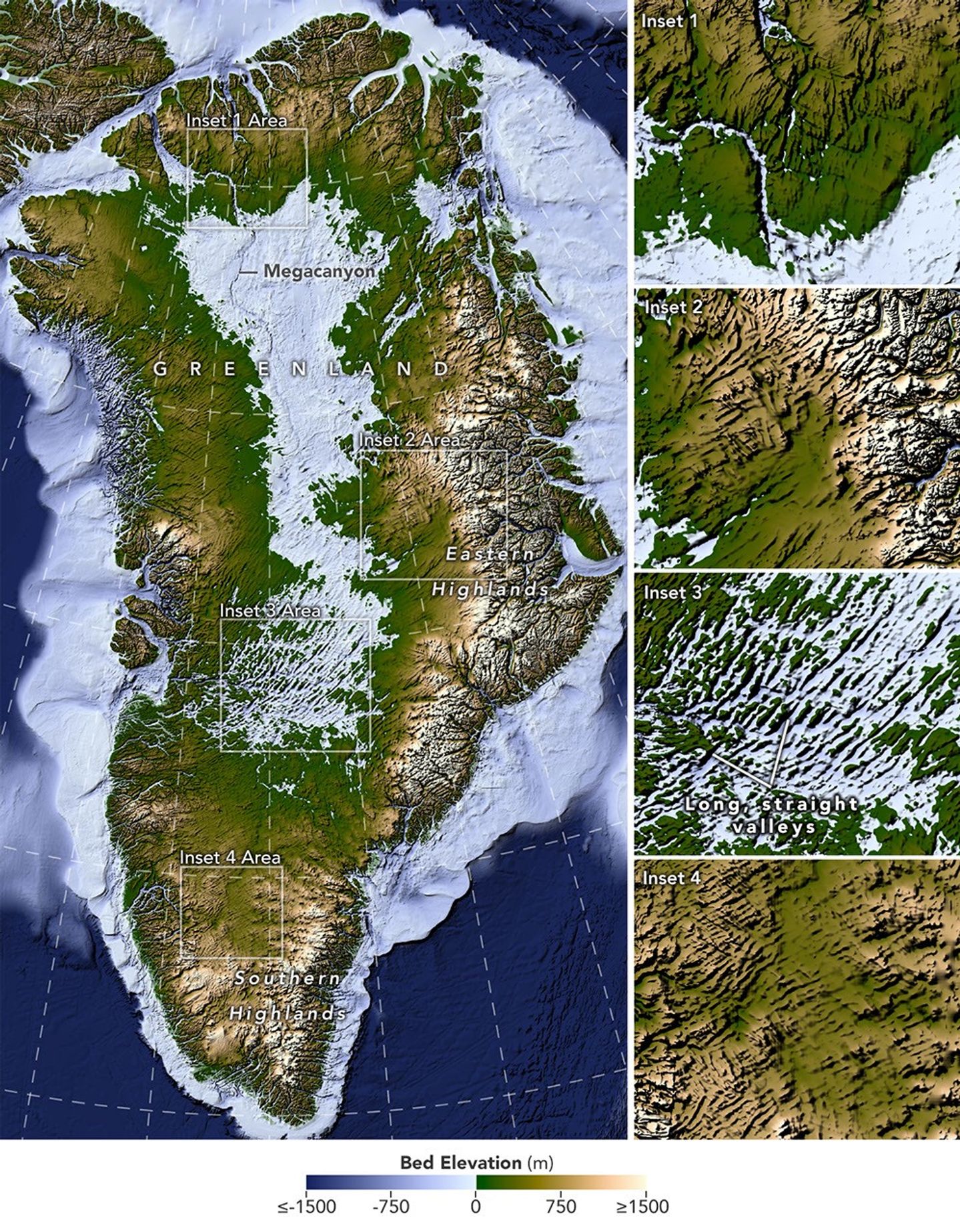
Scientists have produced the most detailed picture yet of the bedrock landscape buried beneath Greenland’s immense ice sheet, revealing a far more connected system of…
Scientists have produced the most detailed picture yet of the bedrock landscape buried beneath Greenland’s immense ice sheet, revealing a far more connected system of subglacial valleys than earlier maps captured. The new work stitches together hundreds of valley segments that previous datasets either missed entirely or represented only in fragments—features that could reshape how researchers interpret Greenland’s geologic past and improve forecasts of how its ice may evolve.
Greenland is covered by an ice sheet spanning roughly 1.7 million square kilometers (656,000 square miles) and reaching more than 3 kilometers (1.9 miles) thick at its maximum. The terrain underneath is largely inaccessible to direct observation, but a NASA-led study published in Geophysical Research Letters reports a new approach that extracts information about the hidden bedrock from subtle clues on the ice surface itself.
The technique, called Ice Flow Perturbation Analysis, is based on a simple premise: when moving ice passes over ridges and valleys, the buried topography leaves faint imprints in the ice sheet’s surface—minute rises and depressions that satellites can measure with high precision. By analyzing these surface signatures, researchers inferred the shape of the underlying landscape and used the results to improve the foundation for future updates to BedMachine Greenland, a widely used, high-resolution compilation of Greenland’s subglacial topography.
Applying the method, the team manually charted 1,943 valleys beneath the ice sheet. About one-third of them had not been identified in earlier mapping. The analysis also showed that roughly half of the valleys already present in BedMachine Greenland—particularly those near the ice margin—actually extend much farther inland than previously indicated, in some cases by hundreds of kilometers.
Some patterns in the new map match prevailing ideas about Greenland’s landscape development. Many valleys appear to originate in the southern and eastern highlands, regions thought to have hosted the earliest growth of the ice sheet. Near the eastern highlands, the study highlights a buried mountain range with linked valleys and increasing relief toward the coast. These alpine-like features may have endured beneath the ice since at least the Pliocene.
Other findings are harder to explain. In west-central Greenland, the researchers identified numerous valleys that are notably long, straight, and consistently oriented southwest to northeast. That uniform alignment hints at tectonic controls—structures in the crust that could have guided water flow and erosion along preferred corridors. Co-author Joe MacGregor, a NASA scientist who studies Earth’s frozen regions, called the pattern “a riddle,” noting that Greenland is usually treated as a stable block of ancient rock rather than a landscape strongly organized by tectonic lineaments.
The valley network also carries clues about how it formed. The relatively wide angles where valleys branch suggest erosion driven not only by surface water, but also by a broad groundwater system that may have seeped upward and helped wear down rock before the ice sheet expanded across the island.
Understanding these buried valleys is not just an exercise in reconstructing ancient terrain. Valleys steer ice flow, concentrating moving ice into channels that can become fast-flowing glaciers and, near the coast, feed fjords where ice breaks off into the ocean. This feedback—channelized flow leading to thicker, faster-moving ice that can deepen valleys further—is especially pronounced along western Greenland. MacGregor compared the scale of the coastal incision to Yosemite’s glacially carved cliffs, describing the west coast as resembling “El Capitan after El Capitan.”
Because the link between valley geometry and ice dynamics is well established, the improved map offers researchers a sharper tool for anticipating how Greenland’s ice will respond as the climate warms and the ice sheet continues to retreat.