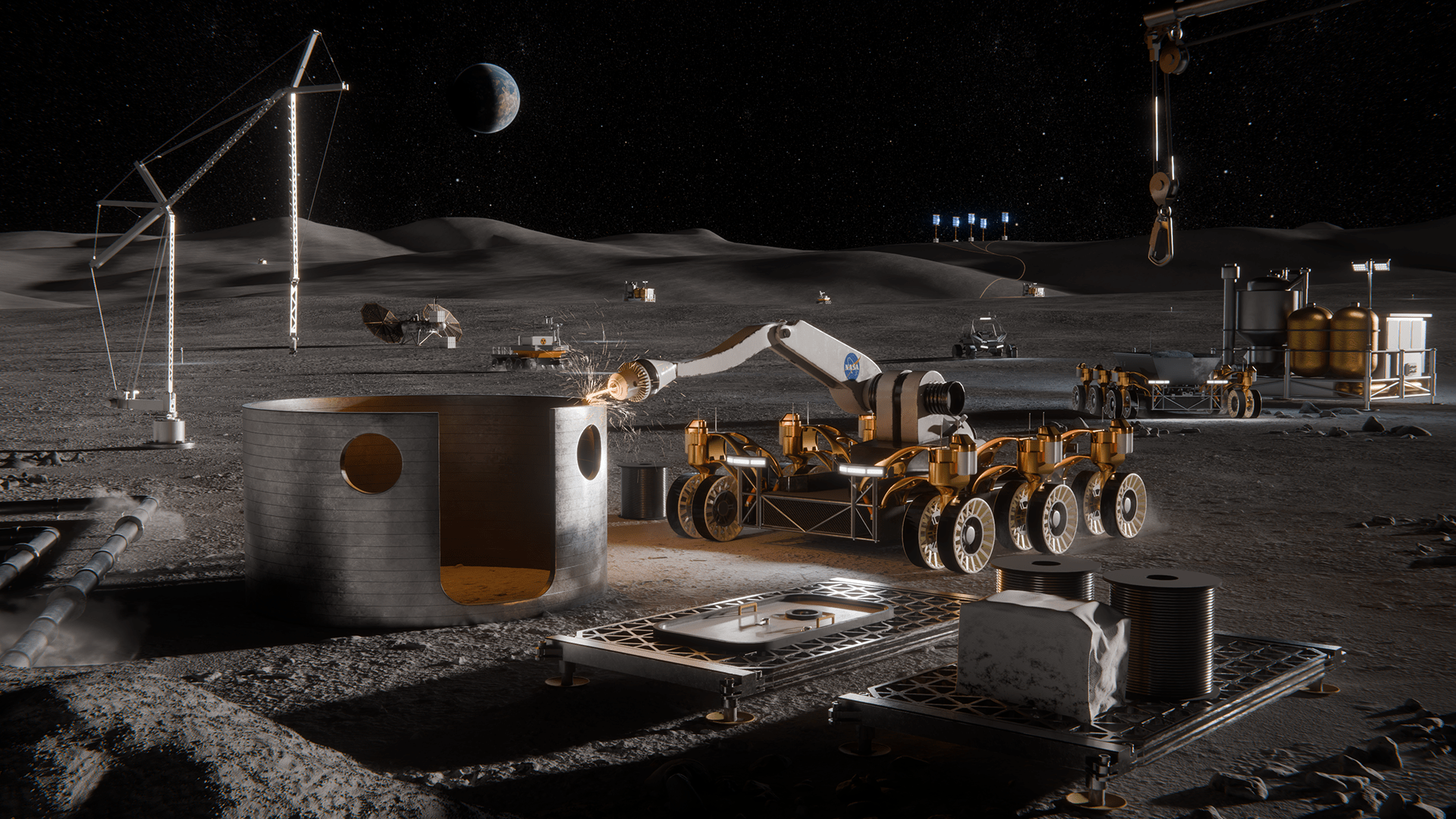
Sustained exploration of the Moon will depend on far more than rockets and landers.
Sustained exploration of the Moon will depend on far more than rockets and landers. NASA says long-duration missions require surface technologies, infrastructure, and day-to-day operations that can work together as an integrated system—powering equipment, producing consumables, and enabling crews and robots to function reliably through the harsh lunar environment.
To speed development of those capabilities and lower technical risk, the agency is asking U.S. organizations to weigh in on a draft solicitation for a new initiative called the Lunar Enabling Infrastructure Accelerator. The program is designed to bring NASA and external partners into closer alignment during the design, development, testing, and evaluation of technologies that support U.S. space priorities. The draft materials are available for review by U.S.-based entities across industry, academia, and the non-profit sector.
NASA says the draft review period is intended to gather practical feedback before the solicitation is finalized. The agency is requesting comments on elements such as requirements, schedules, proposal instructions, and evaluation methods. NASA is urging companies in particular to scrutinize the draft closely and flag unclear language, potential conflicts, or other concerns, with the goal of shaping final requirements and acquisition planning.
At the core of the Lunar Enabling Infrastructure Accelerator are five technology areas NASA describes as addressing critical gaps for missions on the Moon and in cislunar space—the region between Earth and the Moon. These gaps are tied to needs identified in NASA’s Civil Space Shortfalls and are framed around near-term mission priorities.
One focus is surface power. NASA emphasizes that early phases of a Moon Base concept depend on continuous, localized, and scalable electricity generation through both lunar daylight and the long lunar night. The agency’s interests span power generation itself, power management and distribution, and energy storage systems.
A second area is radioisotope power, a nuclear-based approach that converts heat into electricity. NASA notes that such systems can provide dependable energy for spacecraft and instruments operating in locations that are extremely dark, dusty, or remote—conditions common across many destinations in the solar system.
The accelerator also targets in-situ resource utilization, or the ability to use local materials rather than relying entirely on shipments from Earth. As activity on the Moon expands, NASA sees opportunities to harvest lunar resources to make operations safer and more efficient. Advancing these technologies could support producing fuel, water, and oxygen from materials found on the Moon, extending the reach and endurance of exploration missions.
A fourth topic is in-space advanced manufacturing. NASA argues that a lasting human presence beyond Earth orbit will require autonomous production of tools, parts, and other essentials away from Earth. Improved in-space manufacturing could reduce the need for resupply, while increasing flexibility and resilience for missions at the Moon, Mars, and other deep-space destinations.
Finally, NASA is seeking progress in innovative nanomaterials. The agency links this area to U.S. goals that include commercial activity in low Earth orbit and sustained lunar operations under strict mass and performance constraints. The effort aims to improve the commercial availability, performance, quality, and uniformity of nanomaterials that can withstand demanding environments.
NASA expects selected awardees to design, develop, and demonstrate prototype systems, producing validated performance data, analytical models, and operational lessons through testing and demonstrations to mature both technologies and manufacturing applications.
The draft solicitation is posted as Next Space Technologies for Exploration Partnerships-3 (NextSTEP-3), Appendix A, Lunar Enabling Infrastructure Accelerator (Solicitation No. 80GRC026R0008) on SAM.gov, and NASA will accept public comments through July 17, 2026.