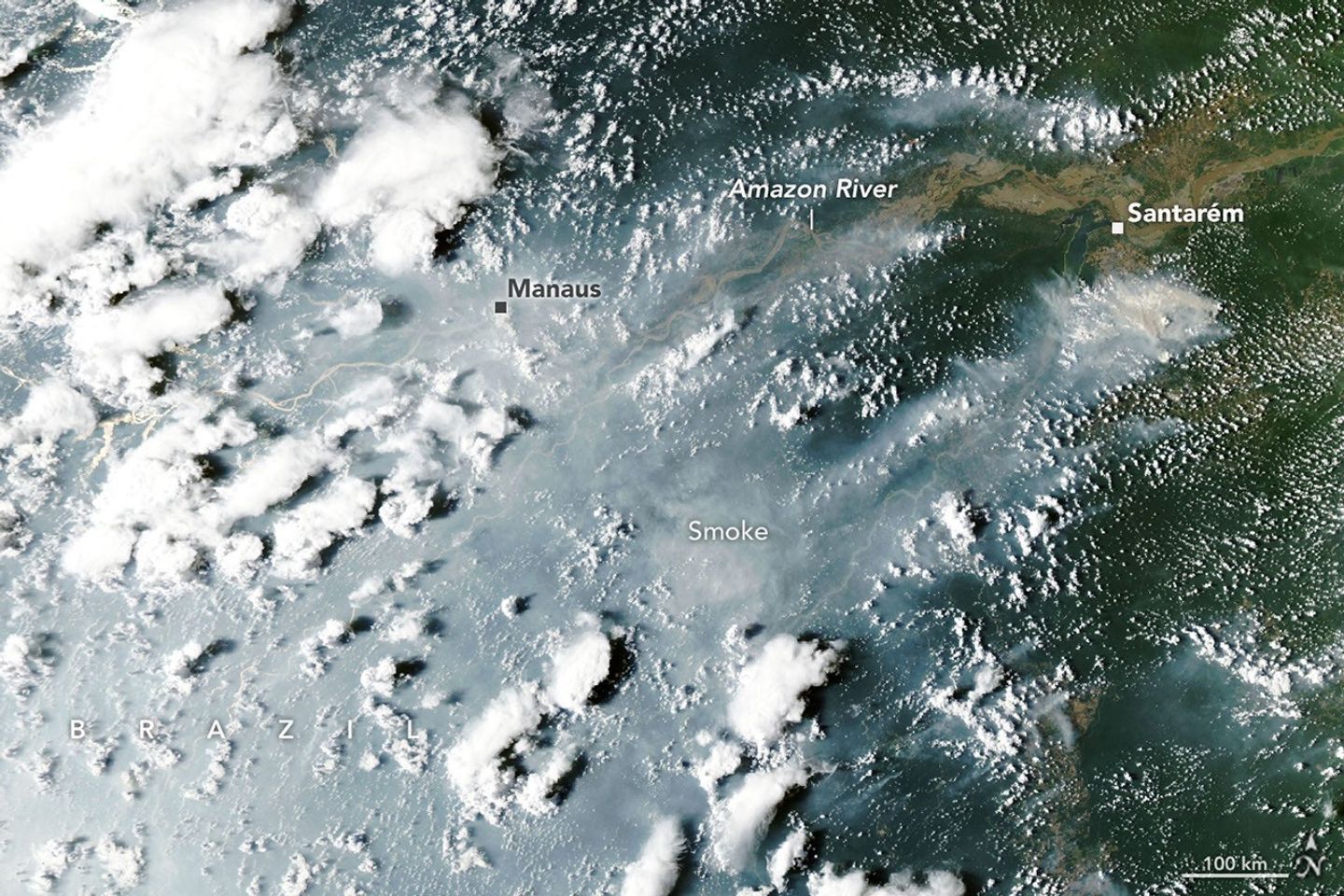
El Niño-driven drought is intensifying fires across the central and eastern Amazon, with satellites detecting sharp rises in active blazes and smoke. Haze has pushed air quality into hazardous ranges in major cities.
El Niño tends to leave a distinct fingerprint on fire activity across the tropics, and scientists say that pattern is emerging again—this time in the Amazon, where drought has set the stage for a potentially punishing fire season.
Unlike fast-moving disasters such as tornadoes or severe storms, El Niño reshapes weather over months by altering rainfall patterns. In 2026, that prolonged shift has helped dry large swaths of the Amazon rainforest, and researchers now believe the region is entering the opening phase of an extended period of burning.
Beginning in September 2026, satellite systems registered a marked jump in both active fires and smoke pollution across the central and eastern Amazon. The increases were visible in widely used monitoring tools, including NASA’s Fire Information for Resource Management System (FIRMS), the Global Fire Emissions Database (GFED), and NASA Worldview. The most affected zone forms a broad corridor from forests surrounding Manaus and Santarém—major commercial and transport hubs—eastward toward the Amazon River’s mouth.
On October 12, 2026, NASA’s Moderate Resolution Imaging Spectroradiometer (MODIS) instrument aboard the Aqua satellite captured thick smoke plumes rising from fires on both banks of the Amazon River. At ground level, Manaus, capital of Brazil’s Amazonas state, was choked by haze. Local officials reported extremely unhealthy air that day: fine particulate matter (PM2.5) exceeded 135 micrograms per cubic meter, placing conditions in the second-worst category on a regional air-quality scale. News reports described widespread disruption in the metropolitan area of more than 2 million people, including school closures and cancellations of city events and children’s sports as authorities warned residents about hazardous air.
Douglas Morton, an Earth system scientist at NASA’s Goddard Space Flight Center, says the Amazon outbreak is part of a broader “cascade” of fires that often unfolds during El Niño. In this sequence, drought and peat fires flare first in equatorial Asia—particularly Indonesia—followed by heightened burning in the central and eastern Amazon. Morton and collaborators from the University of California, Irvine; Vrije Universiteit Amsterdam; and the University of Maryland documented this progression in a 2017 study analyzing the severe 2015–2016 El Niño fire season, and observed a similar chain of events in 2023.
The 2026 El Niño has followed the same script so far. Since August, drought, fire, and persistent smoke have affected parts of Indonesia; by October, hundreds of homes had been destroyed, and dense haze routinely covered entire islands. “Now, in the Amazon, we’re seeing the second domino in the cascade fall,” Morton said, pointing to the rising fire activity in the Brazilian states of Pará and Amazonas.
Researchers expect the next stage to unfold farther north in November and December, with elevated risk in Roraima, northern Pará, and Amapá, as well as parts of Venezuela, Guyana, and Suriname. Morton added that the southern Amazon—areas of Brazil and Paraguay—typically reaches its peak fire danger later, around August and September 2027.
Morton called it “striking—and frustrating” to see repeat burning in some of the same forests affected during El Niño-related fire seasons in 2015 and 2023. Fires in humid rainforests can be especially destructive because many local species are poorly adapted to burning. He also warned that areas scorched in past events may ignite more intensely now: partially burned trees and damaged forest structure can leave remaining vegetation more vulnerable.
Morton expects fires around Santarém and Manaus to persist until the rains return in December 2026 or January 2027. For regions north and south of today’s hotspots, he said, there is still time to reduce the danger. Given the strength of the current El Niño, he urged people to avoid setting fires “at all costs.”
Why it matters
Smoke from Amazon fires can rapidly degrade air quality for millions of people, while repeated burning can push already-stressed forests toward long-term ecological decline. The unfolding El Niño “cascade” also gives governments a forecast-like window to plan enforcement, public-health responses, and fire prevention ahead of the next expected hotspots. What happens in the coming months—especially whether land-clearing burns are reduced—could determine how severe the season becomes across northern South America.