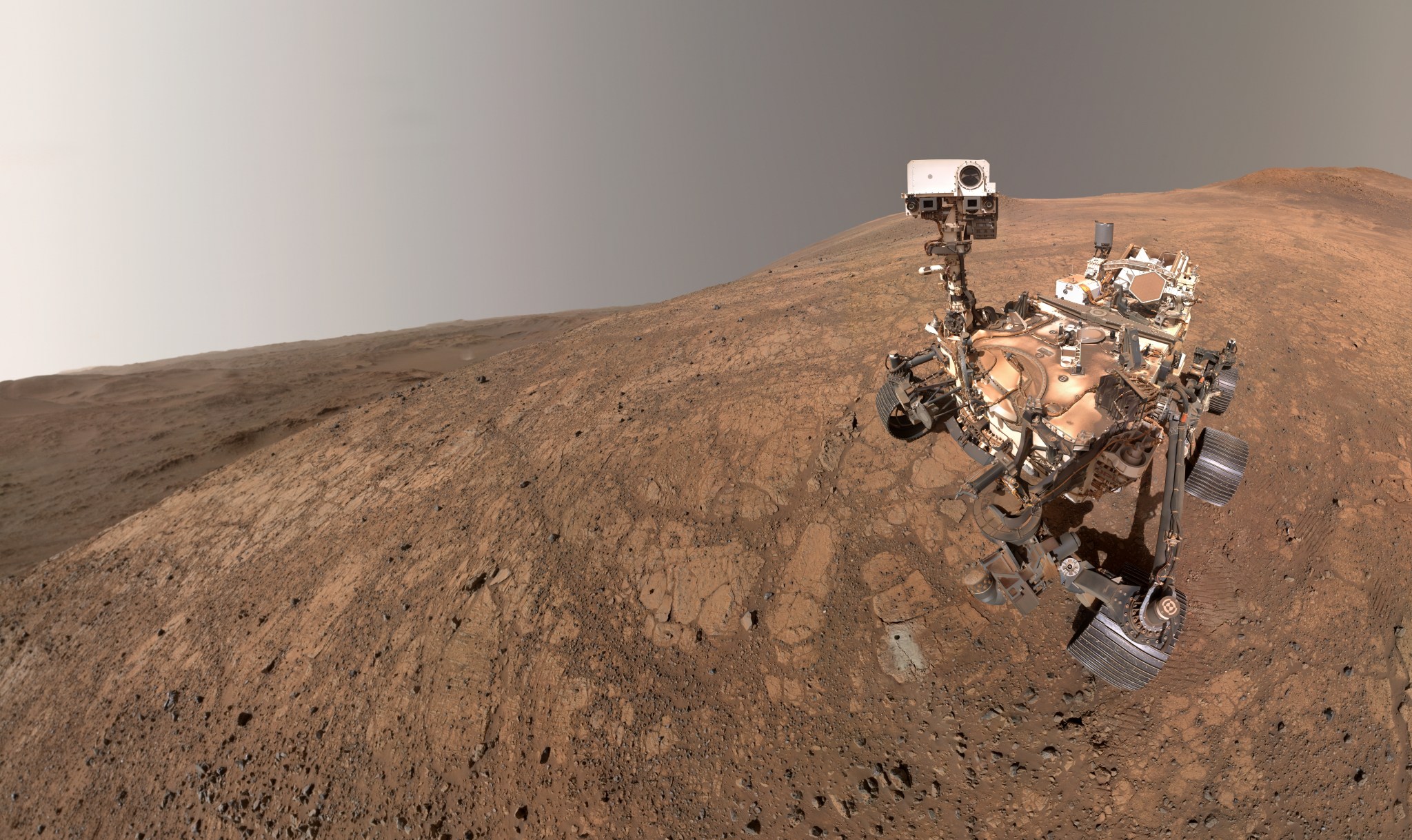
NASA’s Perseverance rover has found that a towering stack of ancient rocks on the western rim of Mars’ Jezero Crater was assembled not by slow sedimentation alone, but…
NASA’s Perseverance rover has found that a towering stack of ancient rocks on the western rim of Mars’ Jezero Crater was assembled not by slow sedimentation alone, but by repeated asteroid strikes that showered the region with debris. The roughly 245-foot-thick (75-meter) package of layered bedrock—nicknamed the “Broom Point member” by the mission’s science team—appears to date back more than 3.9 billion years, placing it among the oldest material ever investigated directly by a rover on the Martian surface.
The results, published Wednesday in Journal of Geophysical Research: Planets, provide a rare look into an early, chaotic phase of solar system history. Perseverance deputy project scientist Ken Farley of Caltech said the rover is now examining a slice of Martian time that predates Jezero Crater itself. Unlike Earth, where plate tectonics continually reshapes and recycles the crust, Mars lacks that global recycling system. As a consequence, extremely old geological records can remain preserved there in ways that are largely impossible on our planet.
After climbing onto Jezero’s western rim in late 2024, Perseverance surveyed the surrounding outcrops with its suite of instruments. At Broom Point, the rover identified six distinct rock types arranged in a repeating pattern. The sequence includes layers of breccia—rocks made of broken, angular fragments—interleaved with bands of fine, pulverized material that resembles compacted rock dust. Many fragments embedded in the breccias contain vesicles, small cavities left behind by gas bubbles, implying the material was once molten.
One of the most telling indicators came from tiny, dark, glassy spheres scattered through the layers. Similar droplets can be created by volcanic eruptions, but the team argues that volcanoes seldom generate them in such large quantities. Instead, the abundance of the beads points strongly to impact events, when rock is flash-melted and sprayed outward before cooling into glass mid-flight. Some of the largest spheres match the scale of impact-produced beads documented from Earth’s Chicxulub event, the asteroid strike linked to the end-Cretaceous mass extinction.
The repeated alternation of rock types through such a thick section suggests the area was hit again and again by high-energy events. Lead author Alex Jones, a planetary geology Ph.D. student at Imperial College London, said the layers likely represent debris from impacts of varying sizes occurring at different distances. Material from faraway large strikes and nearby smaller ones would have rained down onto the same region, gradually building the stacked sequence Perseverance is now reading like a chronicle.
Several layers also hint that water or ice may have influenced how the deposits formed. Some beds resemble fast-moving, ground-hugging flows—surges that on Earth can occur when molten ejecta meets water or ice and triggers explosive steam-driven movement.
The rocks’ structure adds another twist. Portions of the stack are tilted by more than 80 degrees, nearly upright—too steep to be explained by the Jezero-forming impact alone. Scientists propose a two-stage history: first, the colossal impact that created the Isidis Basin—about 1,200 miles (1,900 kilometers) wide—would have disrupted and tipped previously flat strata. Later, a second impact carved the 28-mile-wide (45-kilometer-wide) Jezero Crater, fracturing and heaving the already-tilted rocks into the rugged rim exposures visible today.
To help establish when these events occurred, Perseverance has drilled and cached two core samples, “Bell Island” and “Main River.” If a future mission returns them to Earth, laboratory dating could reveal the timing and frequency of early Martian impacts—offering indirect clues to conditions on the young Earth, where comparable evidence has largely been erased by billions of years of tectonic activity.