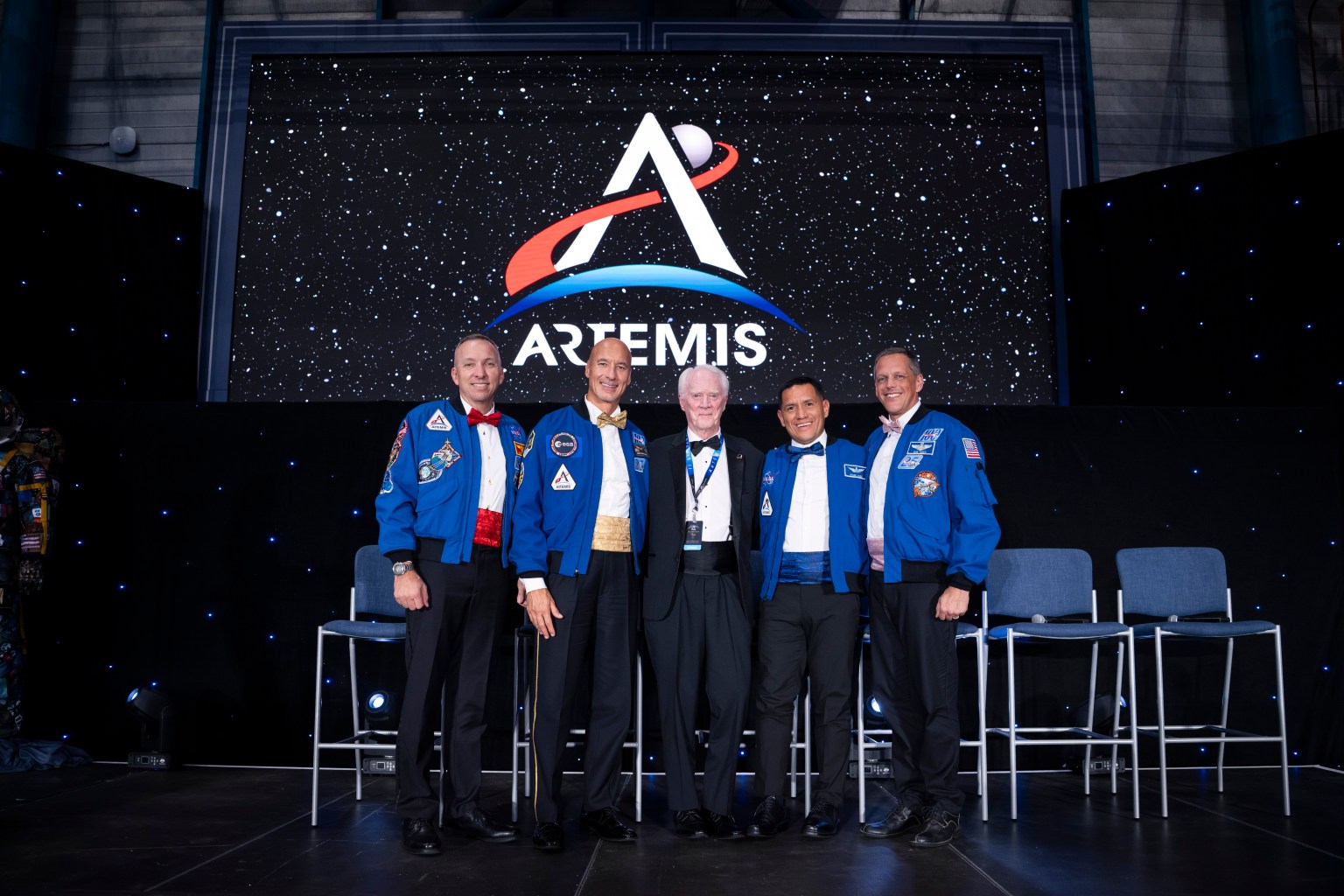
NASA’s Johnson Space Center marks 65 years as the operational heart of U.S. human spaceflight, from Gemini and Apollo to the ISS and beyond, training crews and directing missions.
For 65 years, NASA’s Johnson Space Center in Houston has been a driving force behind U.S. human spaceflight—helping crews learn how to live and work beyond Earth, and building the operational muscle needed to fly increasingly complex missions. From early rendezvous and docking demonstrations in Gemini to the scientific work conducted on the International Space Station (ISS), Johnson’s engineers, flight controllers, scientists, instructors, and medical teams have supported nearly every major chapter of America’s crewed space program.
That legacy began as the space agency was still in its infancy. When the Manned Spacecraft Center officially opened on Nov. 1, 1961, NASA had already completed two suborbital Mercury flights, with the first U.S. orbital mission only months away. Much of Mercury remained based at Cape Canaveral to keep the program stable. Houston, however, became home for the next effort—Project Gemini—initially spread across leased temporary buildings around the city while the permanent Clear Lake campus was being built.
By June 1965, the new Mission Control Center had become NASA’s primary hub for directing crewed missions, taking the lead during Gemini IV, which included the first American spacewalk. From there, Houston oversaw the remaining eight Gemini flights, sharpening the techniques—especially rendezvous and docking—that would prove essential for the Moon.
As NASA transitioned into Apollo, Houston’s teams faced both urgency and tragedy. After the Apollo 1 cabin fire in January 1967, managers, engineers, and astronauts applied hard-won lessons to improve spacecraft safety and protect crews. Crewed flights resumed in October 1968. That same period brought a bold strategic choice from Houston leadership: redirecting Apollo 8 into a mission to orbit the Moon. In December 1968, Apollo 8 completed that historic circumlunar journey. Seven months later, Apollo 11 landed astronauts Neil Armstrong and Edwin “Buzz” Aldrin on the lunar surface—announcing their arrival with a transmission that began with “Houston.” Five additional landings followed, closing Apollo’s first era of lunar exploration in December 1972.
The scientific work did not stop with the last splashdown. At the Manned Spacecraft Center’s Lunar Receiving Laboratory, specialists performed the first examinations of Apollo lunar material and prepared the samples for distribution to scientists worldwide. The laboratory building was demolished in March 2024, and a Lunar Receiving Park was dedicated in 2026 to commemorate its role. Today, Johnson’s Astromaterials Research and Exploration Science (ARES) division continues to curate and study the Apollo collection at the Lunar Sample Laboratory Facility.
Houston’s expertise also proved decisive when Skylab—America’s first space station—suffered major damage during launch in May 1973. The station lost its thermal shield, one solar array was stuck, and the other was torn away. In under 10 days, Johnson engineers designed and built a substitute sun shield and developed the procedures needed to free the jammed array. The first Skylab crew then carried out extensive repair work in orbit. Three missions—lasting 28, 59, and 84 days—ultimately delivered more research than planned, showcased the benefits of human-led long-duration science, and gave mission control continuous experience monitoring extended flights.
International cooperation soon followed. After joint training sessions in Houston and Moscow, U.S. astronauts and Soviet cosmonauts conducted the first in-space meeting between the two nations during the Apollo-Soyuz Test Project in July 1975.
Work on the Space Shuttle era was already underway. Approved in 1972, the program performed five approach-and-landing tests using the orbiter Enterprise, setting the stage for Columbia’s first orbital mission in 1981. The shuttle’s roots stretched back to reusable spaceplane concepts Johnson engineers began exploring in the late 1960s.
Today, Johnson remains central to NASA’s future. The center is home to the Orion and Moon Base programs, continues supporting ISS operations and astronaut training, and is preparing crews and systems for NASA’s return to the Moon—aiming to build the capabilities needed for a sustained human presence on the lunar surface.
Why it matters
Johnson Space Center’s history tracks the evolution of how humans operate in space—from short missions to months-long habitation and international partnerships. The same mission-operations and human-health expertise that helped rescue Skylab and run the ISS is now being applied to Artemis-era lunar exploration. What happens in Houston will shape how quickly NASA can return astronauts to the Moon—and how safely it can keep them there for the long term.