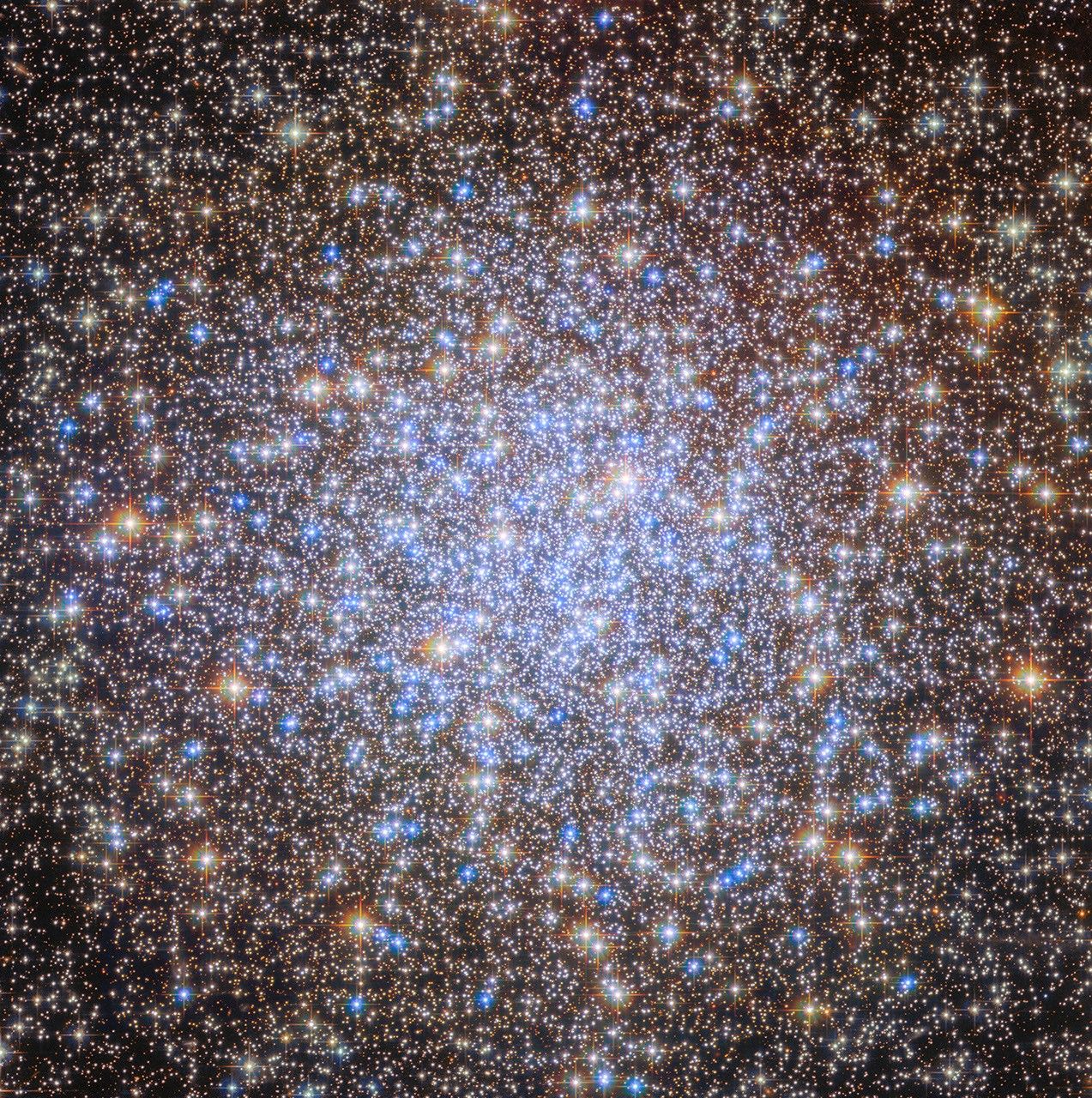
A newly released image dated June 26, 2026, spotlights the globular cluster NGC 6723—an object astronomers sometimes nickname the “Chandelier Cluster” for its glittering, many-pointed appearance.
A newly released image dated June 26, 2026, spotlights the globular cluster NGC 6723—an object astronomers sometimes nickname the “Chandelier Cluster” for its glittering, many-pointed appearance. The comparison is fitting: the scene resembles a hanging fixture studded with lights, except here each pinpoint is not a bulb but a separate star.
NGC 6723 lies about 27,000 light-years from Earth in the direction of the constellation Sagittarius, the Archer. In the Hubble view, the cluster’s densely packed stellar population gives it a rich, sparkling texture, emphasizing just how many stars are bound together in a relatively compact region of space.
Beyond its visual appeal, NGC 6723 represents a class of objects that serve as living archives of the Milky Way’s early history. Globular clusters are known for hosting some of the galaxy’s most ancient stars. Many such clusters are more than 10 billion years old, and a number of them formed so long ago that they are approaching the age of the universe itself. Because the stars in these systems are so old, studying globular clusters helps astronomers reconstruct the conditions that prevailed when the Milky Way was still taking shape.
Researchers generally consider globular clusters to be among the first large-scale structures to assemble in our galaxy. Their formation may have occurred extremely early—potentially billions of years before the Milky Way’s thin disk emerged, the flattened stellar component in which the Sun now travels around the galactic center. If that timeline is correct, then clusters like NGC 6723 provide a window into an era that predates many of the features that define the modern Milky Way.
Even so, key questions remain unresolved. While globular clusters are widely regarded as primordial building blocks of the galaxy, astronomers do not yet have a complete explanation for exactly how these tightly bound, star-rich spheres formed and evolved. Untangling that origin story continues to be an active area of research, informed by detailed imaging and measurements of the clusters’ stellar content.
The image is credited to ESA/Hubble and NASA, with contributions from A. Sarajedini and G. Piotto.