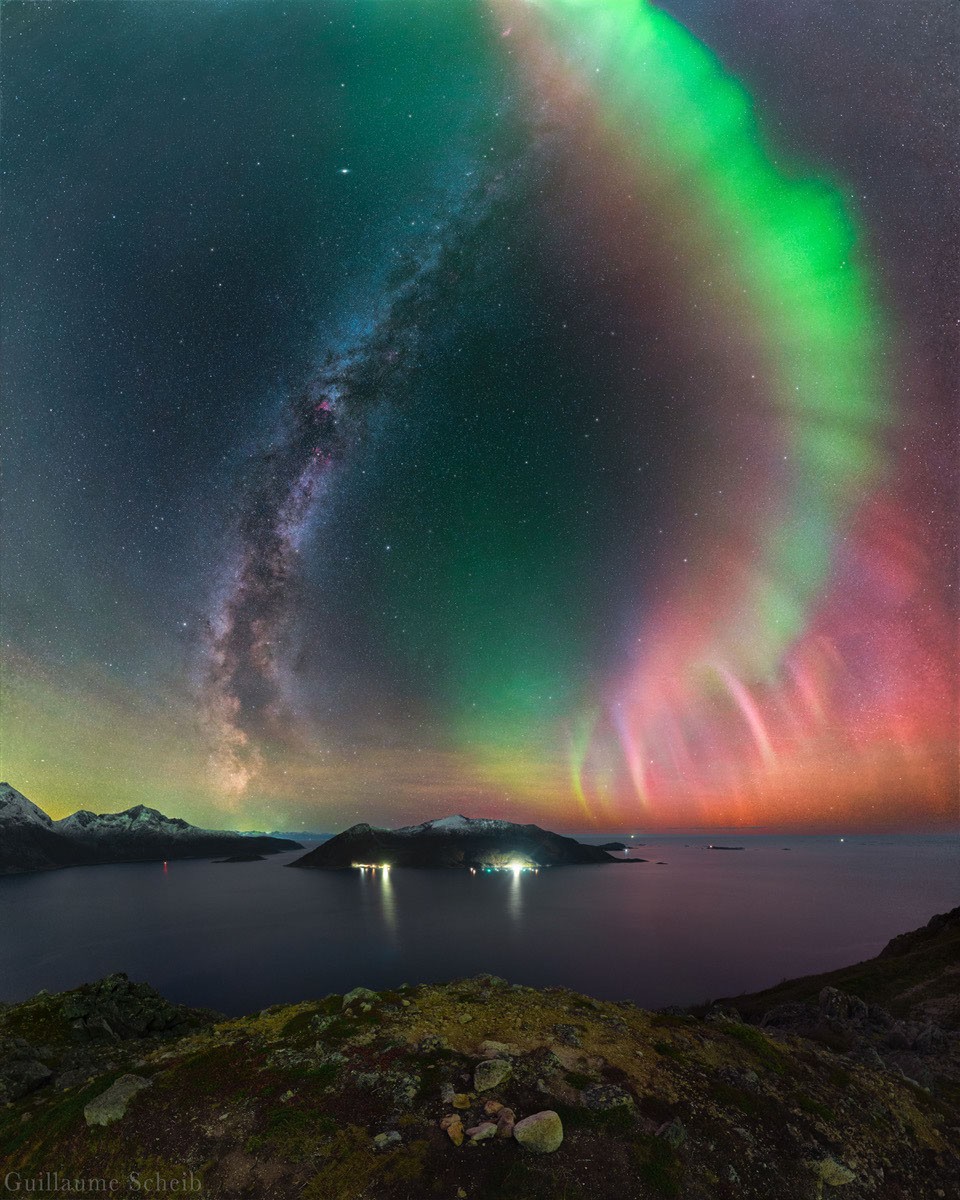
A photo from northern Norway shows the Milky Way’s core band aligned with a fresh auroral arc, linking deep space scenery with Sun-driven space weather.
Two sweeping arcs appear to meet above a northern Norwegian landscape, giving the impression of a dramatic showdown in the night sky. The scene, however, is not a cosmic conflict but a fortunate alignment: the distant core band of the Milky Way set beside a fresh ribbon of aurora in Earth’s upper atmosphere.
On the left side of the image lies the Milky Way’s central plane—an immense, ancient structure made of countless stars mixed with gas and dust. This galactic band long predates Earth and sits at an enormous distance, effectively serving as a backdrop to everything closer in the frame.
The arch on the right is far more local and fleeting. It is an auroral arc, formed only hours before the photograph was taken. Auroras arise when atoms and molecules high in Earth’s atmosphere become energized, producing the characteristic glow. Unlike the Milky Way’s steady presence, auroral curtains can emerge, evolve, and fade within a single night as conditions in near-Earth space change.
Despite their stark differences in age and scale, both arcs are linked by a common source: the Sun. Our star is itself one member of the Milky Way, and it regularly releases streams of energetic particles. When those particles interact with Earth’s magnetic environment, they can ultimately trigger auroral displays in the planet’s upper atmosphere. The photograph captures this relationship in a single frame—local space weather overlaid on the deep structure of our home galaxy.
The sky offers additional reference points beyond the two dominant arches. Behind the central region of the auroral band sits the familiar pattern of the Big Dipper, providing a recognizable landmark amid the glow. Still farther away, near the top of the frame just left of center, a small bright patch marks the Andromeda galaxy. Andromeda is not part of the Milky Way but a neighboring galaxy visible from Earth under dark conditions, appearing here as a distant smudge set against the broader star field.
The image was recorded roughly a month before publication from Kvaløya, an island in northern Norway known for dark skies and frequent auroral activity—conditions that make it an ideal location to witness the interplay of Earth’s atmosphere and the wider universe.
Why it matters
This juxtaposition highlights how processes close to home—space weather driven by the Sun—can share the sky with structures spanning the galaxy and beyond. For researchers and skywatchers alike, it’s a reminder that auroras are not only beautiful but also indicators of energetic solar activity that can affect modern technology. As solar conditions evolve, monitoring geomagnetic activity will remain key for anticipating both spectacular displays and potential disruptions.