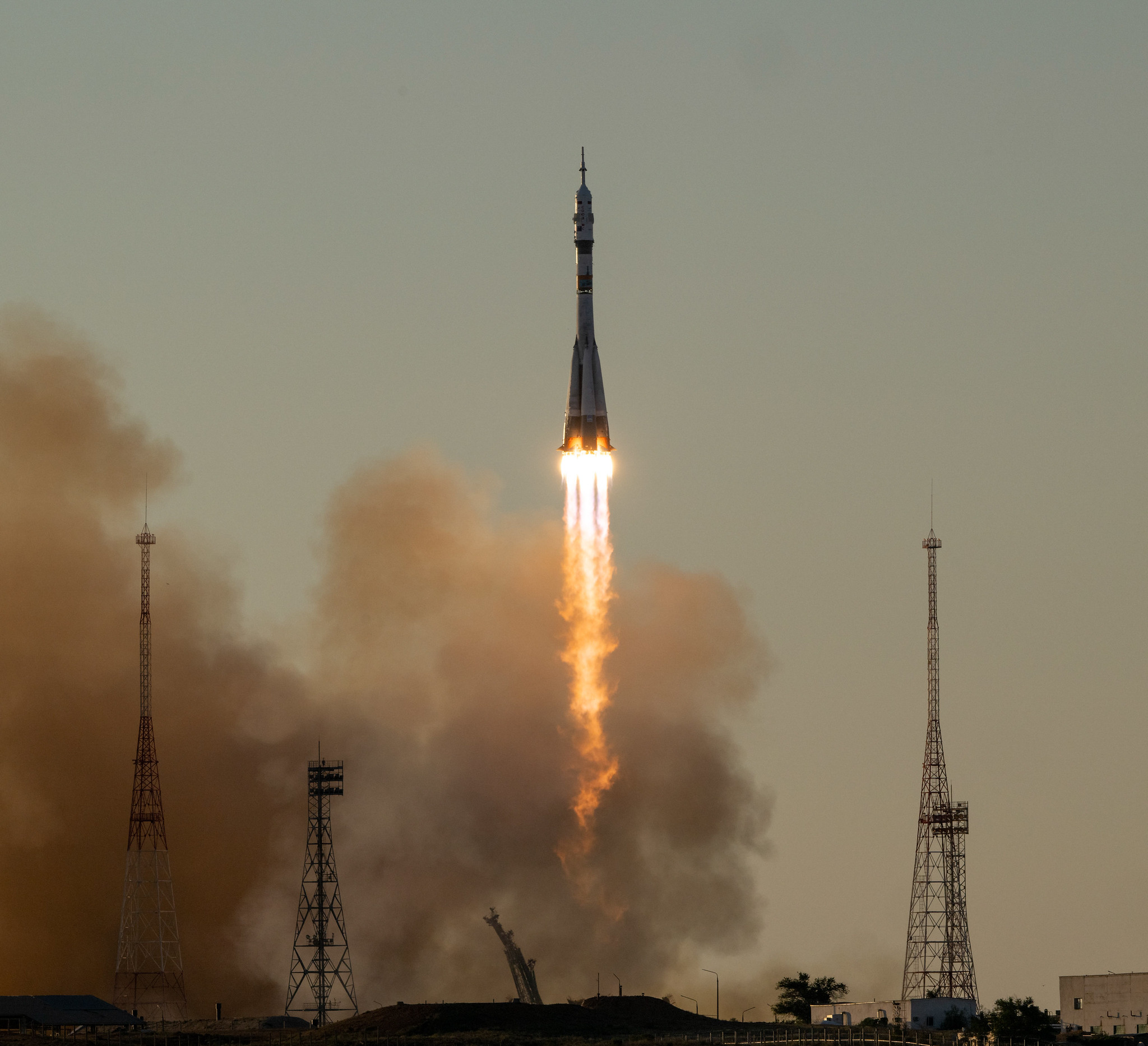
NASA astronaut Anil Menon reached the International Space Station on Tuesday alongside Roscosmos cosmonauts Pyotr Dubrov and Anna Kikina, safely delivering a fresh trio…
NASA astronaut Anil Menon reached the International Space Station on Tuesday alongside Roscosmos cosmonauts Pyotr Dubrov and Anna Kikina, safely delivering a fresh trio of crew members and temporarily boosting the station’s population to 10 for roughly the next two weeks.
The three launched aboard the Soyuz MS-29 spacecraft at 10:47 a.m. EDT (7:47 p.m. local time) from the Baikonur Cosmodrome in Kazakhstan. After a fast rendezvous lasting about three hours and covering two orbits around Earth, Soyuz docked with the station at 1:52 p.m., linking up to the Prichal module. Crew members were expected to open the hatch at about 4 p.m., after which the newcomers would be greeted by the Expedition 74 team already aboard the orbiting laboratory.
Waiting to welcome them were NASA astronauts Jessica Meir, Jack Hathaway, and Chris Williams; European Space Agency astronaut Sophie Adenot; and Roscosmos cosmonauts Sergey Kud-Sverchkov, Sergei Mikaev, and Andrey Fedyaev. NASA planned to air live coverage of hatch opening beginning at 3:30 p.m. on NASA+, as well as via Amazon Prime and YouTube, with additional viewing options available through NASA’s online and social platforms.
Menon’s time on the station is set to focus on a slate of experiments and technology demonstrations designed both to advance future human exploration and to translate space-based insights into benefits on Earth. Among his planned research activities is continued work to improve methods for producing semiconductor crystals in space—an effort aimed at enabling large-scale manufacturing of components critical for high-performance computing, artificial intelligence applications, and next-generation medical devices.
He is also scheduled to carry out ultrasound procedures using augmented reality and artificial intelligence techniques. NASA says these approaches could help crews perform advanced medical imaging without relying on extensive real-time assistance from specialists on the ground, a capability considered essential for longer missions farther from Earth.
Additional investigations will use Menon as a participant in studies of how microgravity alters blood flow, with the goal of better protecting astronaut health. He will also help test the bioprinting of vascular constructs in microgravity—work intended to deepen scientific understanding of the aging process and support the development of new therapies.
Operationally, the station is approaching a transition between expeditions. Expedition 75 is slated to begin on Sunday, July 26, after the planned departure of Williams, Kud-Sverchkov, and Mikaev, who are wrapping up an eight-month research campaign aboard the orbital outpost. Ahead of that changeover, NASA will broadcast the station’s change-of-command ceremony at 9:40 a.m. on Saturday, July 25, when command is scheduled to transfer from Kud-Sverchkov to Meir, streaming live on NASA+.