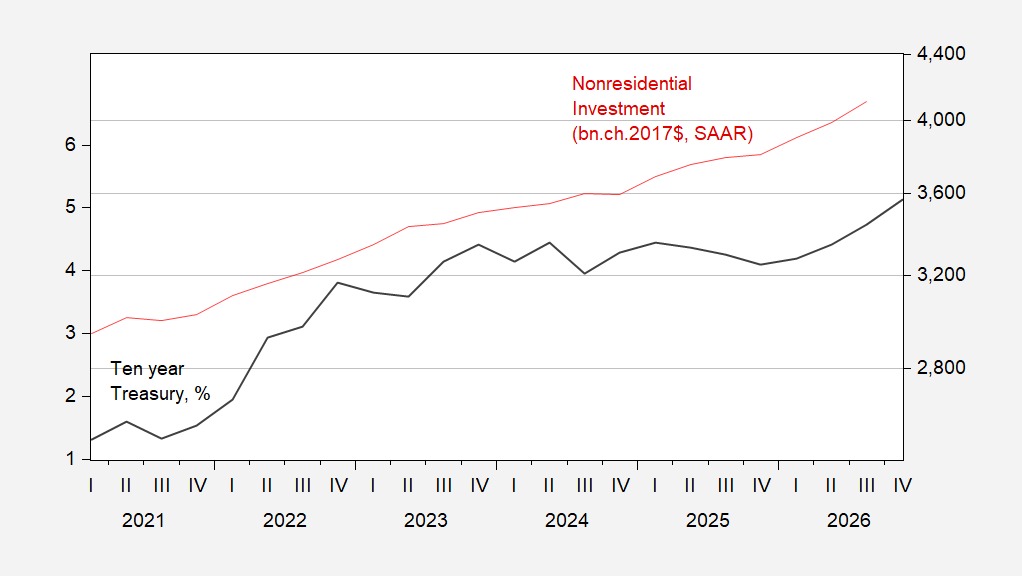
Business investment is rising despite high rates, but the gains are concentrated in AI-related equipment, software and data centers while “non-AI” capex is softening.
U.S. business investment is rising even as borrowing costs remain high, a combination that appears puzzling at first glance. But the top-line numbers mask a growing split inside corporate capital spending—one part of the economy that seems largely unfazed by interest rates, and another that is already showing strain.
Recent data show a surge in aggregate nonresidential fixed investment, measured in inflation-adjusted dollars at a seasonally adjusted annual rate. Over the same period, the 10-year Treasury yield has stayed elevated. Put differently, overall business spending on equipment, structures, and intellectual property has continued to expand despite a cost of capital environment that, historically, would have been expected to cool investment.
The explanation becomes clearer when the investment data are broken into components. Outlays tied to the current artificial-intelligence buildout—especially information processing equipment and software—have continued to climb. Measures that combine information equipment and software with construction related to data centers and electric-power structures also show robust gains. In the available figures, the upward trajectory for information equipment and software persists through 2026 Q3, indicating sustained momentum in the AI-linked portion of capital expenditures.
That strength is not representative of the broader investment picture. When analysts subtract information equipment and software from total nonresidential investment, the remaining “non-AI” portion looks notably softer. Excluding those categories—and further stripping out data-center and electric-power structures—investment is below its most recent high. In other words, the sectors associated with the AI boom are still accelerating, while the rest of business investment has lost some altitude.
This “two-speed” pattern in capital spending is also visible in financial markets. Returns in the Bloomberg “Magnificent 7” index, dominated by the biggest technology firms, have outpaced the broader S&P 500. Even that comparison likely understates the concentration, since the S&P 500 itself has become increasingly weighted toward companies viewed as major beneficiaries of AI-related investment.
The next question is whether the interest-rate immunity of AI-era capex will persist. One reason the AI buildout may have been comparatively insulated so far is financing structure: large technology firms and hyperscale cloud providers have had substantial internal cash flow and balance-sheet flexibility, allowing them to keep investing even as rates rose.
However, that insulation may weaken. As previously observed, hyperscalers appear to be moving further toward debt markets to fund capital expenditures. If more of this spending is financed externally at prevailing yields, AI-related investment should become more sensitive to interest rates—potentially by a large margin.
If that shift occurs, the implications extend beyond Silicon Valley. Monetary policy works partly by changing the cost of financing, which then influences investment and, ultimately, economic activity. A future in which even the currently resilient AI capex engine responds more strongly to higher rates would mean that rate hikes could exert a larger drag on overall output than they have in this cycle.
Why it matters
The split between AI-driven and non-AI investment suggests the economy is being powered by a narrow set of capital-intensive bets while other business spending cools. If hyperscalers increasingly rely on borrowing, changes in interest rates may start to hit the AI buildout too—altering how quickly investment and growth respond to Federal Reserve policy. The key development to watch is whether debt-financed data center, software, and computing outlays begin to slow as financing costs remain high.