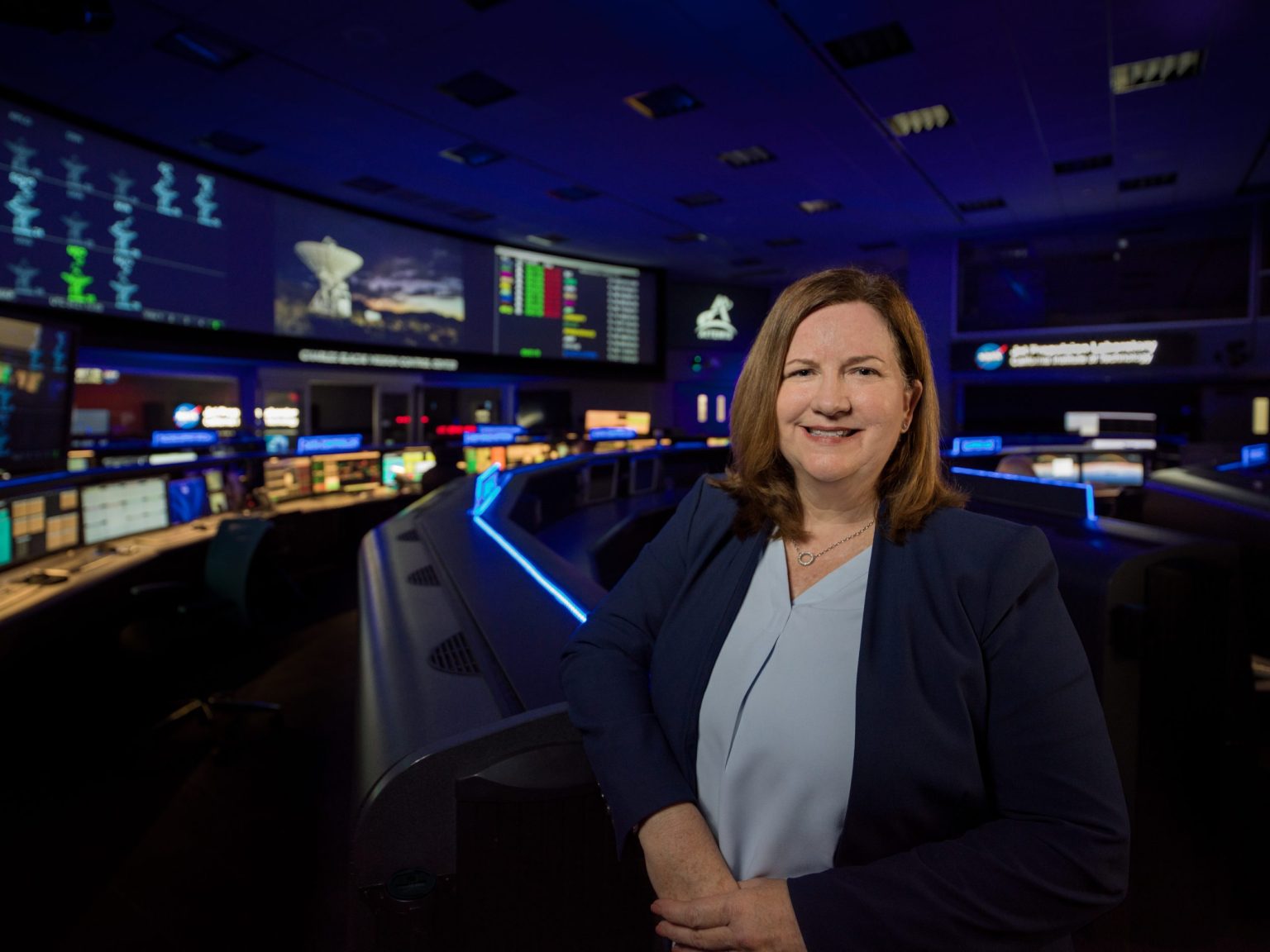
As a young child, Kathleen Harmon watched Apollo rockets lift off on television, an experience that left a lasting impression.
As a young child, Kathleen Harmon watched Apollo rockets lift off on television, an experience that left a lasting impression. Decades later, she finds herself helping guide NASA’s next generation of lunar exploration—this time from behind the scenes, ensuring astronauts and spacecraft can reliably reach back to Earth.
Harmon is the mission interface manager for Artemis II for NASA’s Deep Space Network (DSN), the agency’s far-reaching communications system that links mission controllers with spacecraft. Operated for NASA by the Jet Propulsion Laboratory in Southern California, the DSN is widely regarded as the world’s largest scientific telecommunications network. It supports more than 40 active missions probing deep space, and it is also central to NASA’s Artemis program as the agency works toward sustained exploration of the Moon.
To explain what the DSN does, Harmon compares it to a lifeline that travelers take for granted on Earth. Without GPS or a phone, she noted, a driver could easily become lost—or be unable to tell anyone. The DSN plays a similar role for spacecraft, providing the essential connection that allows missions to “talk” with Earth. Across the solar system—and even into interstellar space—the network receives and sends signals that carry engineering data as well as the science returns that capture public imagination: images and video from Mars rovers, measurements from orbiters, and discoveries from space telescopes.
Harmon brings decades of NASA experience to a job that blends systems engineering with high-stakes coordination. Mission interface managers help get spacecraft ready for launch and for day-to-day operations, working across teams and international partners. That collaboration is built into the DSN itself: its giant radio antennas are distributed globally, requiring continuous coordination so that communications remain steady as Earth turns.
The network’s architecture is designed precisely for that challenge. It consists of three major ground complexes spaced around the planet so that at least one site always has a view of distant spacecraft. As the Earth rotates, responsibility for managing overall communications shifts to whichever complex is in daylight—an operational rhythm the DSN team calls “follow the Sun.” The approach helps ensure consistent connectivity for missions spread across vast distances.
For Artemis II, Harmon said, the DSN provided round-the-clock support throughout the mission using two antennas: one designated as the primary link and another held in reserve as backup. At the same time, the DSN continued its ongoing work supporting other spacecraft and robotic explorers operating throughout the solar system—underscoring how the network must balance new flagship human spaceflight missions with a steady stream of scientific priorities.
While the DSN supports NASA’s return to the Moon in partnership with the Near Space Network, it also continues to keep watch over NASA’s broader fleet at the Moon and far beyond. Harmon’s career has connected her to missions ranging from Juno to Voyager, but the Artemis work carries a personal resonance. The Apollo era, she said, formed her earliest memory—an early spark that ultimately led to her role helping Artemis spacecraft stay connected to home.