NASA’s Institute for Advanced Concepts NIAC has announced its 2026 Phase I selections, backing a wide-ranging slate of early-stage studies that span planetary…
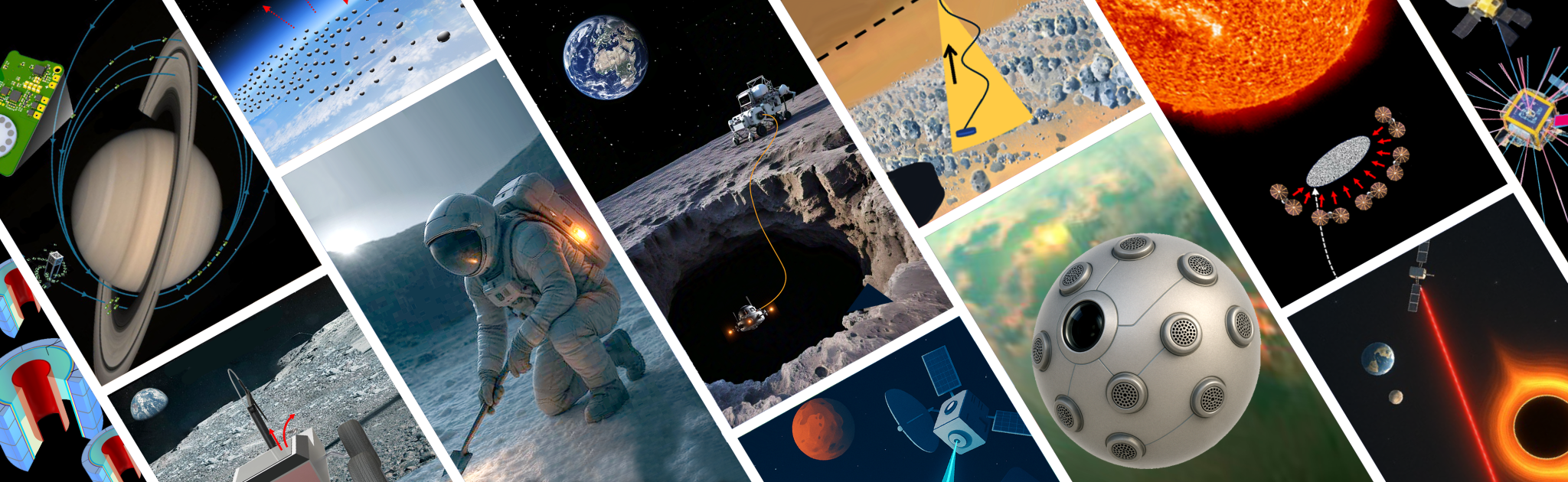
NASA’s Institute for Advanced Concepts (NIAC) has announced its 2026 Phase I selections, backing a wide-ranging slate of early-stage studies that span planetary exploration, space power, advanced sensing, and even speculative climate intervention.
Several of the newly funded concepts focus on novel ways to explore and operate in extreme environments. At NASA’s Jet Propulsion Laboratory (JPL) in Pasadena, Saptarshi Bandyopadhyay will investigate “Dimming the Sun (DimSun),” a concept that would use a controllable dust cloud to reduce incoming solar energy. Also at JPL, David Bugby’s “CANVAS” study—short for Combinatory Architecture offering Neomobility, on-Venus Adaptability, and Survivability—targets new approaches for mobility and resilience on Venus. JPL is also supporting Marco Quadrelli’s “PRAXIS,” which proposes autonomous exploration of planetary rings coupled with in-situ sampling.
Other selections aim to expand the frontiers of spacecraft propulsion and flight architectures. Artur Davoyan at the University of California, Los Angeles will study “Coilable Stacked Solar Sails,” a deployable sail design intended for missions requiring very high delta‑V. Daniel Drew at the University of Hawaii in Honolulu will develop “SPARK,” a solid-state propulsion approach for autonomous reconnaissance of karst landscapes—terrain shaped by dissolution, often riddled with caves and sinkholes.
Power generation and thermal management—persistent constraints on deep-space missions—also feature prominently. Keunhan Park at the University of Utah will assess plasmon-enhanced radioisotope thermophotovoltaic power generation (PRTPV), a pathway aimed at high-performance energy conversion for interstellar-class missions. A.C. Charania of Zeno Power Systems in Washington, D.C., will explore “EARENDIL,” a radioisotope-enabled concept intended to extend astronaut EVA operations in nighttime conditions and across deep-space icy landscapes. For lunar surface systems, Austin Phoenix at Virginia Tech will examine ECLIPSE, an “Efficient variable Conductivity Lunar Insulator” designed for passive environmental control.
A number of Phase I studies target new sensing modalities and measurement capabilities. At NASA Ames Research Center in Moffett Field, California, Zhaoyan Liu will investigate quantum wind lidar applications for planetary and Earth science missions. Benjamin Schafer, also at UCLA, will study photophoretic tracers as a tool for near-space remote sensing in the 30 to 100 kilometer altitude range.
NIAC’s 2026 selections also include multiple efforts aimed at transforming astronomy and space situational awareness. Jeff Nosanov of Orbital Velocity, LLC in Decatur, Georgia, will develop OBLIVIAN—an intensity-correlation approach to observing black hole light. At Brookhaven Science Associates in Upton, New York, Paul Stankus received support for two separate studies: one focused on achieving optical very-long-baseline interferometry (VLBI) for direct exoplanet imaging (“Mapping Alien Continents”), and another on precision astrometry using optically independent spacecraft for gravitational-wave detection. David Smith at Duke University in Durham, North Carolina, will explore robotically assembled electromagnetic metamaterials intended to enable long-range space situational awareness.
Finally, NIAC’s 2026 Phase I portfolio reaches toward new paradigms for scouting resources beyond Earth. Pablo Sobron at the SETI Institute in Mountain View, California, will study “Interworld Slingshot Resource Surveys,” a concept aimed at using interworld trajectories to expand resource reconnaissance.
Taken together, the selections reflect NIAC’s mandate: fund high-risk, high-reward ideas early enough to test whether bold concepts can mature into viable future missions and capabilities.