A lifelong heavy reader says his capacity for demanding books has halved, weakening his deeper “knowledge structures.” He explores using mass-market AI tools to create guided, selective engagement in place of full reads.
At one point in his life, the author measured his intellectual pace in books. In his peak years, he says, he could move through roughly 150 demanding volumes annually—serious works that required attention rather than casual consumption. He didn’t treat every page equally: sections that failed to connect were skimmed, while the ideas that did land were reread, contemplated, and tested. Reading, for him, was not passive intake but a kind of internal debate, in which he would “argue” with the writer—or with a mental stand-in for the writer he constructed as he went.
By his estimate, each book absorbed about five hours. That adds up to around 750 hours a year devoted to building and reinforcing his own thinking, out of the fixed 8,760 hours available in a year. He frames that investment as time well spent.
Now, he reports, that capacity has shrunk by half. He reads closer to 75 substantial books a year, or about one and a half per week. Nearly 40% of those, he adds, are rereads—return trips meant to refresh what he calls his “parasocial acquaintance” with the thinkers who have shaped him and the opponents who have sharpened him.
He attributes the decline to two forces in roughly equal measure. One is simply diminished energy. The other is displacement: more of his time is taken up by reading and watching other material, only about half of which he considers genuinely worthwhile. The result, he argues, is not merely a numerical drop in books finished but a deeper loss. Extended engagement with complex texts, he believes, builds durable internal “knowledge structures” in a way that lighter media rarely does. That missing layer has become, in his view, a gap in his personal information-processing system—one he wants to close.
The proposed fix is technological. He wonders whether what he calls “MAMLM” tools—mass-market large language models—could serve as an assistive layer between him and the books he can’t realistically read in full. The goal is not a generic summary. Instead, he imagines generating a document he could spend an hour with: a structured guide that highlights key arguments, surfaces the passages he likely would have lingered on, and then points him back to the source text selectively. Over time, such a file could also act as a rapid refresher, enabling him to regain context quickly when a topic becomes relevant again.
He acknowledges the trade-off. This approach would not produce the same memories as five hours immersed in the original work, and he would not be able to claim he truly read the book. But he asks a more pragmatic question: could this system help him produce the words he would have produced if those memories existed—effectively turning himself, plus his software, into a “Chinese Room,” where convincing output can be generated even if the underlying understanding is different? If it worked, he suggests, his effective throughput might rise from 75 to the equivalent of 375 serious books a year—at least in terms of what he can communicate to others and feed back into his own thinking.
Even partial success, he argues, could be valuable. It might become an improved note-taking and retrieval system, while also serving as a way to probe the limitations of today’s language models in tasks beyond their standout use case: acting as exceptionally capable coding assistants.
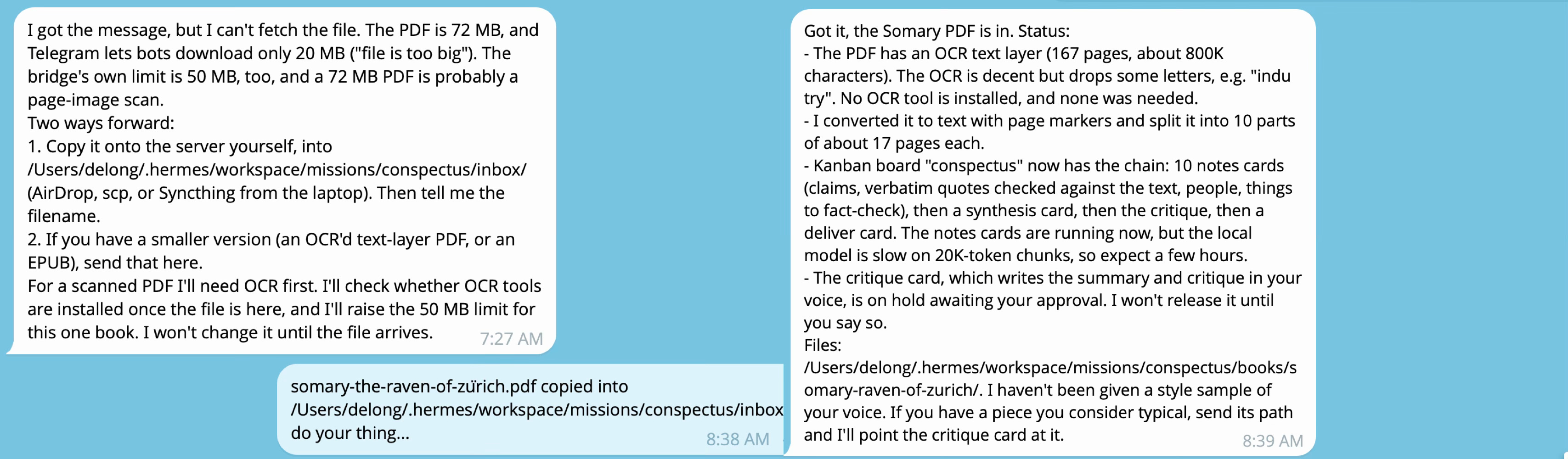
To structure this experiment, he borrows a largely academic term: “conspectus.” A conspectus, he explains, is not merely a compressed summary but a tightly organized map of a text—comprehensive, structured, and as brief as possible. His plan is to build book-by-book folders for works he wishes he had read (or reread), filled with notes, briefings, and synthesis documents. He would consult these files, jump back into the original passages when prompted, and let his systems resurface the material when it appears relevant later.
He is clear-eyed about what that would mean: he still won’t have read the books in the traditional sense. The question is whether the hybrid—human plus model plus structured “conspectus”—can approximate enough of the benefits to be worth pursuing.
Why it matters
As people confront information overload and shrinking attention budgets, tools that promise “compressed understanding” are becoming more attractive—and more risky. If systems like structured conspectuses work, they could change how knowledge workers, students, and researchers prioritize reading and recall. The next test is whether such workflows build genuine long-term understanding, or merely produce fluent outputs that mask shallow comprehension.