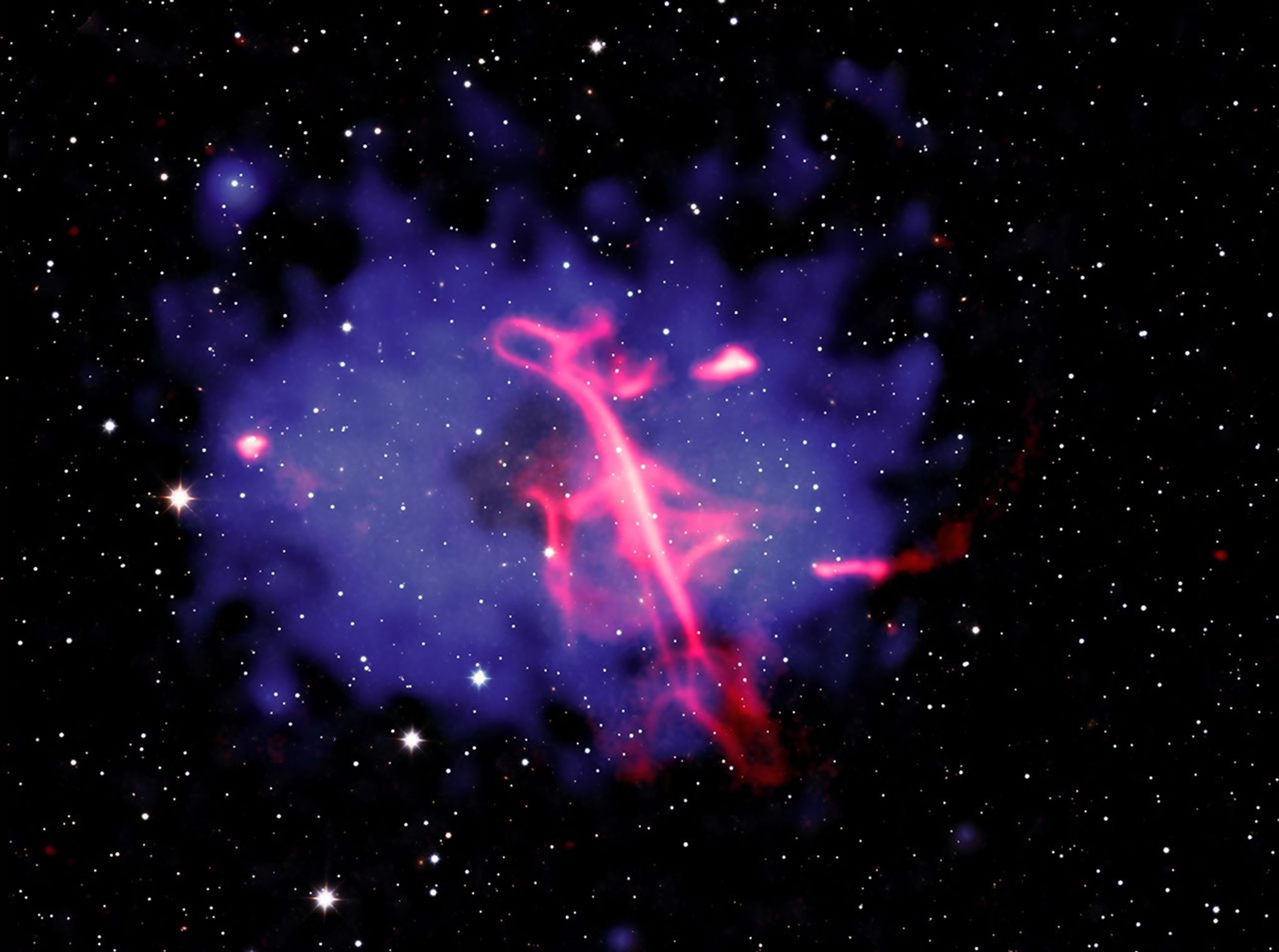
New X-ray data suggest the “Treble Clef” radio structure is fossil plasma from a supermassive black hole, later re-energized by a shock from colliding galaxy clusters.
A gigantic, oddly shaped radio structure known as “Treble Clef” is helping astronomers piece together a dramatic story of black hole activity and colliding galaxy clusters—despite being largely hidden from view in ordinary light by dust and gas in our own Milky Way.
The object, formally cataloged as VLSS J0318.9+5755, stretches across more than 2 million light-years. In radio maps its curved form evokes the familiar treble clef symbol from musical notation. That resemblance earned it its nickname, but the real intrigue lies in what it may represent: the long-lived aftermath of energetic events on the scale of entire galaxy environments.
Treble Clef was scrutinized as early as 2004, yet its true nature remained uncertain. A key obstacle is that visible-light observations offer little help; the object’s line of sight passes through the plane of the Milky Way, where interstellar material obscures background sources. Radio astronomy could trace the structure, but radio emission alone did not conclusively reveal what created it—or why it still stands out so strongly.
New data have shifted that picture. Observations from NASA’s Chandra X-ray Observatory and the eROSITA X-ray telescope have detected X-ray emission associated with the source, providing fresh evidence about the high-energy environment surrounding it. With these X-ray measurements in hand, researchers now argue that Treble Clef likely began as a cloud of charged particles launched from a supermassive black hole at the center of a galaxy.
In this scenario, the black hole’s outburst seeded the region with relativistic particles that initially shone in radio wavelengths. Over time, that radio glow would be expected to diminish as the particles lost energy. The new hypothesis proposes an explanation for why the structure remains conspicuous: a later shock wave—generated when two clusters of galaxies collided—may have swept through and re-energized the fading particle population, effectively “reviving” the radio emission.
A composite image illustrates the multiwavelength view. The radio signal, which outlines the distinctive clef-like shape, is shown in red. The newly identified X-ray component appears in blue, highlighting energetic processes that are otherwise invisible.
Astronomers see unusual systems like Treble Clef as more than cosmic curiosities. Because the proposed revival mechanism involves a shock front tied to cluster–cluster interactions, the object could offer a rare probe of how galaxy clusters disturb, heat, and accelerate particles in the vast spaces between galaxies—processes that influence how large-scale structures evolve over cosmic time.
Why it matters
If Treble Clef is indeed the relic of a supermassive black hole outburst later recharged by a galaxy-cluster collision, it becomes a valuable marker of how energy moves through the largest gravitationally bound structures in the universe. That affects not only theories of particle acceleration and cluster mergers, but also broader models of cosmic structure formation. Next to watch are follow-up studies that can pinpoint the host galaxy and better map the shock environment implied by the X-ray data.