NASA is spotlighting volunteers whose citizen-science work helps collect and interpret data, build tools and guides, and even co-author peer-reviewed research papers.
As the Thanksgiving holiday approaches in the United States, NASA is using the moment to highlight an essential ingredient behind a growing share of its research output: volunteers. Across multiple citizen science programs, participants—ranging from newcomers to seasoned contributors—have helped collect observations, process and interpret data, write software, co-author papers, and in some cases design new research efforts of their own.
Several NASA-affiliated scientists and project leaders marked the season by calling out specific examples of how volunteer work has directly strengthened research results and expanded what these programs can achieve.
In the Space Cloud Watch project, principal investigator Chihoko Cullens credited volunteers for supplying both high-quality imagery and the practical know-how needed to improve how observations are reported. She thanked Pirjo Koski, who regularly shares photographs of noctilucent clouds and connected the project with additional cloud databases in the Netherlands. Cullens also recognized Huub Eggen for routinely providing more than the requested measurements and for actively discussing what he sees—adding interpretive context that helps researchers. Brian Scott was noted for consistent contributions, including time-lapse videos. Cullens said these volunteers also invested time in developing a project Field Guide now used to train new citizen scientists to correctly identify and submit observations.
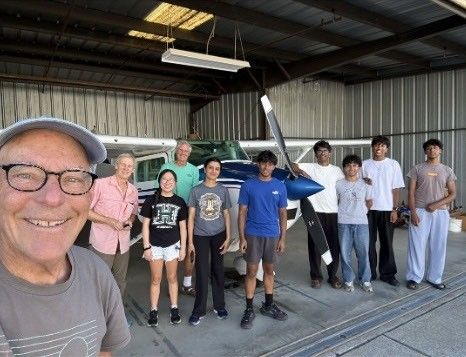
A separate effort shows how citizen science can extend into publishable biomedical research. Ryan Scott, representing the Open Science Data Repository Analysis Working Groups (OSDR AWGs), described how a group of high school students continued volunteering after completing NASA’s free Machine Learning for Space Biology course. Working with OSDR AWG mentors who donated their time, the students analyzed open-access retinal datasets from the International Space Station Rodent Research-9 mission housed in the NASA Open Science Data Repository. They trained a machine learning ensemble that distinguishes oxidative damage from cell death in the eyes of mice that flew in space. The work was published in npj Microgravity as “Machine learning ensemble reveals distinct molecular pathways of retinal damage in spaceflown mice.” Scott emphasized that every participating student co-author received authorship credit, and that many began college this fall already listed on a NASA-linked publication. He thanked student contributors Aditi Adapala, Mushtaq Ali, Naomi Z. Chang, Sophie Cai, Margaret Hitt, Anishka Jain, Matthew Lin, MarcAnthony Paolieri Della Monica, Elior Paley, Rudransh Pathak, Shawnak Samaddar, Shriya Sawant, Zhihan Shi, Rohin Sood, Fabian P. Uribe, Maxwell Volkan, and Jessica Wu, as well as OSDR AWG members Anna Lewkowicz, Sunny Narayanan, Daniya Thomas, Ethan Waisberg, Pinar Avci, Joshua Ong, Marshall Tabetah, Richard Barker, Lauren Sanders, and Xiao Wen “Vivien” Mao.
In Wisconsin, the long-running camera-based wildlife monitoring program Snapshot Wisconsin also highlighted sustained volunteer commitment. Kyra Shaw, a project coordinator at the Wisconsin Department of Natural Resources, thanked Tim Sparks, a volunteer for nearly a decade. Shaw said Sparks played a key role in piloting and then fully launching the Snapshot Phenology Project, a newer initiative that adds environmental measurements to camera monitoring. As part of a small volunteer cohort, Sparks set up and maintains additional instruments to track snow depth, temperature, and sound recordings at his trail camera site.
Other projects offered gratitude for volunteer observations that support space science. Benjamin Fernando of Impact Flash! thanked everyone submitting lunar images, with particular appreciation for Joerg Tomczak for help tied to the Artemis II campaign. And Rachael Mady of Chesapeake Water Watch underscored that volunteers have been central to the project since 2021, enabling monitoring across the Chesapeake Bay, the largest estuary in the United States. Mady noted that volunteer participation helped the project surpass 6,000 observations this year; even as the effort winds down, she said, the benefits for improving the Bay’s health will persist.
Why it matters
Citizen science is increasingly woven into how NASA and partner agencies collect data at scale—from Earth observations to spaceflight biology. The results can be tangible: improved field protocols, richer datasets, and peer-reviewed publications with student co-authors. As more missions and repositories open their data to the public, the next question is how agencies will sustain training, quality control, and long-term volunteer engagement.