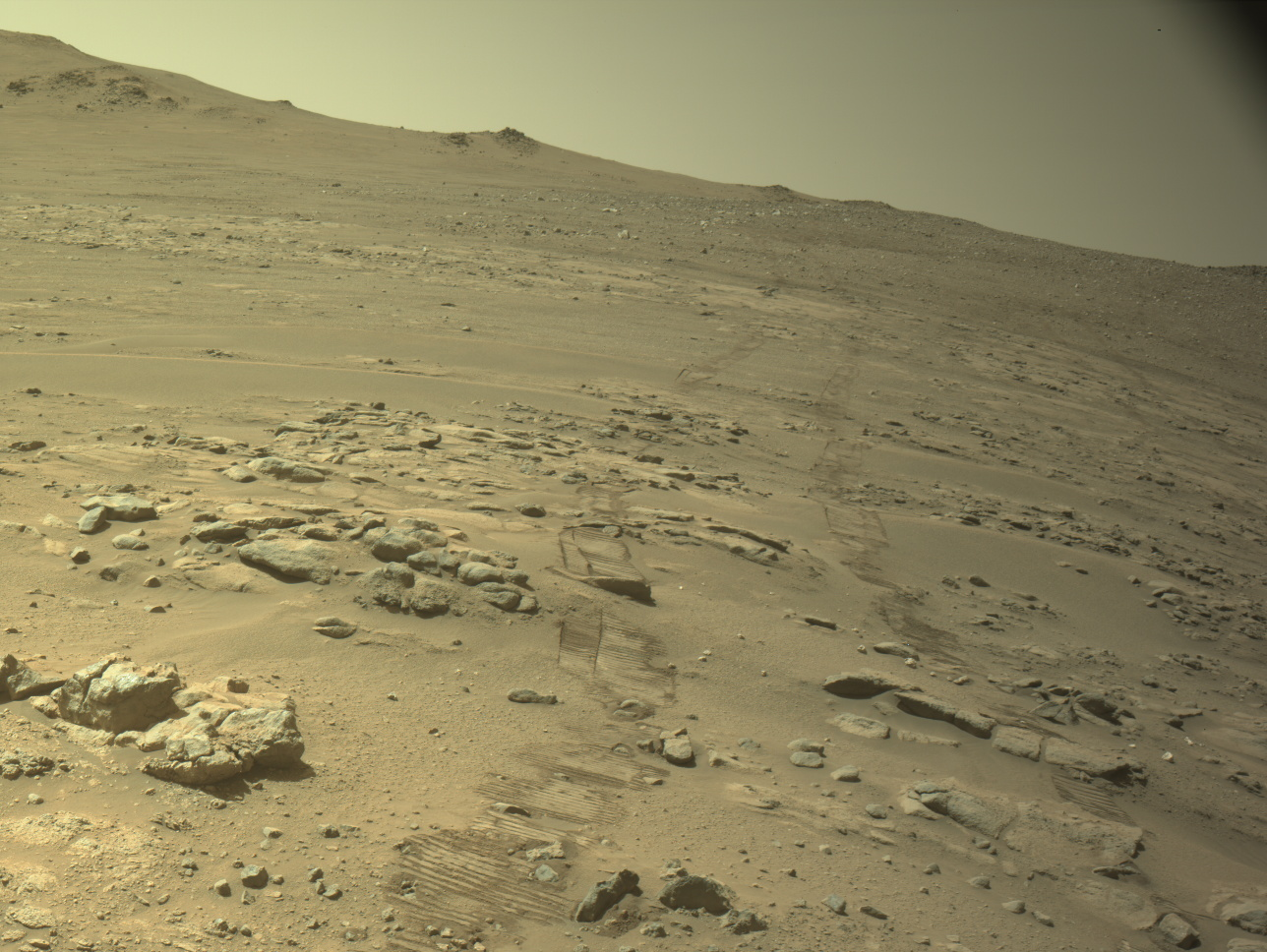
NASA’s Perseverance rover captured fresh images of its wheel tracks while surpassing Opportunity’s record to become the farthest-driving rover on Mars.
Wheel tracks cutting across a rugged Martian scene fill a new image from NASA’s Perseverance rover, recorded by one of the spacecraft’s navigation cameras on Oct. 11, 2026. The photo was taken on the mission’s 2,006th Martian day, or sol, capturing the terrain Perseverance has been steadily traversing as it continues its exploration work on the Red Planet.
That same sol also marked a significant achievement for the mission. Perseverance completed a drive of 299.6 feet (91.31 meters) and, in doing so, exceeded a distance milestone set by a previous NASA rover. With that progress, Perseverance’s cumulative drive distance surpassed the total logged by NASA’s Opportunity rover, which traveled 28.06 miles (45.16 kilometers) over the course of its long-running 15-year mission on Mars.
Opportunity’s total, accumulated across years of careful navigation and scientific stops, has stood as one of the agency’s landmark feats in robotic planetary exploration. Perseverance crossing that benchmark underscores both the rover’s continued health deep into its own mission timeline and the scale of the ground it has covered while carrying out its science objectives.
Perseverance is operated for NASA by the agency’s Jet Propulsion Laboratory (JPL), which is managed by the California Institute of Technology (Caltech) in Pasadena, California. JPL built the rover and runs its day-to-day operations on behalf of NASA’s Science Mission Directorate in Washington. The mission is part of NASA’s broader Mars Exploration Program portfolio.
More information about the Perseverance mission is available from NASA at: https://science.nasa.gov/mission/mars-2020-perseverance/
Why it matters
Distance traveled is more than a headline statistic: it reflects a rover’s ability to reach diverse geological sites and return new observations across changing terrain. Perseverance overtaking Opportunity’s historic mileage highlights the durability and operational success of NASA’s current Mars surface exploration strategy. The next key question is how that mobility will translate into scientific return as the rover continues to access new locations and document Mars’ rocky landscape in detail.