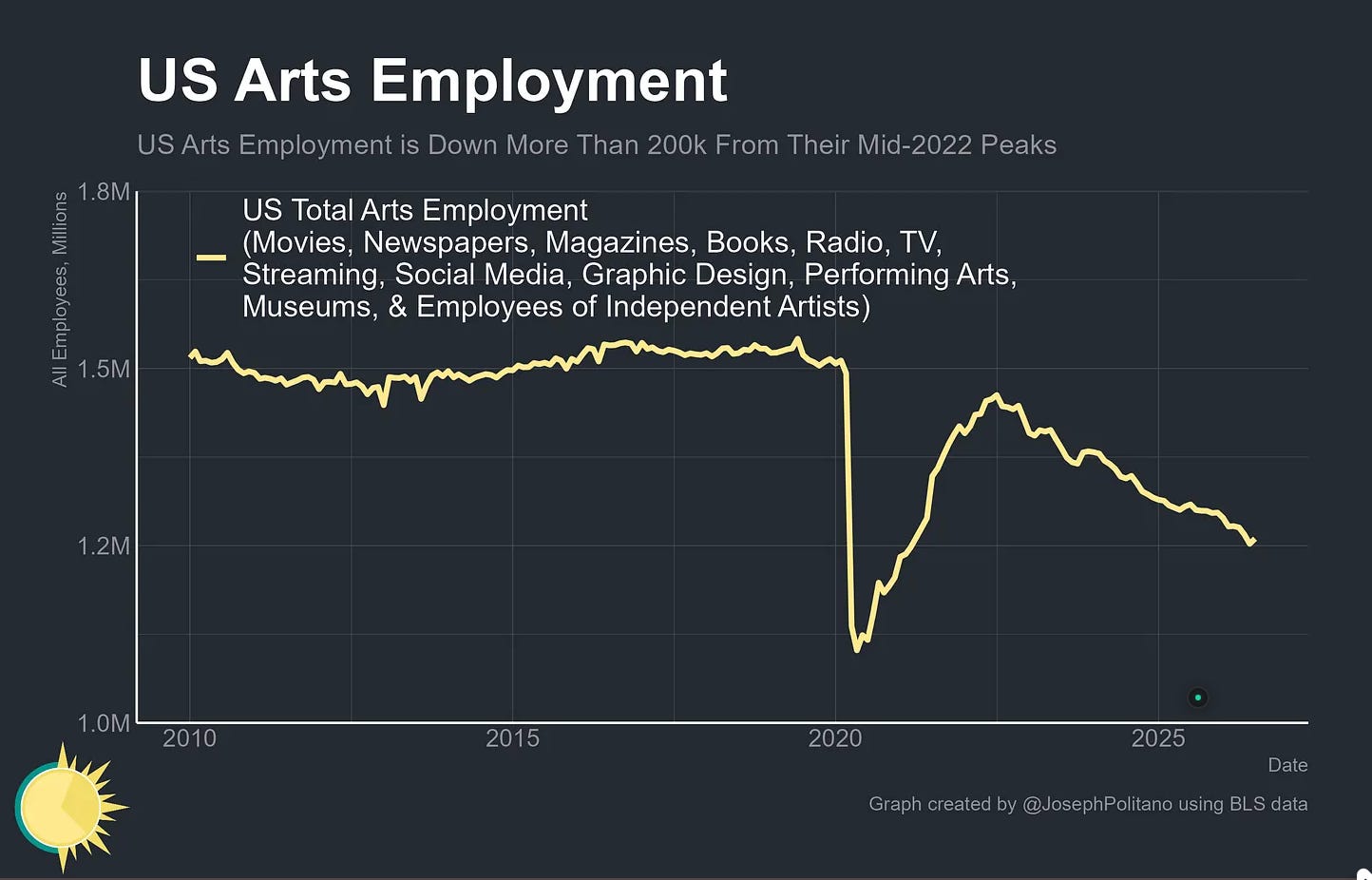
Paid employment in the creative arts has been shrinking sharply in the United States, leaving the sector well below both its pre-pandemic baseline and its brief rebound after the initial COVID-era shock.
Paid employment in the creative arts has been shrinking sharply in the United States, leaving the sector well below both its pre-pandemic baseline and its brief rebound after the initial COVID-era shock. By current counts, there are roughly 200,000 fewer paid creative-arts jobs than at the high point reached in the post-lockdown recovery. Compared with the average levels seen during 2010–2019, the gap is even larger—about 300,000 jobs.
A major portion of that decline is concentrated in screen entertainment. Employment in movie and television production is down by about 100,000. But pinning that loss on a single cause is difficult. Is the downturn primarily a result of upheaval in the streaming business model? How much is attributable to the adoption of artificial intelligence tools? And how much reflects other pressures, from shifting consumer habits to broader changes in media economics?
Economic writer Joey Politano, in a recent analysis of “AI and the fall of the creative class,” argues that firm answers are elusive partly because companies have little incentive to be transparent about how they are using AI. He notes that technology’s effects are tangled with other disruptions hitting arts businesses at the same time. Still, Politano points to a pattern he considers suggestive: job losses are widespread across digital arts subsectors, while in-person entertainment continues to expand at a solid pace.
The deepest cuts, he says, have landed in movie and sound recording. That segment has been shedding jobs at a pace rarely seen in the industry’s history, with the last several years standing out as especially severe by Hollywood standards. Politano situates that collapse within a broader—and painful—transition to streaming, where traditional film and television compete not only with each other but with an expanding universe of user-generated content that is increasingly assisted by AI, and in some cases produced by it. In such an environment, legacy formats can lose audience time even when total “video consumption” keeps rising.
At the same time, Politano cautions against linear forecasts about technology and creative markets. Cultural industries can respond in surprising ways. He highlights the recent surge in book sales—an outcome that might have looked unlikely in an era of short-form video and fragmented attention. Yet one of the drivers of that resurgence has been TikTok, where “BookTok” communities turned recommendations, commentary, and social participation into a powerful engine for discovery that lifted demand for print and reading. AI, he suggests, could produce similarly unpredictable spillovers—tools that initially seem threatening may end up creating new channels for audience growth or new complements to existing work.
So far, Politano argues, evidence for large-scale AI-driven job displacement across the broader economy remains limited. Even in white-collar fields that appear technically ripe for automation, some employers have continued hiring aggressively in recent years. But he adds a warning: if AI’s eventual economic impact matches the scale implied by the trillions of dollars investors are wagering on the technology, the shocks will not remain confined to a few niches.
Economist Brad DeLong adds a further complication specific to the arts. In standard markets with near-zero marginal costs, Jevons-style effects—where efficiency gains can increase total consumption—depend on demand being highly responsive to price. But arts consumers “pay” in two currencies: money and attention. And attention is already scarce, with creative media occupying a large share of people’s non-work, non-sleep hours. Those constraints, DeLong suggests, make the arts an especially difficult arena for technological change to translate into more paid employment, even when production becomes cheaper or faster.