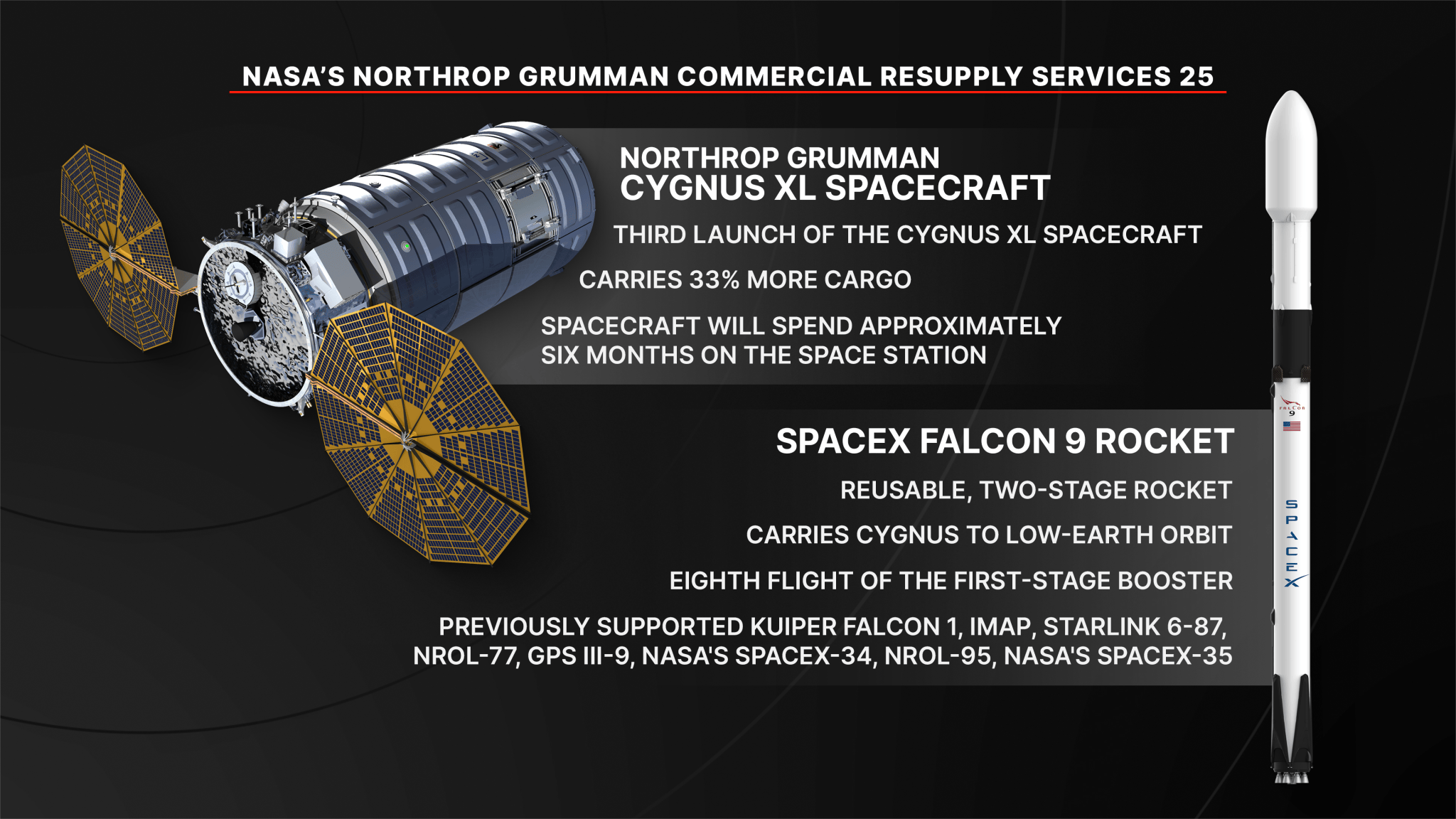
NASA will send about 11,000 pounds of supplies and research to the ISS on Northrop Grumman’s CRS-25 Cygnus XL mission, featuring biomedical, radiation and crop studies.
NASA is preparing to send roughly 11,000 pounds of research and day-to-day supplies to the International Space Station (ISS) on Northrop Grumman’s 25th Commercial Resupply Services flight, known as CRS-25. The mission will mark the third trip for the company’s upgraded Cygnus XL spacecraft, a larger, higher-capacity version of its solar-powered cargo vehicle.
Cygnus XL is scheduled to lift off from Florida’s Cape Canaveral Space Force Station atop a SpaceX Falcon 9 rocket. After the spacecraft reaches the ISS, station astronauts will capture it with the Canadarm2 robotic arm. Ground teams will then guide the arm to berth Cygnus at the Earth-facing port of the Unity module, where the crew will begin unloading its contents.
Alongside food, routine consumables, and hardware for station operations, CRS-25 is carrying a slate of investigations that use microgravity as a laboratory for biomedical and technology development. Several of the experiments focus on improving treatments for cancer, osteoarthritis, and muscle degeneration, while others target radiation monitoring and crop production for future deep-space expeditions.
One project, Cardinal Muscle 2.0, is designed to explore new approaches to preventing muscle loss. Astronauts commonly experience muscle atrophy and reduced strength after spaceflight; these changes resemble aspects of age-related muscle decline on Earth but can occur faster in microgravity, particularly without exercise. Researchers will use a muscle tissue model to evaluate whether existing U.S. Food and Drug Administration-approved drugs—currently prescribed for other conditions—could be repurposed to limit or prevent muscle deterioration.
Another payload, DNA Nano B, investigates the space-based production of extremely small, DNA-inspired particles intended for drug delivery into hard-to-penetrate tissues such as cartilage and solid tumors. The team is examining whether microgravity enables more consistent particle formation, which could help refine manufacturing techniques and ultimately support more targeted therapies for cancer and osteoarthritis.
Radiation risk remains a central challenge for missions beyond low Earth orbit, and the Active Radiation Environment Sensor (ARES) will evaluate a compact monitoring device meant to plug into spacecraft systems and deliver real-time measurements inside crew habitats. Data from the test could guide radiation detection strategies and safety planning for Artemis-era lunar travel and other exploration missions.
Cancer research on CRS-25 also includes Encapsulate-1, which will use small-scale replicas of patients’ tumors to observe how cancer cells migrate, invade nearby tissues, and potentially spread. The long-term goal is a space-enabled diagnostic approach that could help forecast cancer progression months—or even years—earlier than currently possible, supporting more informed treatment decisions.
For sustaining crews over long voyages, NASA is also advancing food production capabilities through Ohalo III, a new plant growth facility that is largely automated and incorporates water-recovery and air-exchange innovations. The system is intended to support cultivation of multiple crop types, informing how astronauts might reliably grow fresh food on lengthy missions, including potential trips to Mars.
Finally, JOining demonstrations IN-Space (JOINS) will push forward methods for robotic “joining” of materials in orbit. The ability to assemble, integrate, repair, or expand large structures after launch could help overcome rocket size constraints and may prove essential for building and maintaining future exploration infrastructure, including concepts envisioned for lunar surface operations.
Why it matters
Cargo missions like CRS-25 are how the ISS stays supplied—and how NASA turns low Earth orbit into a testbed for medicine and exploration technology. The results could influence everything from next-generation cancer diagnostics and drug delivery to radiation protection and sustainable food systems for long-duration missions. What happens in these experiments will help determine which technologies are ready to scale for Artemis and, eventually, Mars-class expeditions.