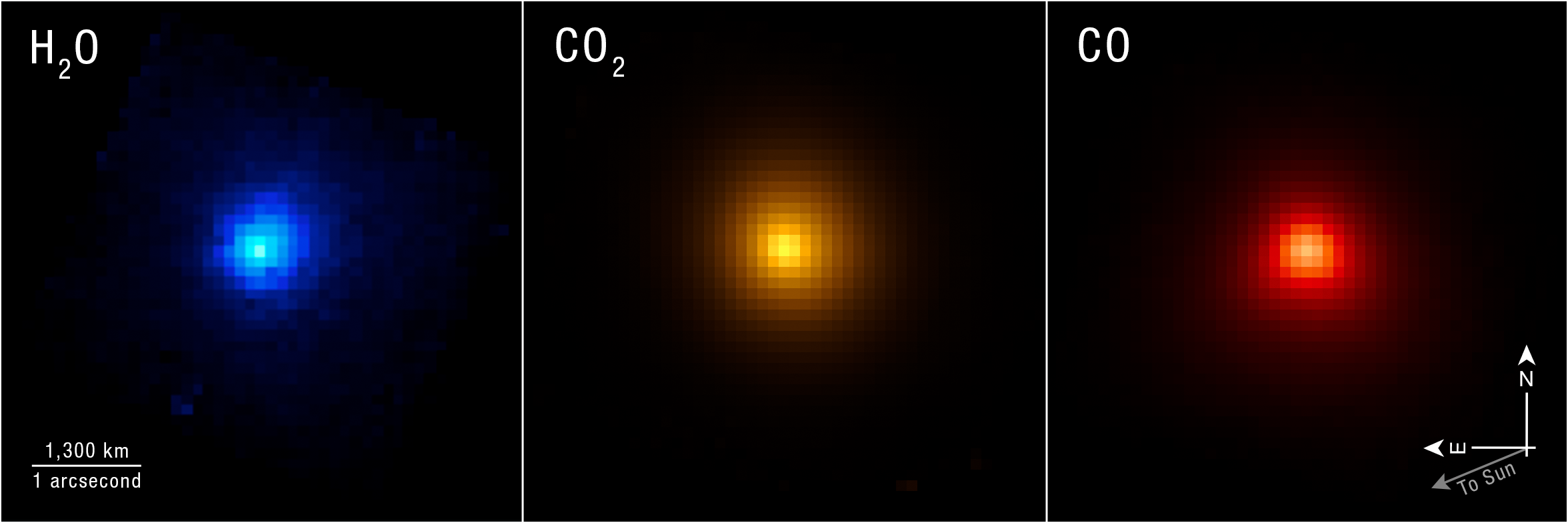
As the interstellar comet 3I/ATLAS swung away from the Sun in December 2025, astronomers seized a brief window to examine a visitor from beyond the solar system at unusually high fidelity.
As the interstellar comet 3I/ATLAS swung away from the Sun in December 2025, astronomers seized a brief window to examine a visitor from beyond the solar system at unusually high fidelity. NASA’s James Webb Space Telescope was aimed at the departing object just after its closest solar approach, when heating had transformed pristine ancient ices into a luminous cloud of gas—an ideal target for spectroscopy.
Using Webb’s Near-Infrared Spectrograph (NIRSpec), researchers measured the comet’s chemical makeup and, crucially, its isotopic “fingerprints,” including ratios involving deuterium (heavy hydrogen) and carbon. Those ratios did not match what scientists typically see in comets born in our own planetary neighborhood. The findings, published June 22 in Nature, suggest 3I/ATLAS formed in an environment far older and colder than the one that produced the Sun and its retinue of planets and comets.
The comet’s designation reflects its status as the third confirmed interstellar comet—an object that originated outside the solar system—while “ATLAS” refers to the NASA-funded Asteroid Terrestrial-impact Last Alert System, the survey that first detected it. For the Webb observations, the team received approval to temporarily interrupt the telescope’s pre-planned schedule to capture the fleeting opportunity.
“This was a unique opportunity to study an ancient object from the distant galaxy, probably pre-dating our Sun and solar system,” said lead author Martin Cordiner, an astrochemist at NASA’s Goddard Space Flight Center in Greenbelt, Maryland. He added that the measurements offer both a view into early galactic history and a way to gauge how typical—or unusual—our own solar system may be.
NIRSpec data revealed extraordinarily high deuterium: roughly 30 times the level observed in comets native to the solar system. Such enrichment points to formation in extremely cold conditions, likely early in the Milky Way’s history. The team argues that the material incorporated into 3I/ATLAS experienced substantial radiation but avoided prolonged warming that would have altered deuterium-rich “heavy water” ice into the more familiar balance of H₂O found on Earth.
The same Webb spectra also showed only small amounts of carbon‑13 compared with carbon‑12. That, too, implies great age. Over cosmic time, successive generations of stars manufacture and disperse carbon‑13, gradually enriching the interstellar medium. Because the Sun formed comparatively late—about 4.5 billion years ago—our solar system contains higher carbon‑13 levels than would be expected in a body assembled much earlier.
Working backward from these isotopic clues, the researchers estimate that 3I/ATLAS may have formed 10 to 12 billion years ago, during “cosmic noon,” the era when star formation across the universe peaked. They propose the comet’s birth environment was a cold, dense cloud, consistent with the heavy-water signature indicating it spent its earliest history deeply frozen.
A separate, complementary investigation using the European Southern Observatory’s Very Large Telescope, led by Cyrielle Opitom of the University of Edinburgh, examined isotopes of carbon and nitrogen in cyanide, adding another perspective on the comet’s chemical heritage.
For scientists, the unusual isotopes are more than a curiosity. “For us as scientists, finding these rare isotopes is fascinating, but the bigger picture here is looking at the possibilities of prebiotic chemistry elsewhere in the galaxy,” said NASA Goddard’s Stefanie Milam, a co-author on Cordiner’s study. With life confirmed in only one place so far—Earth—each interstellar object that can be chemically decoded offers a new test of how common the ingredients and conditions for life might be.
Webb, now the world’s leading space science observatory, continues to probe mysteries close to home and far beyond, from solar system relics to planets orbiting other stars.