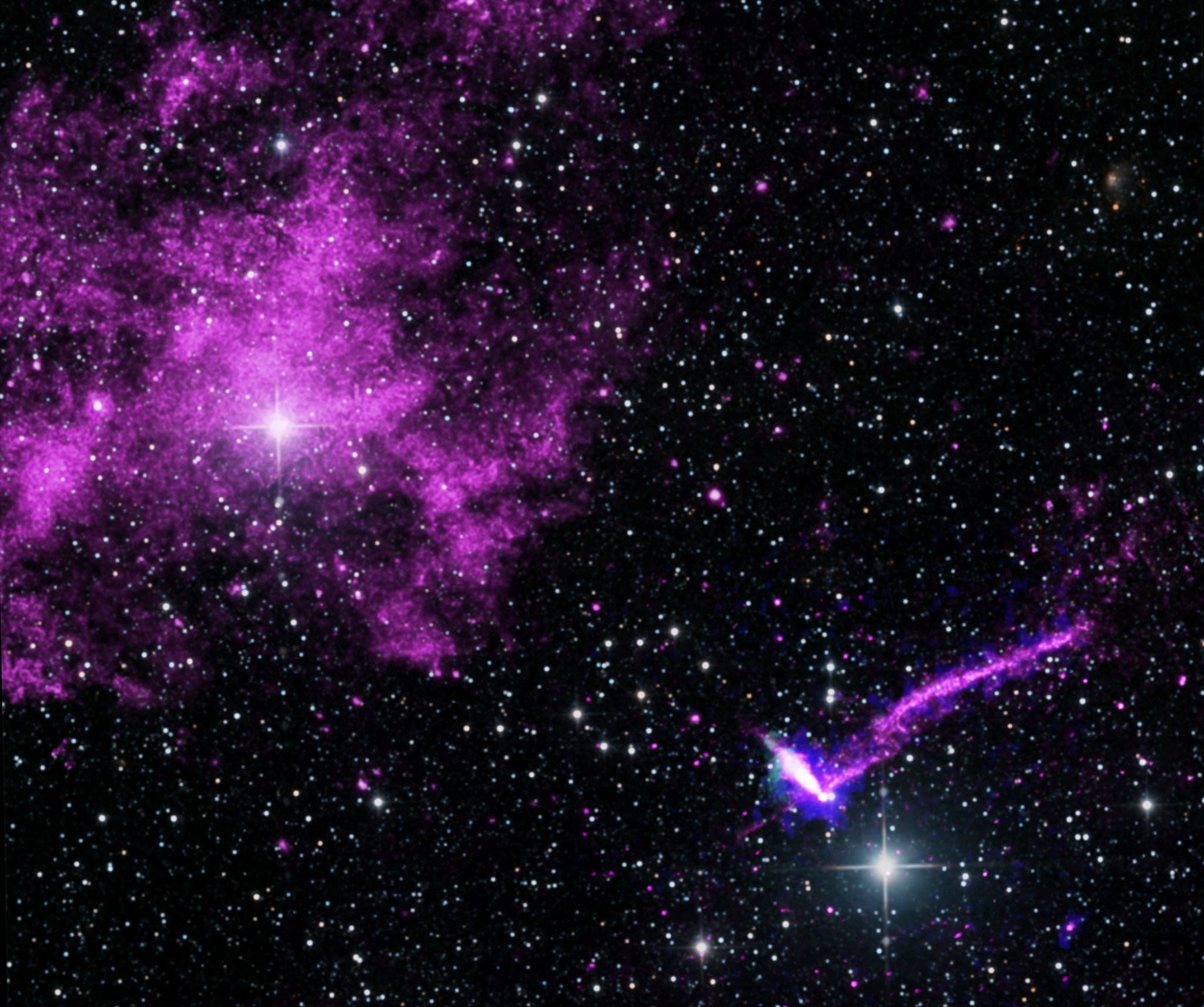
A newly released composite view of the Lighthouse Nebula is offering astronomers an unprecedented look at the magnetic environment around a rapidly spinning neutron star.
A newly released composite view of the Lighthouse Nebula is offering astronomers an unprecedented look at the magnetic environment around a rapidly spinning neutron star. The image, made public on July 9, 2026, centers on a pulsar—an ultra-dense stellar remnant whose intense magnetic field and fast rotation drive powerful high-energy emission.
The multiwavelength portrait blends several observatories’ perspectives. X-ray observations from NASA’s Chandra X-ray Observatory are shown in purple, while X-rays detected by NASA’s Imaging X-ray Polarimetry Explorer (IXPE) appear in blue. Radio emission mapped by the Australia Compact Telescope Array is rendered in green. Additional optical context comes from 2MASS, a sky survey operated by UMass and IPAC at Caltech with NASA and NSF support.
Beyond producing a striking image, the data set marks a milestone for pulsar research. Using IXPE, scientists have directly measured the pulsar’s magnetic fields—something the mission has now achieved for the first time in a pulsar system. IXPE is designed not only to detect X-rays, but also to measure their polarization, a property that carries information about the geometry and alignment of magnetic fields in the regions where the X-rays are produced.
By combining IXPE’s polarimetry with Chandra’s sharp X-ray imaging and radio observations from the Australia Compact Telescope Array, the team was able to better probe the structure of this extreme object and its surroundings within the Lighthouse Nebula. The results add to scientists’ understanding of how pulsars shape their environments, and how matter and radiation behave under conditions that cannot be recreated on Earth.
The findings were reported in a study published July 9 in The Astrophysical Journal. The composite image and analysis reflect a collaboration drawing on multiple facilities and teams: Chandra data credited to NASA’s Chandra X-ray Center and Stanford University (J. Dinsmore and colleagues), IXPE data credited to NASA’s Marshall Space Flight Center (also J. Dinsmore and colleagues), radio data from CSIRO/ATNF/ATCA, with image processing by NASA/CXC/SAO (L. Frattare). Together, the observations underscore NASA’s continuing effort to use specialized space telescopes to investigate the physics of the most extreme objects in the universe and to refine our picture of how the cosmos operates.