Star trails over the Banda Sea: what a long-exposure view from space reveals about a universe built by stars A long-duration photograph taken from the International…
Star trails over the Banda Sea: what a long-exposure view from space reveals about a universe built by stars
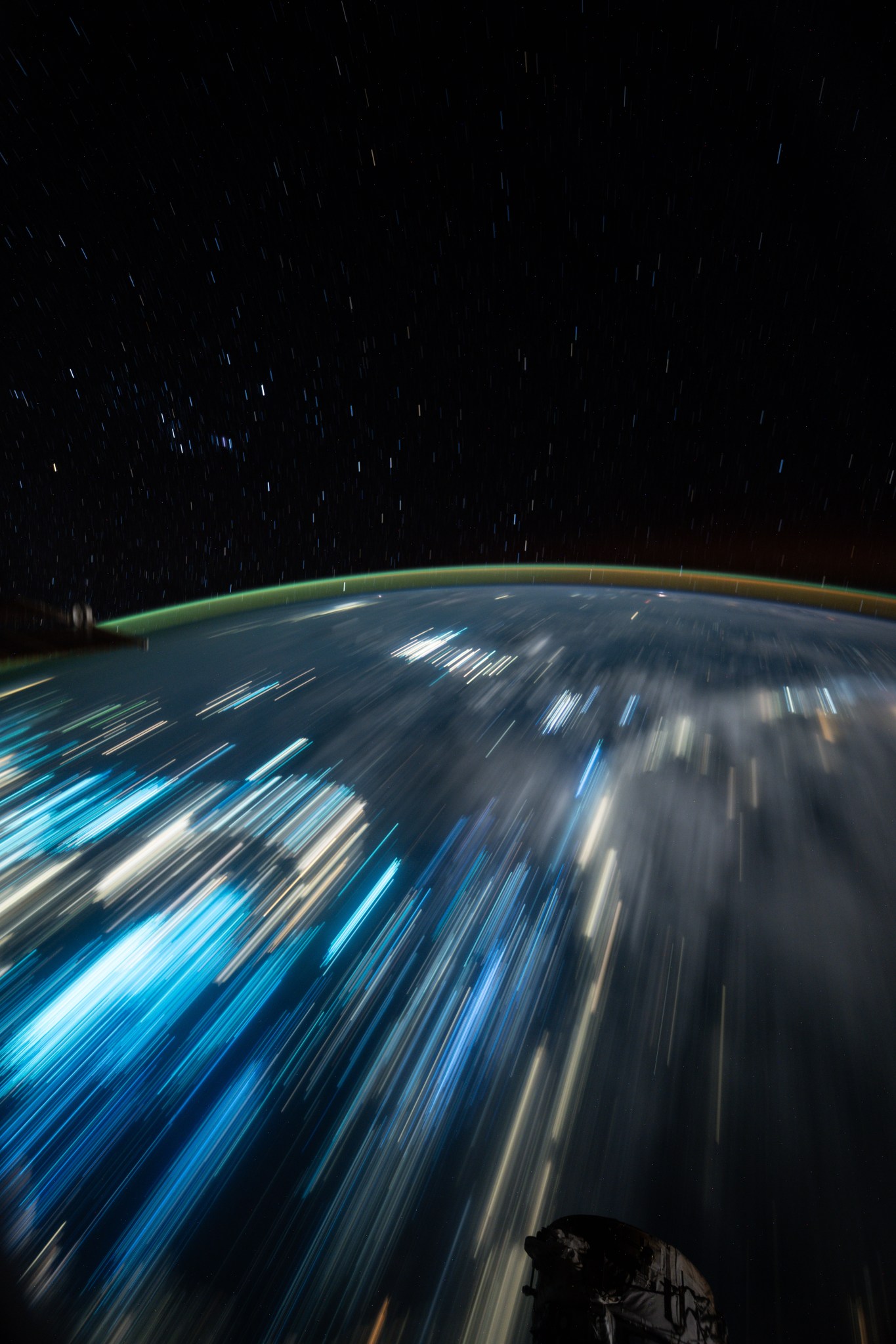
A long-duration photograph taken from the International Space Station offers an unusual perspective on a familiar night-sky phenomenon: star trails. In the image—captured as the station passed roughly 258 miles (about 415 kilometers) above Indonesia’s Banda Sea on Sept. 20, 2026—stars appear as curved streaks across the blackness, while Earth below is traced in human color: electric-blue clusters from fishing boats and warmer yellow patterns marking Indonesian cities. Credited to NASA and astronaut Anil Menon, the scene turns a technical artifact of photography into a visual summary of motion: the spacecraft racing forward, Earth rotating beneath, and the heavens seemingly wheeling overhead.
Star trails happen when a camera’s shutter remains open long enough for the apparent positions of stars to shift across the sensor. From the ground, that apparent motion is driven primarily by Earth’s rotation, which makes the night sky seem to turn around the celestial poles. From orbit, the geometry becomes more complex. The ISS circles the planet about every 90 minutes, so a long exposure blends several motions at once: the station’s rapid orbital travel, Earth’s spin, and the changing viewing angle as the camera platform hurtles along at several kilometers per second. The result is a sky written in arcs—evidence not of stars “moving” in the moment, but of the observer’s motion through space.
Yet the streaks also invite a deeper thought: each line represents a star—an object so distant that, despite enormous physical speeds, it appears fixed to the naked eye over short timescales. Research suggests the universe may contain as many as one septillion stars—a one followed by 24 zeros. Our Milky Way alone hosts more than 100 billion, including the best-studied example of all: the Sun. The orbital photograph compresses that immensity into a single frame, making the cosmos look close enough to draw with a shutter.
Modern astronomy describes stars not as static points but as evolving structures—giant spheres of hot gas dominated by hydrogen, with helium and trace heavier elements. Their lifetimes vary dramatically, from a few million years to spans so long—trillions of years—that some small stars could outlast the universe’s current age. That diversity arises largely from one factor: mass. Studies of stellar physics show that low-mass stars burn fuel slowly, shining cooler and dimmer but for far longer; massive stars must generate much greater pressure to resist collapse, consuming their fuel at a far faster rate.
The story begins in molecular clouds, vast, cold accumulations of gas and dust. Research finds these clouds can carry from roughly 1,000 to 10 million times the Sun’s mass and stretch across hundreds of light-years. Because they are cold, gas within them tends to clump into denser pockets. As pockets collide or draw in surrounding matter, gravity strengthens until some regions collapse. The collapse heats the material through friction and compression, creating a protostar—a stellar “infant” whose early energy comes mainly from gravitational contraction.
After millions of years, pressure and temperature in the core become extreme enough to trigger nuclear fusion: hydrogen nuclei combine to form helium, releasing energy. That outward energy flow provides the pressure that balances gravity, stabilizing the star. Astronomers call this long, steady period the main sequence—the dominant phase of a star’s life. The Sun, research indicates, is around the midpoint of its main-sequence existence.
What happens next depends on the star’s mass. When core hydrogen runs low, the core contracts and heats, and the star’s outer layers expand. In lower-mass stars, this swelling produces subgiants and giants; later, helium fusion builds carbon. Eventually, many of these stars shed their outer layers as a glowing planetary nebula, leaving behind a white dwarf—an Earth-sized remnant that cools gradually over billions of years.
High-mass stars meet a more violent end. Their cores can fuse progressively heavier elements—carbon toward oxygen, neon and magnesium, and, in the most massive cases, onward until silicon fusion produces iron. Studies show each step yields diminishing returns in stability, and the final stages can unfold extremely fast. Iron marks the limit because fusing it does not release energy. With no further energy source to counter gravity, the iron core collapses, rebounds, and drives a shock wave that can rip the star apart in a supernova. The crushed core remains as a neutron star or, if massive enough, a black hole. The explosion’s debris enriches surrounding space with heavier elements, seeding future molecular clouds and, ultimately, new generations of stars and planets.
Seen from the ISS, star trails are an aesthetic byproduct of motion. But the photograph also functions as a reminder: the sky’s bright streaks are not merely decoration. They are signatures of a universe where stars are born in cold clouds, shine for eons through fusion, and die in ways that recycle matter into the next cosmic chapter—while, below, human lights continue to mark the curve of Earth.