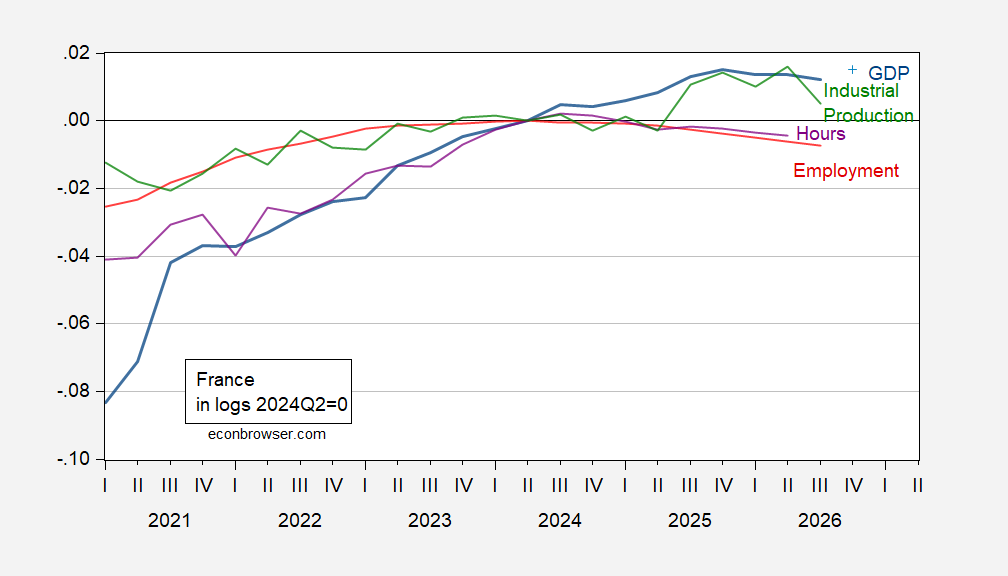
France’s latest business-cycle data send mixed signals, with industrial output and labor indicators weakening even as GDP is expected to post modest growth.
France’s latest set of business-cycle readings is sending mixed signals: measures tied to factories and labor are weakening, even as real GDP is expected to edge up in the final quarter of the year.
Recent data show declines in industrial production (excluding construction), alongside softer labor-market indicators such as employment and hours worked. In contrast, a widely watched GDP “nowcast” from the French Economic Observatory (OFCE), dated Nov. 10, points to modest quarter-on-quarter growth in Q4. The nowcast estimates GDP growth of 0.28% q/q, a downgrade from roughly 0.46% projected in early October, but still above zero.
This divergence is notable because headline GDP has already been slipping—sometimes only marginally—for three consecutive quarters. Over the same period, industrial output appears to have topped out earlier, peaking around Q2 before turning lower. When these series are plotted together on a comparable basis (using log indexes normalized to 2024 Q2), the contrast is clear: output in the industrial sector and labor inputs are moving down even as aggregate GDP is projected to stabilize or rise slightly.
Economists caution that relying on GDP alone can be misleading when judging whether the economy is expanding or contracting. One reason is that GDP estimates are frequently revised, sometimes materially, as more complete data arrive. That concern was highlighted in a recent communication on economic conditions from France’s business-cycle dating authorities—the French Business Cycle Dating Committee and the French Economic Association—underscoring that recession calls should not hinge on a single aggregate series.
Official forecasters, meanwhile, remain relatively sanguine. The Banque de France has indicated it expects France to avoid a recession in 2026 and sees positive growth in Q4, aligning with the OFCE’s current nowcast even after its downward revision.
Labor-market data add another layer to the assessment. A second comparison, juxtaposing the unemployment rate with industrial production, suggests that the factory slowdown is occurring alongside changes in job-market conditions. While unemployment is reported in percentage terms and industrial production in log levels, the pairing is meant to illuminate whether weakness in goods-producing activity is spilling over into broader employment dynamics.
Taken together, the indicators point to an economy navigating a narrow path: aggregate output may remain slightly positive, but underlying momentum in industry and labor inputs is softer than the GDP nowcast alone would suggest. For analysts and policymakers, the message is to watch a broader dashboard—production, hiring, hours, and revisions to national accounts—rather than treating preliminary GDP prints as definitive.
Why it matters
For businesses and households, the gap between a positive GDP estimate and weakening production and labor metrics can signal a more fragile expansion than the headline growth number implies. Policymakers will be watching whether the industrial slowdown feeds into employment and whether upcoming GDP revisions change the narrative. The next key test is whether Q4’s anticipated growth materializes—and if it is strong enough to offset the recent run of quarterly declines.