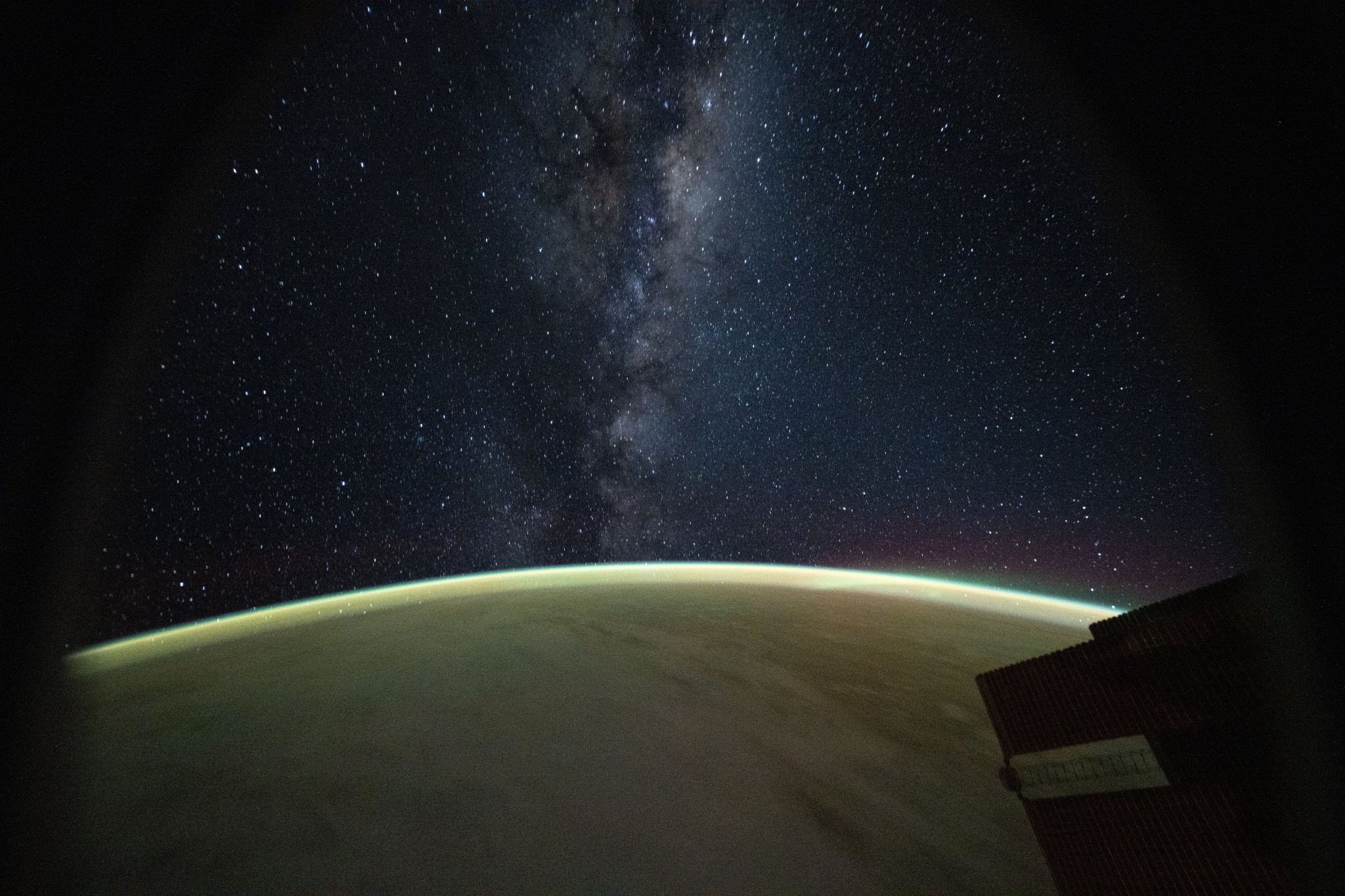
NASA astronaut Chris Williams has returned a striking view from orbit: the Milky Way appearing to climb above Earth’s faint, luminous rim.
NASA astronaut Chris Williams has returned a striking view from orbit: the Milky Way appearing to climb above Earth’s faint, luminous rim. The photograph was taken April 13, 2026, from a SpaceX Dragon spacecraft that was docked to the International Space Station.
That soft band of light along the planet’s edge is not city glow or an aurora. It is “airglow,” a natural emission from the upper layers of the atmosphere that can be visible from space as a delicate sheen. Airglow forms when sunlight interacts with the thin gases high above Earth, leaving atoms and molecules in energized states. As these particles release the extra energy and settle back down, they emit tiny packets of light known as photons.
Scientists describe two common pathways to that glow. In one, solar radiation excites atmospheric atoms and molecules directly, boosting them into higher-energy configurations. In the other, sunlight ionizes some of those particles, stripping away electrons; later, collisions allow the ions to recapture free electrons. Both routes end with the same result: as the particles relax to lower-energy states, they give off photons that collectively produce the subtle, global glow seen in Williams’ image.
The effect has a family resemblance to auroras, but the driving force is different. Auroras flare when charged particles from the solar wind are funneled by Earth’s magnetic field into the atmosphere, where they trigger bright, dynamic displays. Airglow, by contrast, is powered by the steady, everyday stream of solar radiation rather than bursts of high-energy solar particles. From orbit, that constant process outlines the planet with a thin, radiant atmosphere—an illuminated boundary beneath the star-filled backdrop of the Milky Way.