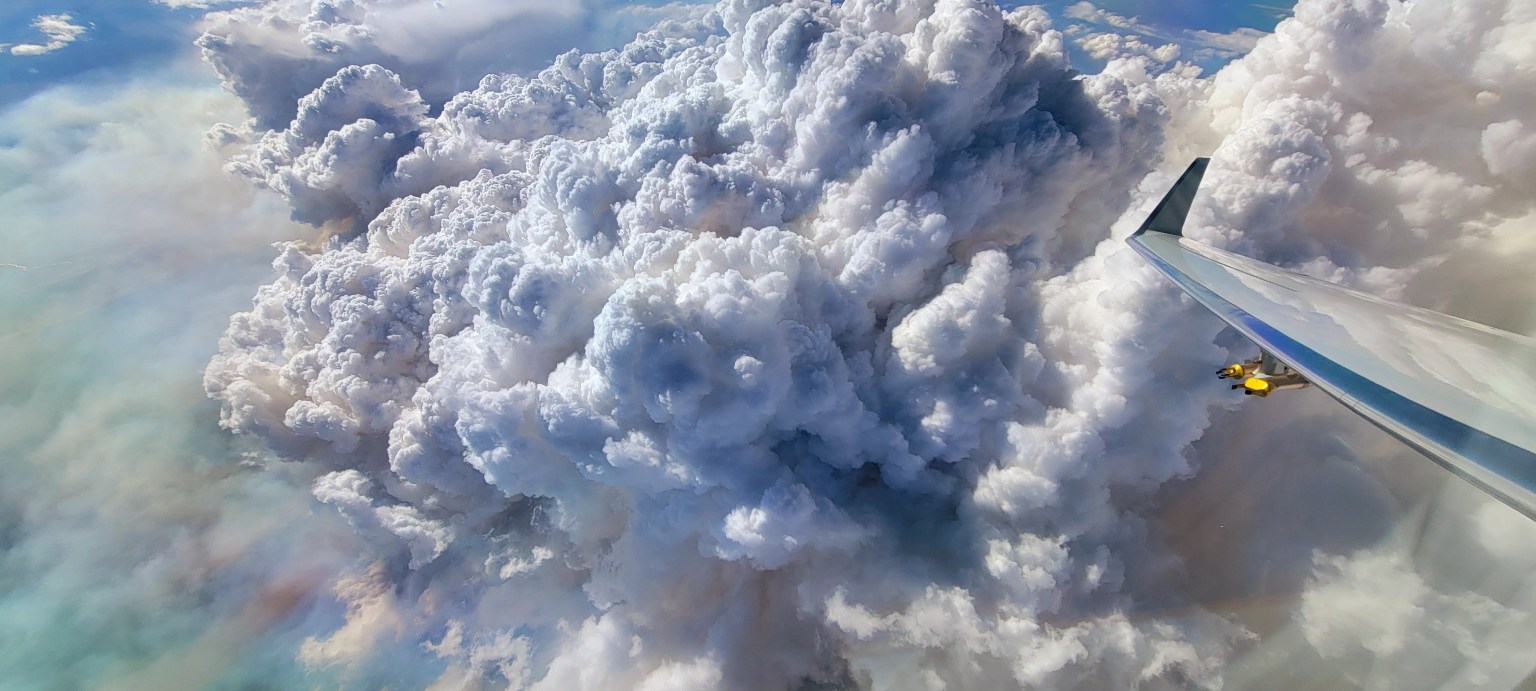
A sudden surge of smoke from the Wildhorse grass fire in eastern Idaho caught researchers off guard this summer.
A sudden surge of smoke from the Wildhorse grass fire in eastern Idaho caught researchers off guard this summer. The blaze had generated a pyrocumulonimbus cloud—known as a pyroCb—an intense, fire-driven thunderstorm that can tower over wildfires and dramatically reshape conditions both in the sky and on the ground.
NASA scientists have been searching for these rare events across western North America as part of INSPYRE, short for the INjected Smoke and PYRocumulonimbus Experiment. PyroCbs form above especially energetic fires and can unleash lightning and rain, while also producing strong, erratic winds capable of rapidly worsening the very flames that created them. The largest of these clouds can loft smoke to about 30,000 to 50,000 feet (10 to 15 kilometers), reaching altitudes comparable to commercial air traffic and, at times, pushing into the stratosphere.
Interest in pyroCbs intensified around the start of the 21st century, when satellites began detecting wildfire smoke at heights once mainly associated with major volcanic eruptions. That discovery raised alarms because smoke that penetrates the stratosphere behaves differently than smoke confined to the lower atmosphere: it can travel far beyond the original fire zone, spread across continents, even circle the planet, and linger much longer than it otherwise would.
Yet despite their scale, pyroCbs remain poorly understood—an uncertainty that matters because their impacts can outlast and outdistance the fires that spawned them. “We still do not understand if they’re driven by fire energetics, or fire intensity, or by atmospheric conditions above,” said Olga Kalashnikova of NASA’s Jet Propulsion Laboratory in Southern California. Kalashnikova is one of the principal investigators leading INSPYRE, described as the first aircraft campaign built specifically to study pyroCbs.
For six weeks, the team operated from the National Center for Atmospheric Research near Boulder, Colorado, flying a Gulfstream research jet repeatedly into and around smoke plumes and fire-influenced cloud systems. The aircraft sampled airborne particles and trace gases, imaged ice crystals, and measured how radiation moves through clouds and reflects back into space. By flying above, below, and through the evolving systems, researchers aimed to capture a detailed, three-dimensional picture of how wildfire smoke and weather interact.
INSPYRE also paired those in-cloud measurements with observations from above and below. NASA’s ER-2—an aircraft that flies at very high altitude—carried 14 instruments to assess fire intensity, the strength of updrafts, the distribution of smoke, and key cloud characteristics from overhead. On the ground, instrumented trucks provided another vantage point, recording the same events at the surface as the airborne platforms passed above.
The campaign’s analyses will focus on how these wildfire-driven storms inject smoke upward, how cloud processes chemically and physically alter the particles and gases within the plume, how much of that material reaches the stratosphere, and what becomes of it once it does. The findings could also aid firefighting operations. PyroCbs are “fire-generated weather,” said Neil Lareau, an atmospheric scientist at the University of Nevada, Reno, who led INSPYRE’s ground observations—storms in which the fire effectively builds its own thundercloud and, in the process, its own wind field.
Lareau hopes the work will eventually support warning systems akin to severe thunderstorm alerts, giving fire managers lead time to anticipate hazardous downdrafts and abrupt wind shifts and to pull crews to safety. Beyond immediate hazards, the results could improve Earth system modeling. PyroCbs can inject vast amounts of smoke into the stratosphere, where particles may persist for months or longer and influence how much solar energy the atmosphere absorbs versus how much reaches Earth’s surface. Many numerical prediction models still do not explicitly represent these smoke injections and their consequences, noted INSPYRE co-principal investigator Dave Peterson, a meteorologist at the Naval Research Laboratory.