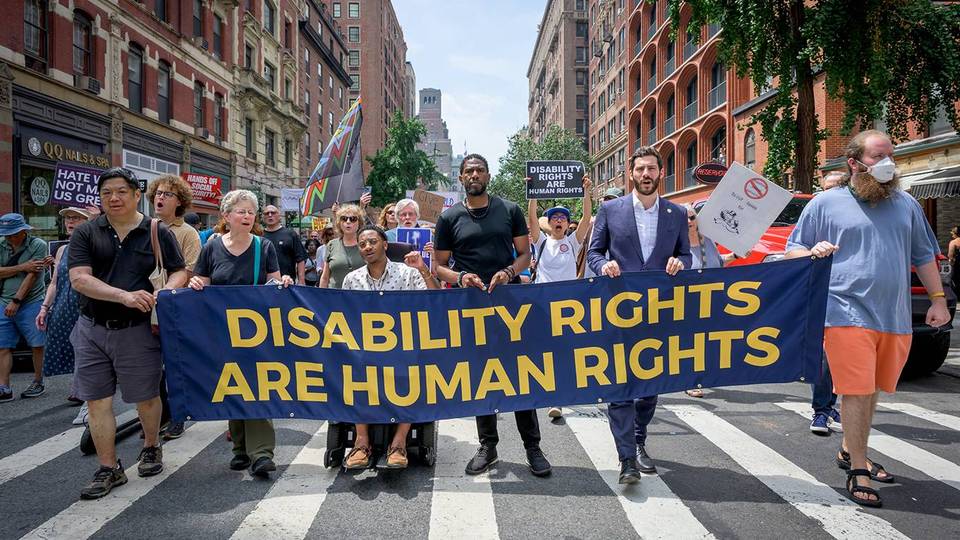
The once-reasonable assumption that integrating disabled people into the existing multilateral order would help them benefit from the results being delivered no longer holds.
The once-reasonable assumption that integrating disabled people into the existing multilateral order would help them benefit from the results being delivered no longer holds. Achieving better outcomes requires learning from disability movements about how to put diversity, access, care, and participation at the center of the agenda. GENEVA—Before the United Nations General Assembly adopted the Convention on the Rights of Persons with Disabilities (CRPD) in 2006, disability rights had beenlargely absentfrom the postwar multilateral order. In the 20 years since then, disability has gone through the contemporary inclusion playbook: a binding human-rights treaty, a treaty-monitoring body, a dedicated UN special rapporteur, incorporation into the Sustainable Development Goals, and UN-wide mainstreaming through theUN Disability Inclusion Strategy (UNDIS). But while the institutional advances have been significant, progress remains uneven, owing to insufficient resources and political will. The CRPD and its related mechanisms have prompted many countries to enactlegal and policy reforms, and UNDIS has raised the visibility of disability across the UN. Even so, anindependent evaluation of UNDISin 2025 found that meaningful outcomes for disabled people remain limited and urged a shift from addressing institutional readiness to delivering tangible results. To that end, the more ambitious UNDIS 2.0 strategy was launched in June. It may be time, however, to question the premise of this approach: that disabled people would benefit from being included into the existing international system’s structures for human rights, development, humanitarian action, peace and security, and economic cooperation. This once-reasonable assumption has come to seem insufficient, if not naive. Facing mounting financial and legitimacy crises, multilateral institutions are struggling to deliver on peace, development, climate change, inequality, and human rights. When budgets are strained, inclusion efforts are among the first to be cut, precisely because they were never considered essential. At the same time, shrinking civic space in many countries has hindered efforts to advance disability agendas on the global stage. Mainstreaming and representation—long positioned as the only viable routes to political influence for groups labeled as vulnerable—are not enough to change institutional priorities. Disability movements worldwide have developed political ideas about diversity, access, care, and participation that could help us rethink how international institutions work and what they prioritize. For starters, human diversity must inform policy design. The international community still devises policy for a population of relatively independent, able-bodied individuals who can work, move, and communicate without substantial support. Consider a disaster response that assumes everyone can evacuate independently, or a reconstruction program that rebuilds inaccessible infrastructure. This Black Friday, aPSsubscription starts at $39.99. You can read every new commentary from the likes of Joseph Stiglitz, Claudia Goldin, Raghuram Rajan, and Mariana Mazzucato, and explore an archive of 26,000 more prescient analyses by the world’s leading thinkers. With the year ahead promising to be a volatile one, few investments will serve you better Disability is part of every society, and the boundary between disabled and non-disabled people is neither fixed nor permanent. Displacement, climate disasters, and war can create new impairments, while the number of people with disabilities and the demand for support are likely to grow as populations age. International policymaking must reflect this reality. The same is true for multilateral institutions themselves: instead of designing them around an imagined “normal” person,universal designimproves accessibility by accounting for human diversity from the outset. While UNDIS 2.0 explicitly commits to “accessibility by design,” thelatest report on UNDIS implementationfound that only 49% of UN entities and just 25% of UN country teams met or exceeded accessibility requirements. UN institutions have historically been organized around states. Universal design could help broaden who can effectively participate. Accessible meeting formats, more multilingual communication, and adequate resources for participation could benefit people well beyond the disability community, creating more opportunities for diverse groups and movements to contribute to defining global priorities. Equally important is recognizing that disability is never experienced separately from gender, race, class, age, and migration status, which is why disability-justice movements, drawing on Black feminist thought, have embraced intersectionality, as opposed to viewing issues in isolation. Consider the cascading effects of climate disasters, which can displace people, disrupt their access to health care and support services, and deepen poverty and inequality. International institutions regard these issues as separate agendas, shaping how civil society organizes and reinforcing fragmented approaches to problems that are deeply interconnected. The UN and other multilateral institutions must break down the silos between policy areas and improve coordination of existing inclusion strategies. Disability movements also emphasize interdependence: everyone, disabled or not, relies on care and support (often sustained by unacknowledged labor), shared infrastructure, and public institutions. Organizing these interdependencies to strengthen autonomyand reduce inequalities requires placing greater emphasis on collective responsibilities, global public goods, and international cooperation. It also means viewing social protection, rehabilitation, and accessibility as global concerns, rather than as domestic or disability-specific matters. Lastly, few ideas associated with disability activism have traveled as widely as “nothing about us without us.” Popularized by disability-rights movements in the 1990s, the slogan challenged paternalistic decision-making and pushed for disabled people to have control over the decisions affecting their lives. In institutional practice, however, this demand has often been reduced to a hollow consultation requirement. UNDIS 2.0, which explicitly calls for “co-creation” with persons with disabilities through their representative organizations, must follow through on this commitment, from design to delivery and monitoring. More broadly, international institutions should reconsider the role of civil society in their decision-making, taking seriously concrete proposals that would enable affected communities to shape policies and programs—including aWorld Citizens’ Initiativethat would allow people to add issues to the UN agenda. As multilateral institutions like the UN come under pressure to reform, disability movements should question their assumptions about how to bring about change on the global stage. It would be a missed opportunity to keep the focus on representation when they could instead rely on their ample experience in building agendas around human diversity, universal access, intersectionality, interdependence, and meaningful participation. As disabled activists learned long ago, “inclusion” can only go so far if the priorities and structures into which people are being included remain beyond question. Nov 25, 2026Fiona E. Murray&Constanze Coelsch-Foisner Report a problemContact UsLicensingSwitch to classic view