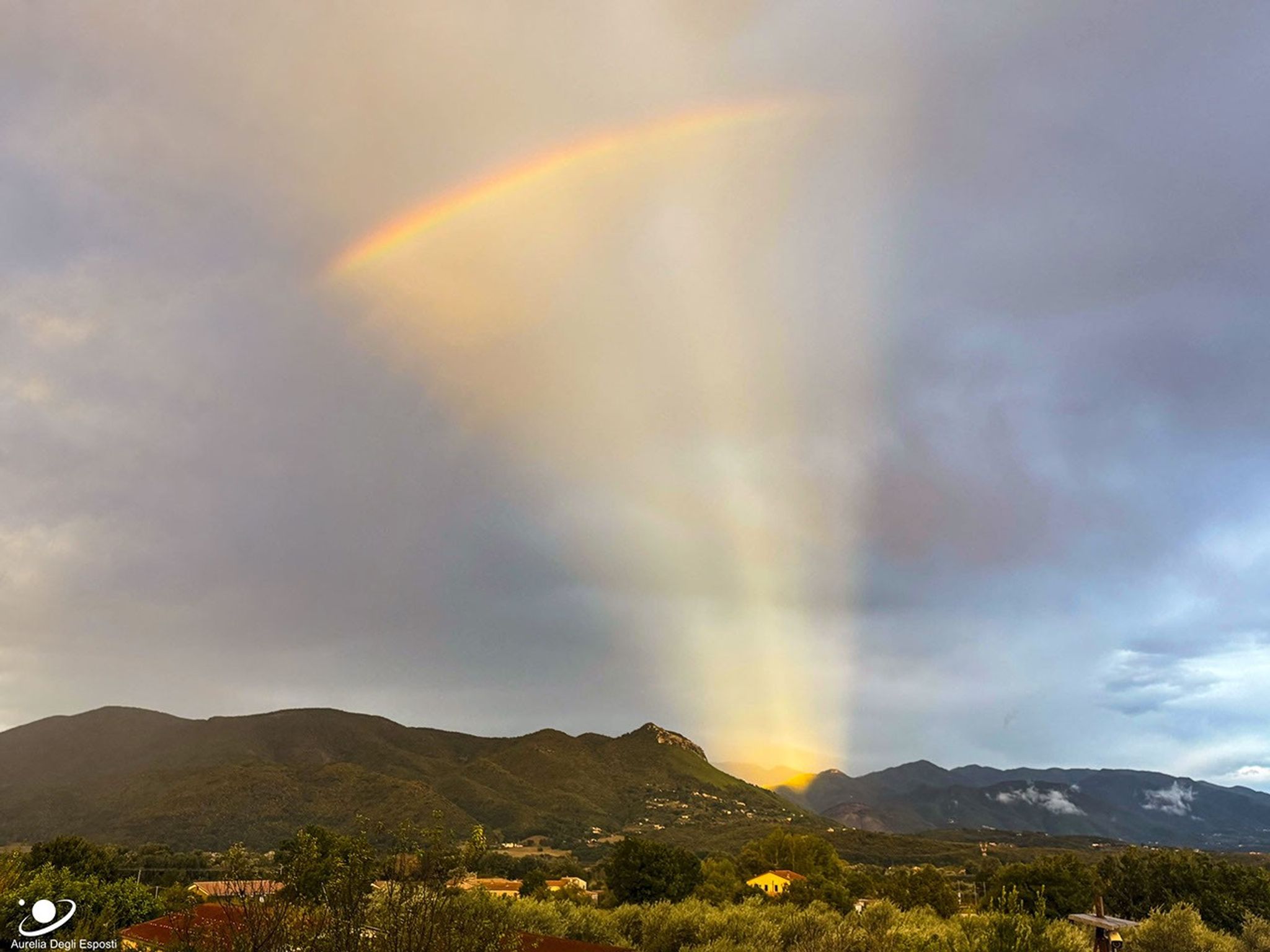
A photo from Italy shows a “reverse” rainbow seeming to form with the Sun in front. Anticrepuscular rays created the illusion by lighting sky opposite the real sunset.
A striking photograph captured last week in Presenzano, Italy, shows what looks like a rainbow forming in the wrong part of the sky.
At first glance, the scene appears straightforward: a partial rainbow arcs across a bright wedge of sunset light, rather than spanning the entire horizon. That kind of “incomplete” rainbow isn’t especially rare. Rainbows can appear clipped or fragmented when only a portion of the sky contains the right combination of sunlight and falling rain.
What makes this image remarkable is the apparent position of the Sun. In the photo, the brightest glow seems to come from the direction of the hills ahead, as if the Sun were low in front of the observer. If the Sun were truly there, a rainbow shouldn’t form where it does. The physics of rainbows requires the opposite geometry: sunlight enters raindrops, reflects internally, and exits back toward the observer. Because that process sends light back toward its source direction, the Sun must be behind the viewer for a rainbow to appear in front.
So why does the sky look as though the Sun is “ahead” of the observer?
The answer lies in an optical effect produced by clouds near the setting Sun. Breaks between those clouds allowed narrow beams of sunlight to stream outward. As the rays crossed the sky, perspective made them appear to converge toward a point opposite the Sun’s true position. These converging bands are known as anticrepuscular rays—the counterpart to the more familiar crepuscular rays often seen fanning out from the Sun at dawn or dusk.
In this case, the anticrepuscular rays created a bright, sunlit fan in the sky opposite the actual sunset. Within that illuminated region, conditions were right for rainbow formation, producing what looks like a “reverse” rainbow associated with an illusory solar location. The effect can be especially convincing because human vision and cameras naturally interpret converging rays as pointing toward a light source.
The photograph was taken on a phone at sunset and, fittingly, the phenomenon was spotted during an everyday task: the observer noticed it while hanging laundry.
Why it matters
Images like this highlight how simple atmospheric optics can create convincing illusions of where light is coming from. For skywatchers, photographers, and educators, anticrepuscular rays paired with a rainbow offer a clear, real-world demonstration of perspective and the geometry required for rainbow formation. As seasons shift and sunsets become more dramatic in many locations, these conditions may recur—making it worth watching the sky opposite the Sun, not just near it.