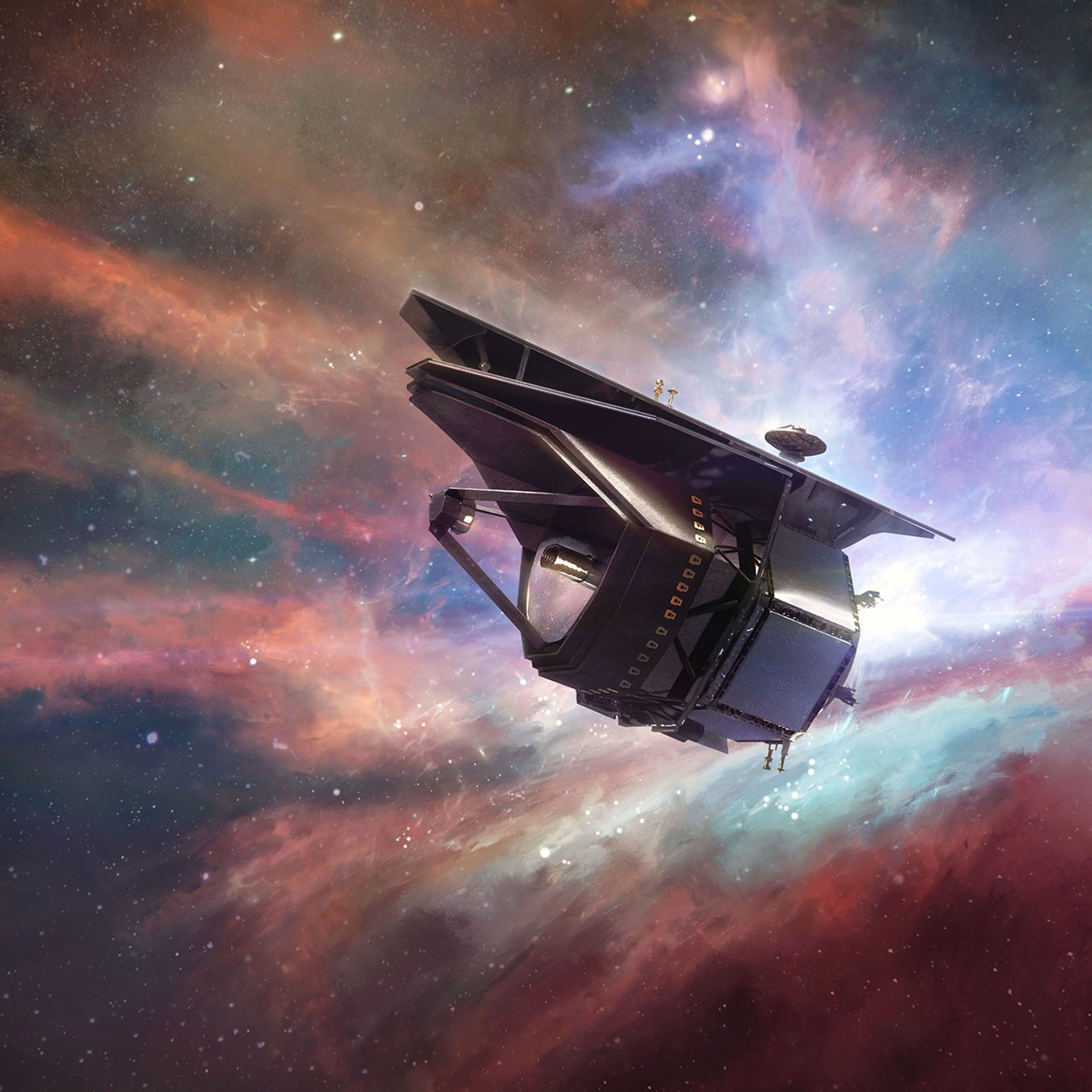
NASA’s proposed PRIMA far-infrared telescope would inaugurate the new Probe Explorers class, peering through cosmic dust to study the formation of stars, planets, black holes and water’s origins.
An artist’s rendering offers a first look at the proposed spacecraft for NASA’s PRobe far-Infrared Mission for Astrophysics, known as PRIMA, a concept the agency selected in September 2026. If the mission proceeds through NASA’s confirmation process, PRIMA would become the first observatory in a newly established category of astrophysics projects called Probe Explorers, part of the agency’s long-running Explorers Program.
PRIMA is designed to observe the universe in far-infrared wavelengths, a region of light that is especially valuable to astronomers because it can pierce through thick veils of cosmic dust. Many of the most important stages of cosmic evolution—such as the early growth of stars and the assembly of planetary systems—often occur inside dust-rich environments that block visible light. By focusing on far-infrared emissions, PRIMA would allow researchers to examine objects and processes that are otherwise difficult or impossible to study with traditional optical telescopes.
NASA says the mission’s scientific goals center on understanding how key structures in the cosmos take shape, including planets, stars, and black holes. The observatory’s dust-penetrating view is expected to help scientists trace how these objects form and evolve over time, providing a clearer picture of the physical conditions inside dense clouds of gas and dust where new systems are born.
Beyond the lifecycle of stars and planets, PRIMA is also intended to address questions tied to the origins of water—an ingredient central to life as we know it. By measuring far-infrared signatures associated with water and other molecules in dusty regions of space, the mission could help researchers refine theories about how water was delivered to Earth and how it may be distributed in other emerging planetary systems.
The current plan, if NASA confirms the mission, is to target a launch in 2033. PRIMA would be designed for a five-year prime mission, giving scientists a sustained window to carry out far-infrared observations and build a rich dataset on dust-hidden cosmic environments.
Why it matters
Far-infrared astronomy is one of the best tools for exploring the universe’s most dust-shrouded regions, where stars and planets are actively forming. If confirmed and launched, PRIMA could expand NASA’s ability to study these hidden processes and sharpen understanding of how black holes grow and how water—critical for habitability—may reach rocky worlds. The next key milestone to watch is NASA’s formal confirmation of the mission ahead of its planned 2033 launch target.