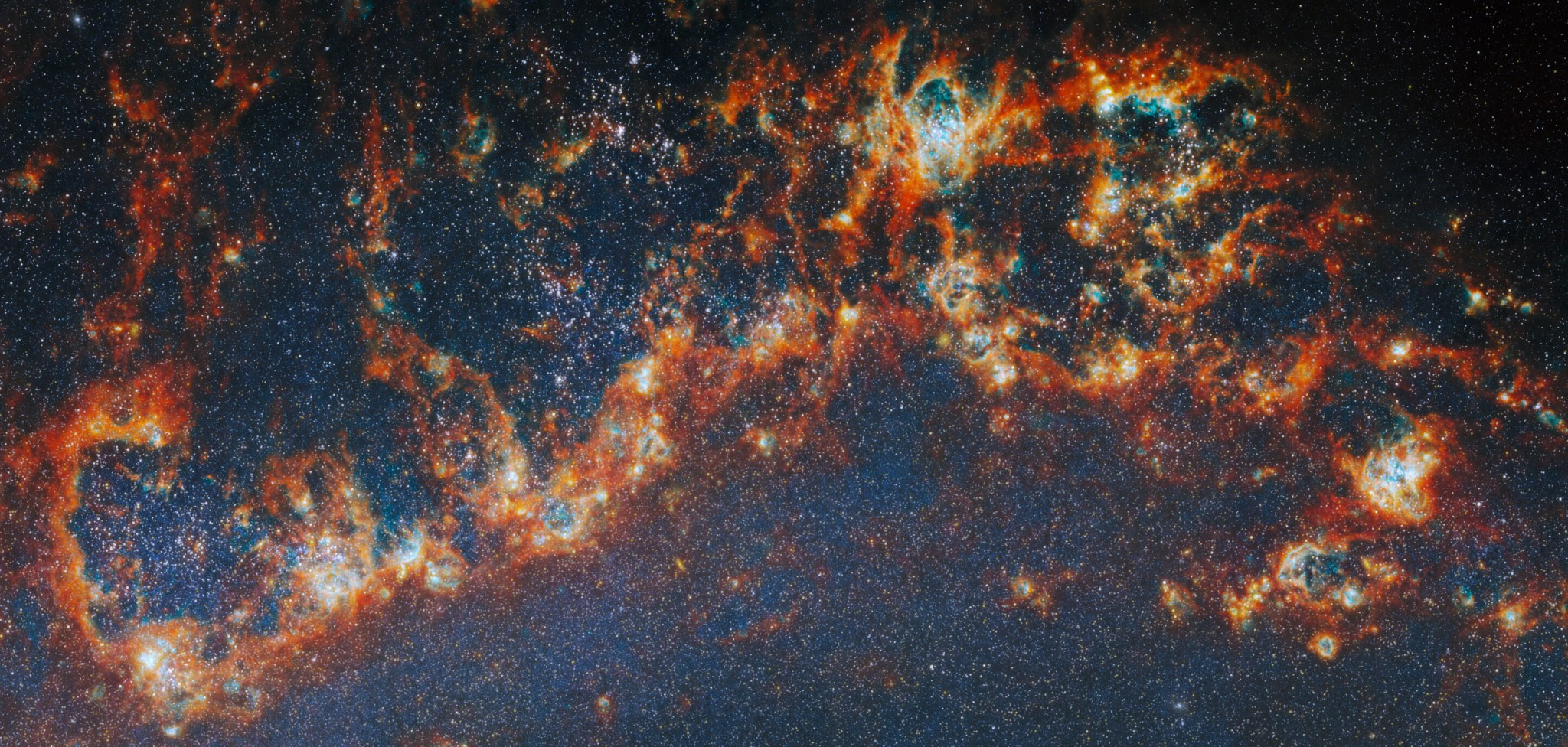
A newly released near-infrared view from NASA’s James Webb Space Telescope is offering a detailed look into the bustling star-forming environment of Messier 51, the well-known Whirlpool Galaxy.
A newly released near-infrared view from NASA’s James Webb Space Telescope is offering a detailed look into the bustling star-forming environment of Messier 51, the well-known Whirlpool Galaxy. The image, made public on May 6, 2026, focuses on a portion of one of M51’s spiral arms, where dense gas and dust help fuel the birth of new stars and star clusters.
M51 is also playing a key role in a broader Webb-led investigation into how star clusters develop. In the study, astronomers examined nearly 9,000 star clusters spread across four nearby galaxies, using Webb’s ability to peer through obscuring dust in infrared light. By comparing clusters at different stages of development, the team traced how these stellar groupings transition from their natal environments into more exposed systems visible across a wider range of wavelengths.
One clear trend emerged from the data: the most massive star clusters appear to break out of their birth clouds sooner than less massive ones. Those birth clouds—cold, dense regions of gas and dust—initially conceal young clusters. As newly formed stars begin to heat their surroundings and inject energy into the cloud, the material is gradually dispersed, revealing the cluster more fully. The new results indicate that cluster mass is linked to how quickly this “emergence” happens, with heavier clusters clearing their immediate environments on shorter timescales.
Researchers say this kind of timing matters because star formation is not just a local process; it helps shape an entire galaxy. How quickly clusters shed their natal material can influence the structure of spiral arms, the distribution of gas available for future star formation, and the overall cycle of matter within galaxies. The findings also connect to bigger questions about galactic evolution and the internal dynamics that govern how galaxies grow and change over time.
Beyond the scale of galaxies, the work feeds into efforts to understand how and where planetary systems arise. Stars—and the planets that may eventually form around them—are born from the same reservoirs of gas and dust. Mapping the earliest stages of star cluster development helps astronomers refine their understanding of the environments in which stars are assembled and how those conditions may affect the materials that go on to build planets.
The image and study are credited to ESA/Webb, NASA and the Canadian Space Agency, with analysis by A. Pedrini and A. Adamo of Stockholm University and the FEAST JWST team.