No spacecraft has ever physically collected material from a planetary ring.
No spacecraft has ever physically collected material from a planetary ring. Scientists have flown through and around rings—most notably with NASA’s Cassini mission at Saturn—but the particles themselves remain untouched. A new concept called PRAXIS, short for Planetary Rings Autonomous EXploration with In-situ Sampling, argues that changing this would fundamentally advance what researchers know about how rings form, behave, and evolve.
The stakes extend well beyond Saturn. Saturn’s rings are the Solar System’s most massive and optically dense, but Uranus and Neptune also host far fainter, more tenuous ring systems. Even small bodies such as the Centaurs Chariklo and Chiron are known to have rings, raising broader questions about how ring structures arise and persist under very different conditions. Understanding the physics of rings also feeds into a bigger astrophysical puzzle: many of the same processes likely operated in the early stages of planet formation, within protoplanetary and circumstellar disks.
Cassini revealed rings to be complex, active environments filled with structures that evolve over time. Yet major gaps remain in the data. Key ring features—self-gravity wakes, “propellers,” density waves, and sharply defined edges of gaps—still need higher-resolution investigation, particularly at the scale of individual particles and their interactions. Saturn’s rings contain a shifting mixture that ranges from micron-sized grains to objects as large as houses. Most of the material is water ice, and the ring population behaves like a constantly rearranging rubble pile, clumping together and then breaking apart.
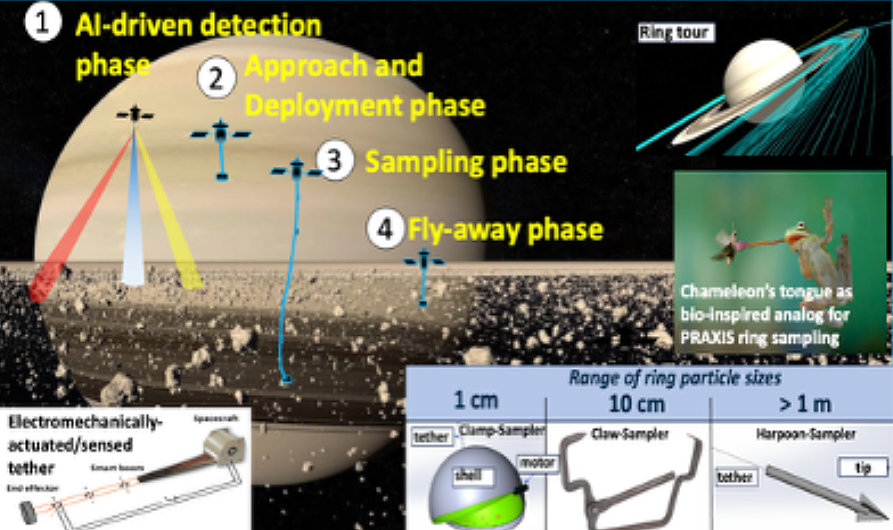
PRAXIS is designed to meet a prominent planetary-science priority: obtaining the first direct observations and measurements of ring particles in the millimeter-to-centimeter size range, a regime Cassini could not directly sample. The proposal emphasizes that getting those measurements requires not only a sampler, but a system capable of operating safely amid fast-moving debris. In a place where everything is in motion, collision avoidance, accurate targeting, and reliable sample acquisition cannot depend on constant ground control. PRAXIS therefore centers on advanced autonomy—using AI to guide close operations, select targets, and conduct collection and analysis in real time.
The sampling approach borrows ideas from sport casting to snag free-floating particles, paired with miniaturized instruments intended to characterize material immediately after capture. With those tools, PRAXIS aims to directly measure properties central to ring science, including particle size, porosity, and composition.
The mission architecture also reflects lessons from prior studies. PRAXIS builds on elements assessed in the Saturn Ring Observer Mission Study, which examined trajectories that skim near the rings and hover above them to watch particles moving in detail. In the PRAXIS concept, the spacecraft begins with an imaging and characterization phase to identify a suitable target. It then performs a touch-and-go sampling maneuver, reaching toward the particle with a long, soft, deployable boom. The boom allows agile contact while keeping the main spacecraft at a safer distance—an important safeguard in a crowded, dynamic environment.
After retrieving a sample, the spacecraft would reposition to different parts of the rings, including distinct regions or gaps, to collect material across a range of conditions. The team plans to establish feasibility in a Phase I effort focused on simulation and system design, followed by Phase II development of a physical prototype. If successful, the technology could extend beyond Saturn, with proponents positioning it as adaptable for future planetary-formation investigations and as a candidate capability for missions such as the upcoming Uranus Probe.