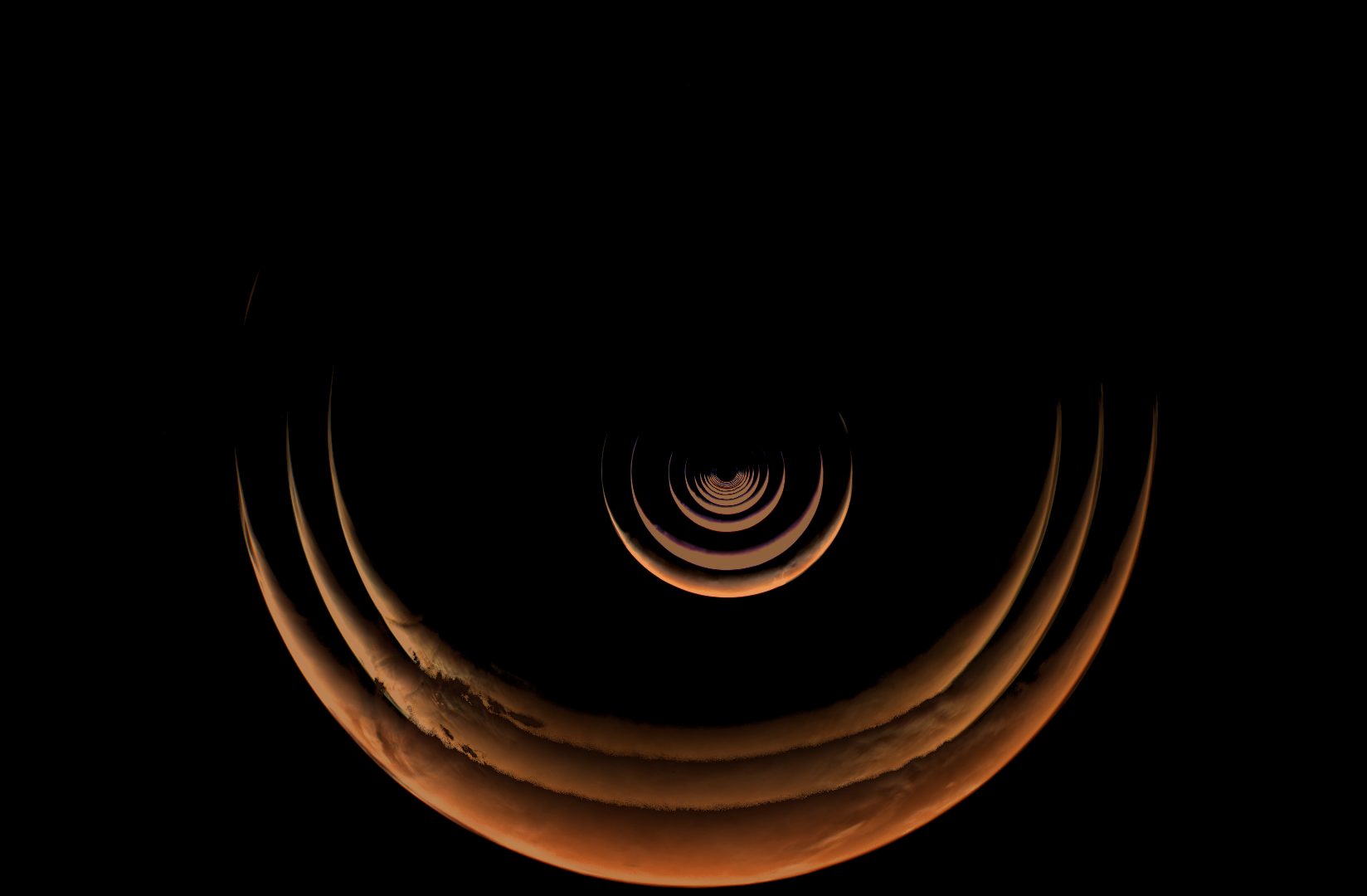
NASA’s Psyche spacecraft has returned a striking new look at Mars, capturing the red planet as a narrowing sliver of light that steadily expanded while the probe closed in for a crucial gravity-assist flyby.
NASA’s Psyche spacecraft has returned a striking new look at Mars, capturing the red planet as a narrowing sliver of light that steadily expanded while the probe closed in for a crucial gravity-assist flyby.
The images come from a composite sequence assembled from observations taken between May 2 and May 15, 2026, during Psyche’s approach to Mars. At the start of the series, Mars appears as the smallest, thinnest crescent—positioned at the center of the composite—when the spacecraft was still at its greatest distance from the planet. As the days pass and Psyche draws nearer, the illuminated arc grows larger from frame to frame, visually tracking the shrinking gap between spacecraft and world.
The views were recorded with Psyche’s multispectral imager, an instrument designed to collect pictures across multiple wavelengths. That camera watched the planet’s lit portion increase as the geometry of the encounter changed. Psyche’s trajectory brought it in from what mission teams describe as a high phase angle—an alignment in which the Sun, Mars, and the spacecraft form a steep angle. In that configuration, most of the planet’s near side is not directly illuminated from Psyche’s vantage point, so Mars presents itself as a thin crescent rather than a bright, full disk. The crescent shape seen in the days leading up to closest approach is the sunlit part of the planet, shining by reflected sunlight.
As the spacecraft reached its closest point to Mars, the planet began to exceed the camera’s field of view, effectively becoming too large to fit in a single frame. Around that time, Psyche transitioned from the broader crescent views to collecting a set of higher-resolution images of the Martian surface during the flyby.
By combining the approach sequence, the close-approach imaging, and the post-encounter departure views, the Psyche team has produced a time-lapse that chronicles the spacecraft’s entire passage by Mars—from the first distant crescent to the rapidly enlarging planet and onward again as Psyche continued on its route.
NASA’s Psyche mission is using the Mars flyby to gain a gravity assist, a maneuver that leverages the planet’s motion and gravity to adjust the spacecraft’s speed and trajectory without expending large amounts of propellant. More information about the mission is available through NASA’s Psyche mission resources online.