Voyager Technologies’ Griffin-1 lunar lander has completed nearly three months of environmental testing at NASA’s JPL, clearing a key milestone toward its planned Moon mission.
A lunar lander built by Voyager Technologies has wrapped up an intensive environmental test campaign at NASA’s Jet Propulsion Laboratory (JPL) in Southern California, marking a key step toward its planned mission to the Moon. The spacecraft, called Griffin-1, spent almost three months undergoing a gauntlet of trials designed to show it can tolerate the punishing conditions of launch, transit through space, and touchdown on the lunar surface.
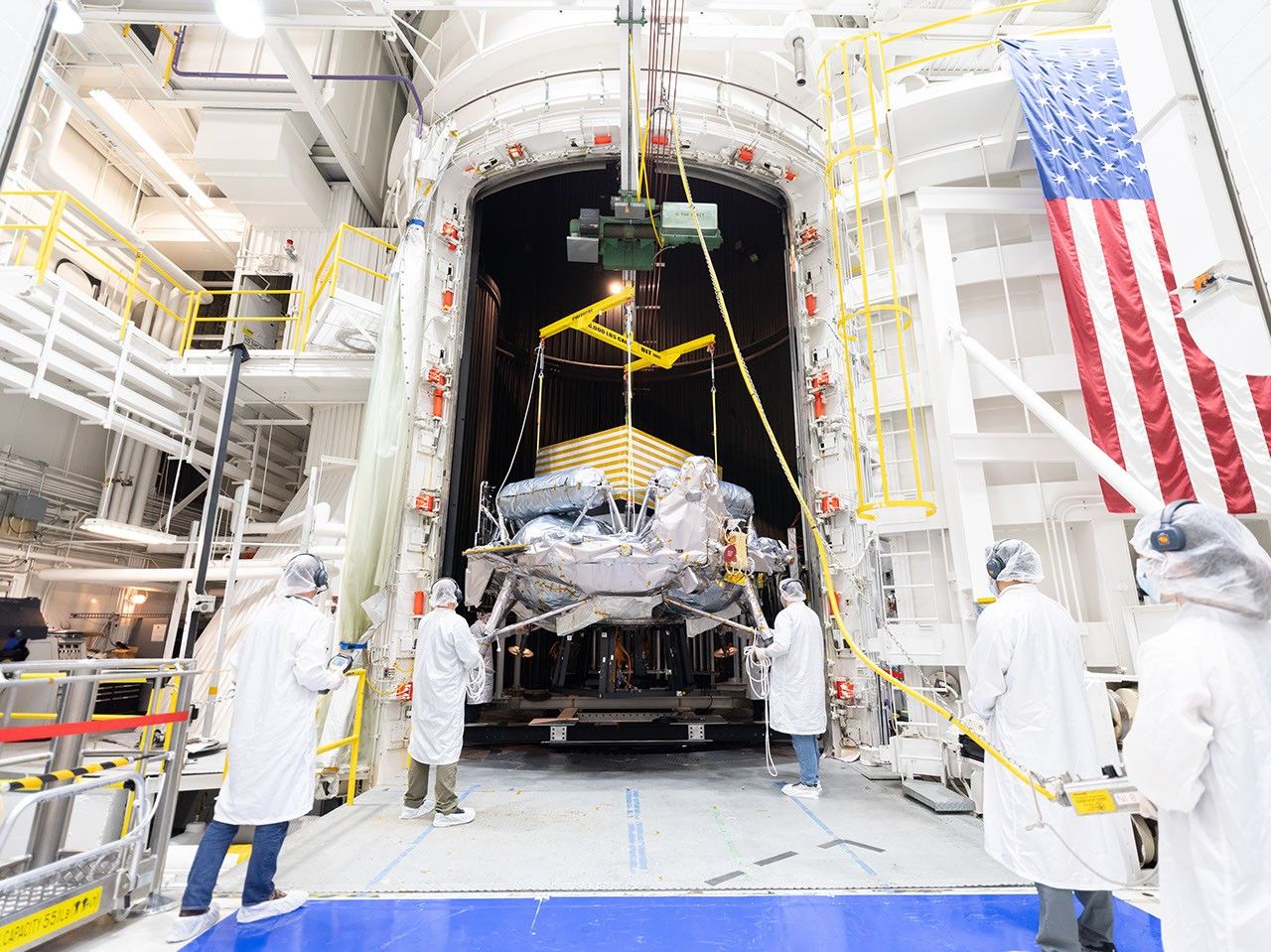
The capstone test concluded in late September 2026 inside one of JPL’s most storied facilities: the 25-Foot Space Simulator. The towering thermal-vacuum chamber—listed on the National Register of Historic Places—has supported some of NASA’s most consequential robotic explorers, including spacecraft from the Ranger, Surveyor, Mariner and Voyager eras. On Aug. 31, engineers and technicians used a crane to lower Griffin-1 into the chamber for a series of thermal-vacuum cycles meant to replicate the airless, temperature-swinging environment of space.
During the test, the lander was alternately heated to about 167 degrees Fahrenheit (75 degrees Celsius) and chilled to roughly minus 148 F (minus 100 C). Those extremes are used to mimic the kinds of hot-and-cold transitions the vehicle will encounter during its mission profile. Mounted atop the lander was a yellow-striped box representing a future payload interface—standing in for Astrolab’s FLIP (FLEX Lunar Innovation Platform) rover that will later be integrated with Griffin-1.
The thermal-vacuum work capped a broader suite of evaluations performed across multiple JPL facilities. Earlier in the summer, Griffin-1 was placed in an anechoic chamber on July 29 for electromagnetic interference and electromagnetic compatibility testing, a check that verifies the spacecraft’s electronics can operate without their signals disrupting one another. The chamber’s walls are lined with foam wedges that suppress reflections of both sound and electromagnetic waves to create a controlled environment for sensitive measurements.
Engineers also characterized the lander’s physical behavior during flight by measuring its mass properties. In a July 20 test, Griffin-1 spun quickly on a dedicated table so teams could determine how the spacecraft is balanced and detect any unexpected wobble—data that feeds directly into models of how it will maneuver in space and operate on the surface.
To replicate the violence of liftoff, the lander was subjected to acoustic and vibration testing. On Aug. 12, microphones surrounded Griffin-1 inside a sealed acoustic chamber while large horns, driven by compressed gaseous nitrogen, blasted it with sound levels up to 153 decibels—approximating the roar produced during launch. Separate vibration trials used a shaker table to jolt the vehicle along three axes with escalating intensity, while hundreds of sensors monitored its response to the simulated rocket ride out of Earth’s atmosphere.
With the JPL campaign complete, Griffin-1 has been shipped back to Voyager Lunar Systems’ facility in Pittsburgh for final assembly. The mission is part of NASA’s Commercial Lunar Payload Services (CLPS) initiative within the Moon Base Program, which contracts commercial providers to deliver technology and science payloads to the lunar surface.
Voyager expects Griffin-1 to launch in late 2026 aboard a SpaceX Falcon Heavy. The infrastructure-class lander is slated to carry more than 1,100 pounds (455 kilograms) of cargo—10 payloads representing six countries—to Nobile Crater near the Moon’s south pole. JPL is managed for NASA by Caltech in Pasadena, California.
Why it matters
Environmental testing is where spacecraft designs either prove they can survive space—or reveal flaws before they become mission-ending failures. Griffin-1’s successful test run strengthens the near-term pipeline for CLPS deliveries to the lunar south pole, a region central to many nations’ exploration plans. Next to watch: final integration in Pittsburgh and whether the late-2026 launch window holds as payloads and flight readiness reviews come together.