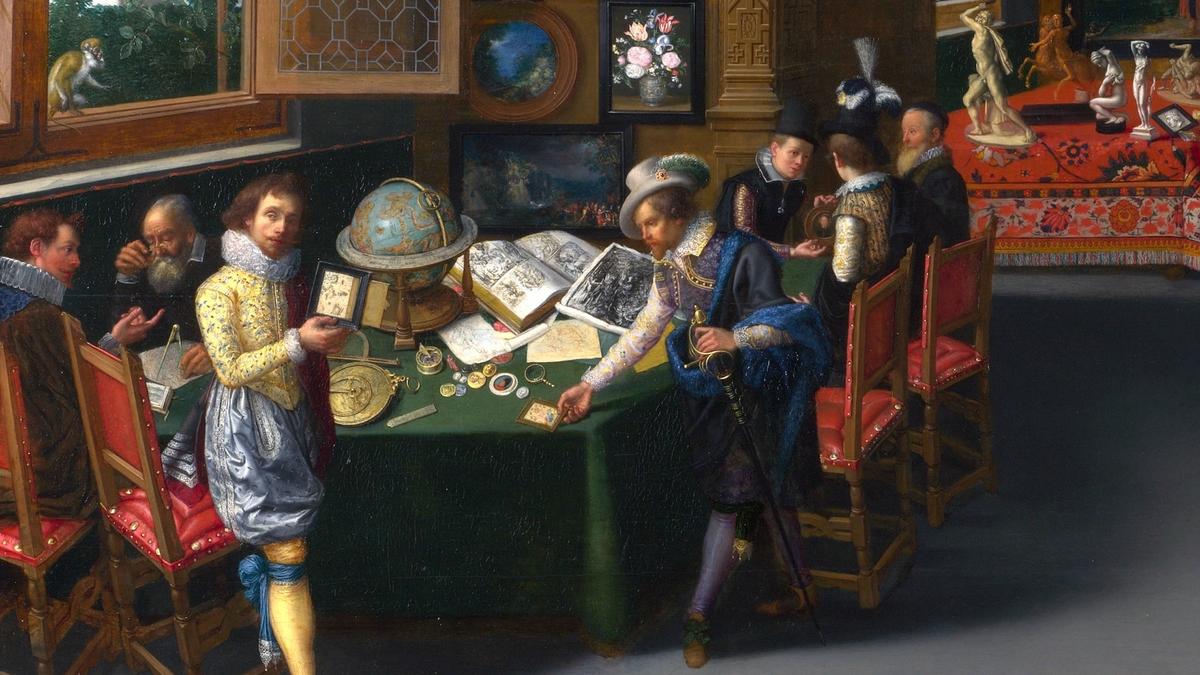
Europe’s Wunderkammern were more than eccentric collections: they staged global trade, empire and new science in miniature, turning exotic goods into prestige and power.
Wunderkammer: how Europe’s “cabinets of curiosities” mapped a newly global economy
Introduction
Long before the modern museum standardized labels and glass cases, Europe’s elites built rooms meant to astonish. The Wunderkammer—literally “chamber of wonders”—was equal parts collection, performance and claim to knowledge. Emerging in the 16th century and flourishing through the 17th, these “cabinets of curiosities” gathered seashells, coral, taxidermied animals, minerals, maps, automata, scientific instruments, religious relics, paintings and objects acquired from Africa, Asia and the Americas. They were not just cultural eccentricities. They were products of a rapidly integrating world economy—an early attempt to organize, display and profit from the flood of goods and information released by global trade and empire.
Historical context: trade, empire and the shock of the “new”
The timing matters. From the late 15th century onward, European expansion—Portuguese routes around Africa, Spanish colonization in the Americas, and later Dutch, French and English commercial empires—rearranged trade networks and the flow of commodities. Silver from the Americas, spices from Southeast Asia, porcelain and silk from China, and botanical products like tobacco and cacao entered European markets at volumes that reshaped consumption and state finance. Joint-stock companies such as the Dutch East India Company (VOC, founded 1602) made long-distance trade more systematic and more aggressively extractive.
Wunderkammern arose in this environment of abundance and bewilderment. They offered elite Europeans a way to turn far-flung connections into something tangible: a room-sized catalog of global reach. These collections also tracked a major shift in European knowledge-making: from medieval scholastic authority toward observation, classification and the early scientific culture that would later underpin the Enlightenment.
Key early figures illustrate the link between collecting and global commerce. The Habsburg court in Prague under Emperor Rudolf II (reigned 1576–1612) became a magnet for artists, instrument-makers and natural philosophers; Rudolf’s collecting was as much a statement of imperial power as personal fascination. In Italy, the polymath Ulisse Aldrovandi (1522–1605) assembled extensive natural history collections tied to the growth of comparative observation. In Northern Europe, merchants and officials—people plugged directly into trade routes—were often among the most avid collectors.
Main analysis: the Wunderkammer as an economic institution
A display of networks and power. In an age when state capacity and commercial power were increasingly intertwined, a cabinet of curiosities functioned like a three-dimensional map of connections. Exotic shells, “Indian” featherwork, carved ivories, Japanese lacquer, or specimens from the Caribbean did not merely signal taste; they signaled access. To acquire such items required ships, intermediaries, credit, and—frequently—colonial coercion. The cabinet made those invisible infrastructures visible, translating the reach of trade into prestige.
A micro-economy of rarity. Wunderkammern thrived on scarcity and wonder, both of which have clear economic logic. Collectors sought the rare (raritates) and the marvelous (mirabilia)—objects whose value came from being difficult to obtain, hard to explain, or both. That created specialized markets: dealers, ship captains, missionaries, colonial administrators and artisans who supplied curiosities, sometimes with forged provenance or embellished stories. The cabinet thus sat at the crossroads of luxury consumption and information asymmetry—where buyers often knew less than sellers about an object’s origin or authenticity.
Knowledge as capital. Cabinets were also investments in status through learning. To “possess” the world in miniature was to claim mastery over it. Many collectors employed catalogers or corresponded with scholars; inventories and illustrated compendia circulated through Europe’s Republic of Letters. This mattered economically because classification and standardization reduce uncertainty. Early natural history collecting, even when mixed with spectacle, helped build habits of sorting and comparing that later supported more systematic science—botany, zoology, mineralogy—and the applied knowledge useful to states and firms (navigation, metallurgy, pharmacology, agriculture).
From theatrical jumble to ordered museum. Over time, the very forces that produced cabinets—global exchange and accumulating knowledge—undermined them. As objects multiplied, the logic of “wonder” gave way to the logic of “system.” By the 18th century, classification frameworks (in natural history especially) encouraged separation by type and function rather than dramatic juxtaposition. Meanwhile, states and cities increasingly created public collections as instruments of civic prestige and education. A watershed example is the founding of the British Museum in 1753, built around the physician and collector Sir Hans Sloane’s assemblage, and opened to the public in 1759. The museum format aligned with a broader institutional transition: knowledge moving from private courts and salons toward public, state-backed infrastructure.
Conclusion: why Wunderkammern matter for economic history
Wunderkammern sit at a hinge in the history of capitalism and empire. They reveal how early modern Europeans processed globalization not only through prices and profits, but through display, taxonomy and ownership. The cabinet of curiosities was a cultural technology for an expanding commercial world: it converted distant extraction and exchange into local authority and social power. And it foreshadowed a modern truth—still contested today—that collecting and curating are never neutral. They reflect who controls trade routes, who commands labor, and who gets to define what the world is, and how it should be understood.