June offers skywatchers a packed schedule of planetary meetups, a dramatic lunar event, the official start of astronomical summer, and the return of some of the Northern…
June offers skywatchers a packed schedule of planetary meetups, a dramatic lunar event, the official start of astronomical summer, and the return of some of the Northern Hemisphere’s most popular deep-sky sights.
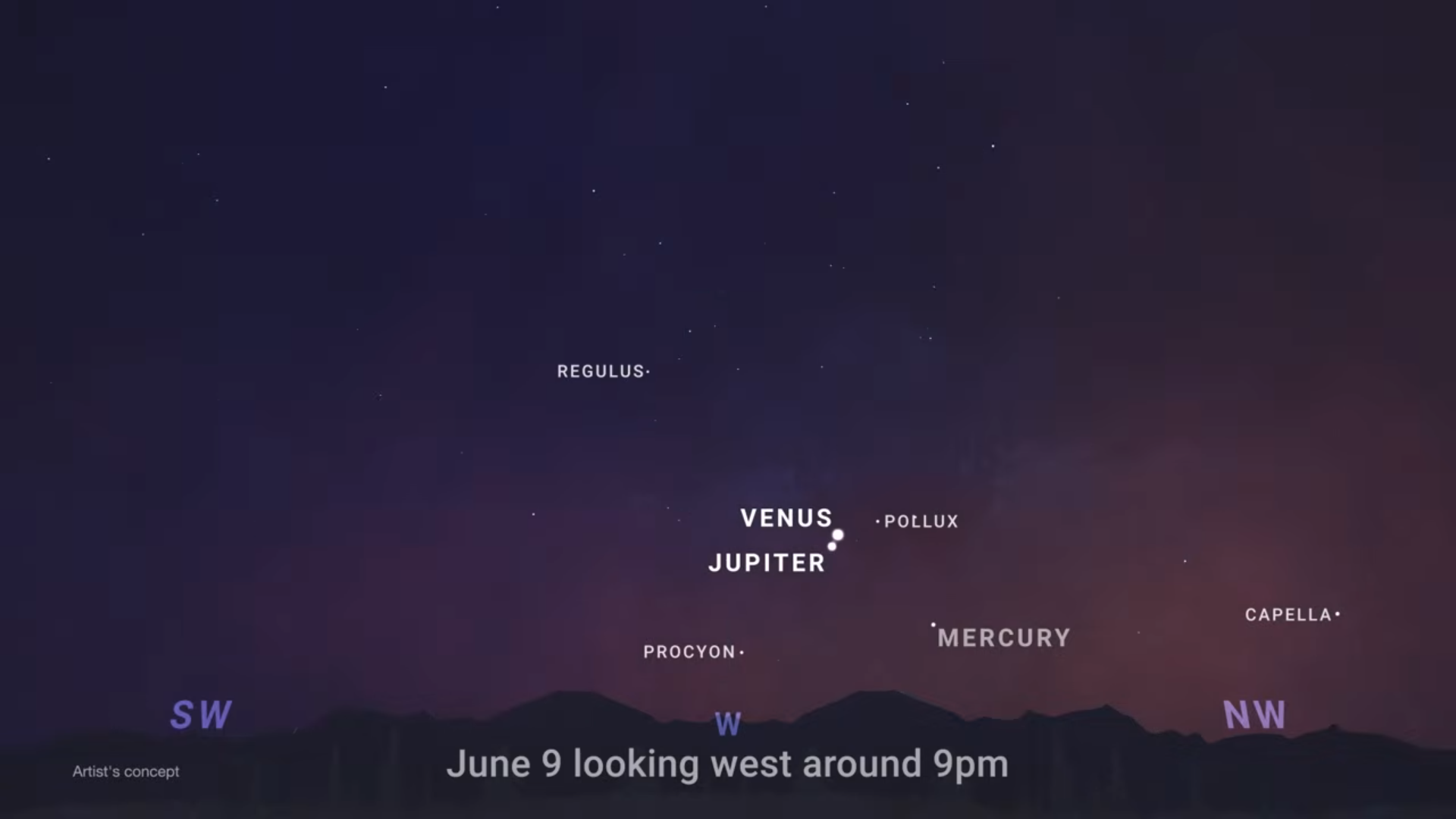
Start by turning your gaze to the western horizon shortly after sunset in the first part of the month. Venus and Jupiter—two of the most luminous planets visible from Earth—take center stage, appearing especially close together around June 9. Astronomers call this kind of close apparent pairing a conjunction: the planets only look near one another from our perspective, while remaining separated by millions of miles in space.
A few nights later, the view becomes even more interesting. From June 11 through June 15, Mercury joins Venus and Jupiter low in the west, creating a short-lived lineup of worlds after sundown. This clustering happens because the major planets travel along nearly the same sky-path, the ecliptic, which traces the plane of the solar system. When several planets occupy the same stretch of that path at once, they can seem to gather together in a small patch of sky.
Venus will be the easiest object in this group to spot, with Jupiter nearby. Mercury, however, sits closer to the horizon and can be swallowed by twilight haze, so observers will need a clear, unobstructed view to the west to pick it out before it sets.
Mid-month brings the most striking event. On June 17, observers in a narrow viewing zone will see the Moon move directly in front of Venus, temporarily hiding the planet. This phenomenon—known as a lunar occultation—makes Venus appear to vanish behind the Moon’s edge and then reemerge later. NASA notes the occultation will be visible from parts of the United States and Canada, as well as locations in Brazil and Venezuela. Even outside the precise path where Venus is covered, many people will still notice the Moon and Venus paired closely in the sky.
There is an important caution: for many locations, this Moon–Venus encounter occurs during daytime. Anyone attempting to watch it should avoid pointing binoculars, telescopes, or cameras anywhere near the Sun without proper solar-safety equipment. Viewing the Sun through optical devices can cause severe eye damage.
June also marks the summer solstice in the Northern Hemisphere—the moment astronomical summer begins. In Pacific Time, the solstice arrives Sunday, June 21 at 1:24 a.m. The days around this date bring the year’s longest daylight periods and shortest nights north of the equator. Yet the solstice doesn’t necessarily coincide with the earliest sunrise or latest sunset. In Los Angeles, for instance, the earliest sunrise occurs before the solstice, while the latest sunset falls after it.
Once darkness finally settles in, summer skies deliver classic targets for telescopes and astrophotography. Look for the Summer Triangle, a prominent pattern formed by Vega, Altair, and Deneb. In and near that region lie several celebrated nebulae, including the Dumbbell Nebula (Messier 27), the Ring Nebula, the North America Nebula, and the Veil Nebula. M27 is historically notable as the first planetary nebula ever identified. Though these objects aren’t as bright as planets to the naked eye, telescopes and long-exposure images reveal glowing gas clouds, stellar remnants, and active star-forming regions within our Milky Way.
NASA also highlights June’s changing Moon phases and directs readers to science.nasa.gov for updates on the agency’s ongoing exploration of the solar system and beyond.