Workers at NASA’s Kennedy Space Center have taken delivery of major new hardware designed to keep the Nancy Grace Roman Space Telescope impeccably clean as it moves through critical prelaunch operations.
Workers at NASA’s Kennedy Space Center have taken delivery of major new hardware designed to keep the Nancy Grace Roman Space Telescope impeccably clean as it moves through critical prelaunch operations.
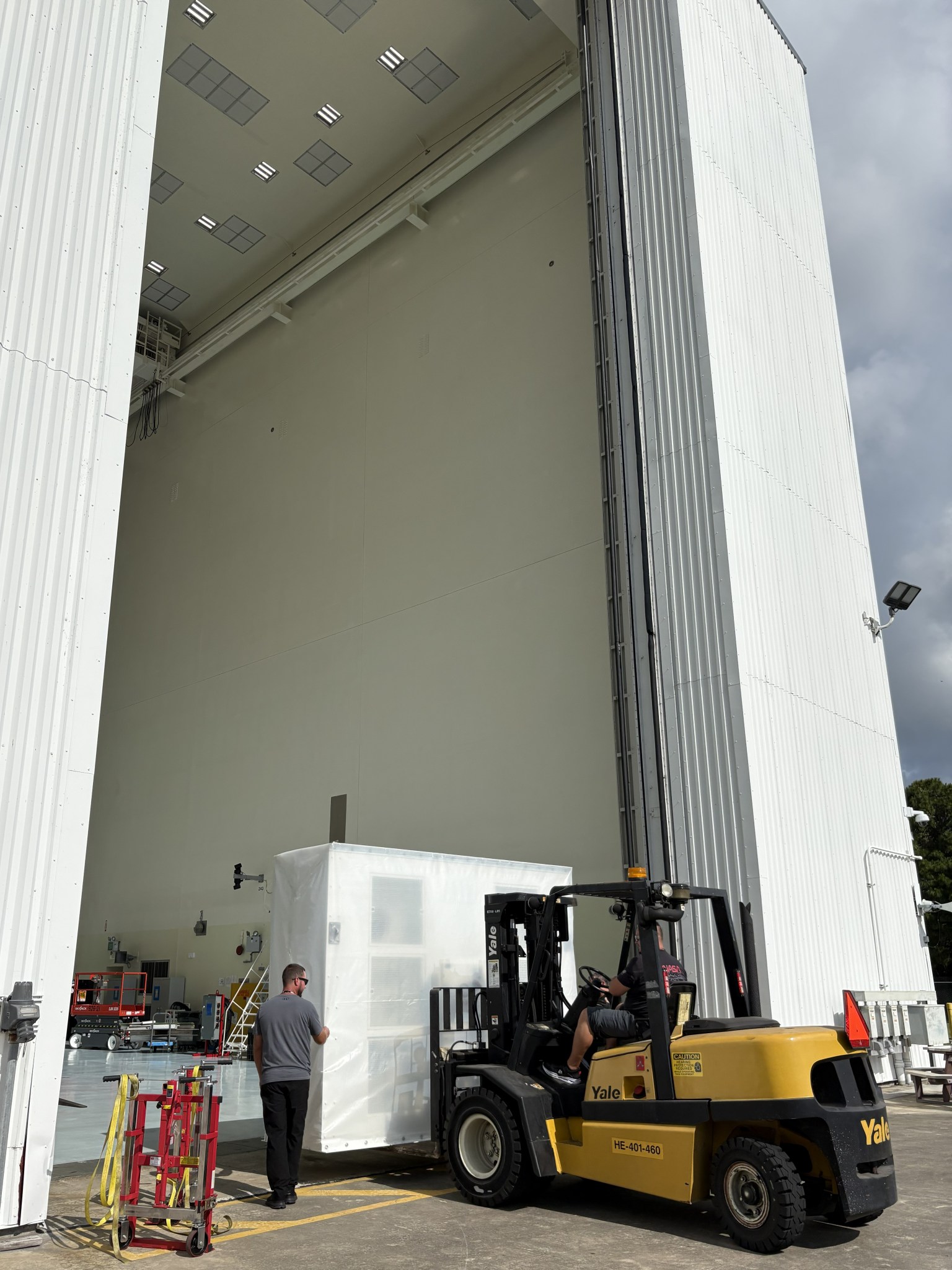
On April 27, technicians at the Payload Hazardous Servicing Facility (PHSF) in Florida unloaded eight high-efficiency particulate air (HEPA) wall modules along with additional ground support equipment. The modules—each weighing about 1,800 pounds—are intended to strengthen the facility’s clean-room capabilities, an essential step for handling a sensitive infrared observatory whose performance depends on stringent contamination control.
Roman is expected to spend time inside the PHSF during launch processing, when teams carry out hazardous but routine tasks that must be performed under carefully controlled conditions. One of the key milestones conducted in such a facility is fueling the spacecraft ahead of liftoff. The upgraded filtration and airflow infrastructure will help ensure the observatory’s hardware remains within the strict cleanliness limits required for spaceflight instruments.
Once launched, Roman will study the cosmos in infrared light. The mission’s primary science payload includes the Wide Field Instrument, which is designed to capture expansive views of the sky, and a Coronagraph Instrument technology demonstration, which will test advanced methods for blocking starlight to better isolate faint nearby targets. Together, these capabilities will allow Roman to deliver wide-area “panoramic” observations that can be used to probe fundamental questions about the universe.
Among Roman’s central goals is investigating why the expansion of the universe appears to be speeding up. Scientists commonly attribute this behavior to dark energy, a poorly understood component thought to drive cosmic acceleration. Roman will tackle the problem by applying multiple complementary measurement approaches to chart how the universe has changed over time, providing new data intended to sharpen—or potentially reshape—researchers’ understanding of dark energy.
The telescope’s wide-field surveys are also expected to bolster studies of planets beyond our solar system, while helping researchers map how matter is arranged across the universe. That includes both ordinary, “normal” matter and dark matter, the invisible material inferred from its gravitational effects. By tracing the structure and distribution of these components across space and cosmic history, Roman aims to offer a clearer picture of how galaxies and large-scale cosmic structures formed and evolved.
NASA teams are working toward a launch as soon as early September. The observatory is slated to fly on a SpaceX Falcon Heavy rocket from Launch Complex 39A at Kennedy Space Center.