NASA’s Chandra X-ray Observatory has released new “tracks” that turn star-forming regions into sound, mapping X-ray, optical and infrared data into distinct musical elements.
NASA’s Chandra X-ray Observatory has released a new set of “tracks” built from astronomical observations—an album-like collection that turns data from stellar nurseries into sound. The project features four fresh sonifications, each based on regions where stars are actively forming. Chandra’s X-ray view is paired with observations from other NASA missions, translating different kinds of light into distinct musical elements.
Astronomers focus on these newborn-star environments because they offer a window into how stars evolve from formation to maturity—a story that ultimately includes the history of our own Sun. The new releases span targets inside the Milky Way as well as a galaxy beyond it, illustrating both the variety and the intensity of star birth across the cosmos.
One of the featured objects is Messier 82 (M82), a so-called starburst galaxy where stars are being created at a pace tens to hundreds of times faster than in the Milky Way. Researchers suspect that a past encounter—possibly a collision—with another galaxy helped trigger this frenetic activity. Chandra’s observations show vast outflows of extremely hot gas rising from M82, consistent with the energetic consequences of rapid star formation, including massive young stars that live fast and end in explosive deaths. The M82 sonification blends Chandra data with optical imagery from the Hubble Space Telescope and infrared observations from the James Webb Space Telescope plus the now-retired Spitzer Space Telescope. The listening experience begins with a scanning, radar-like sweep that grows louder where the sources are brighter. X-rays are assigned the highest pitches, infrared is rendered as a low continuous drone with plucked accents, and visible-light data becomes a broader spread of musical tones and textures.
Closer to home, the Orion Nebula—one of the most active and accessible nearby star-forming regions—gets its own audio translation. Under dark skies it can be spotted below Orion’s belt with a small telescope, but in X-rays it looks especially busy: Chandra detects more than a thousand youthful stars there, many marked by intense activity early in their lives. In the sonification, these compact sources are turned into sparkling, twinkling sounds, while the region’s diffuse X-ray emission is mapped to clear, high tones. Webb’s infrared view, which highlights the gas and dust that serve as the raw material for new stars, is represented by lower notes along with distorted string-like timbres and a digital harp.
Another piece draws from a segment of the Carina Nebula known as the “Cosmic Cliffs,” a dramatic structure made famous by Webb’s infrared imagery. Chandra’s X-ray vision penetrates the dust to reveal individual infant stars. In the audio mapping, those point-like young stars become brief string sounds, while the more extended X-ray glow is assigned longer sustained notes. The infrared nebula itself becomes a continuous tone, punctuated by other instruments that signal features such as ridges and stars.
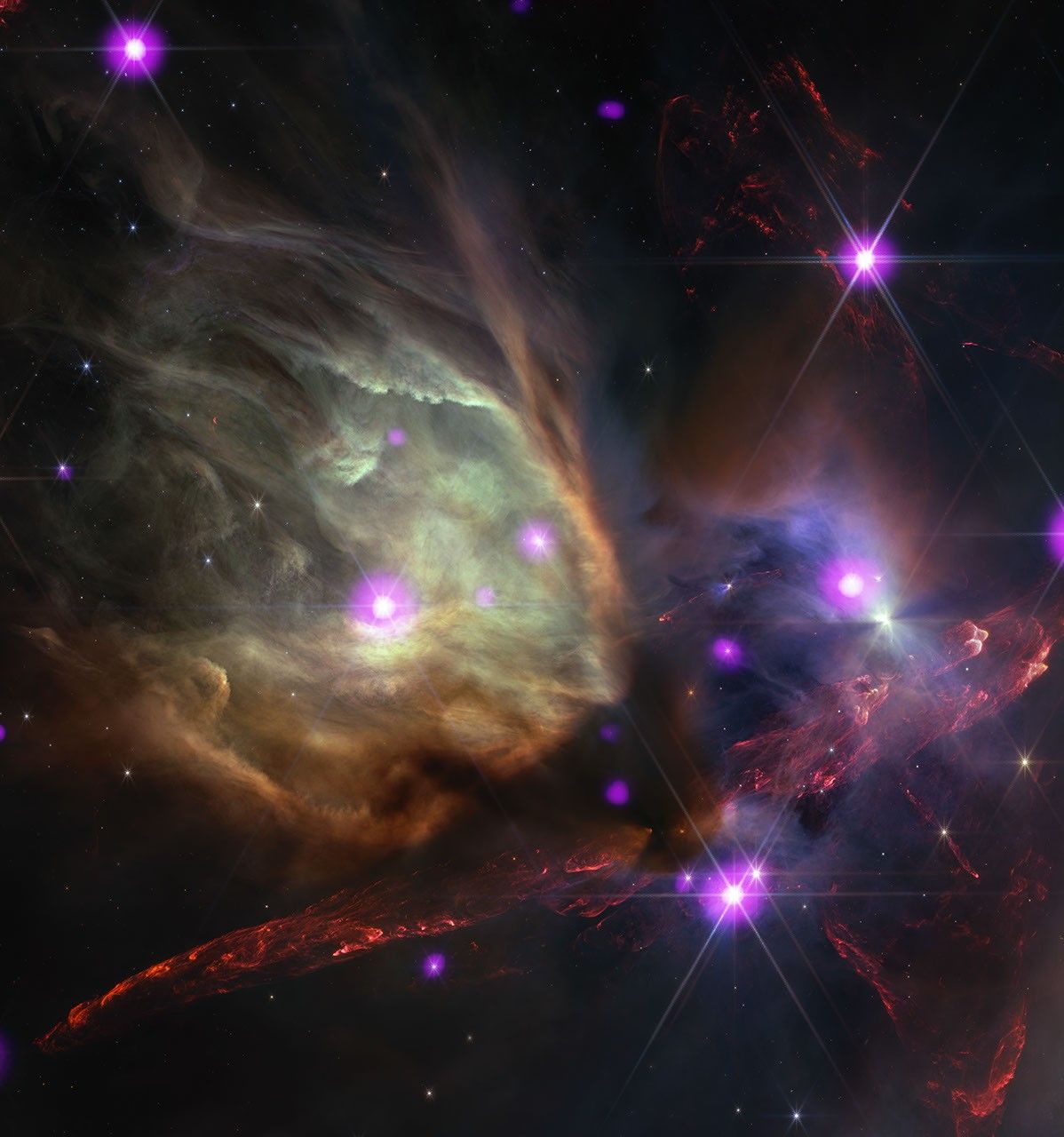
The fourth sonification focuses on Rho Ophiuchi, a star-forming cloud complex packed with gas and stars spanning a range of sizes and ages. Chandra identifies very young stars that unleash violent flares and emit X-rays, while Webb’s infrared observations trace the surrounding dust-and-gas structure. In the sound design, the X-rays are expressed as high, glass-like tones, with additional sustained elements marking bright extended sources. Infrared cloud structures become notes at different pitches, and stars are portrayed with metallic plucks. A noticeable pause appears mid-piece, corresponding to dense, dark dust that emits little light.
NASA’s Marshall Space Flight Center in Huntsville, Alabama, manages the Chandra program. The Smithsonian Astrophysical Observatory’s Chandra X-ray Center leads the mission’s science operations from Cambridge, Massachusetts, and handles flight operations from Burlington, Massachusetts. The sonification effort is led by the Chandra X-ray Center.
Why it matters
Sonification offers a new way to explore complex astronomical datasets, potentially widening access for people who are blind or have low vision and providing fresh tools for pattern recognition. For scientists and the public alike, these audio translations also underscore how multiwavelength observatories—X-ray, optical, and infrared—work together to reveal the physics of star birth. What comes next will likely be more targets and refinements in how sound mappings convey scientifically meaningful differences in brightness, structure, and energy.