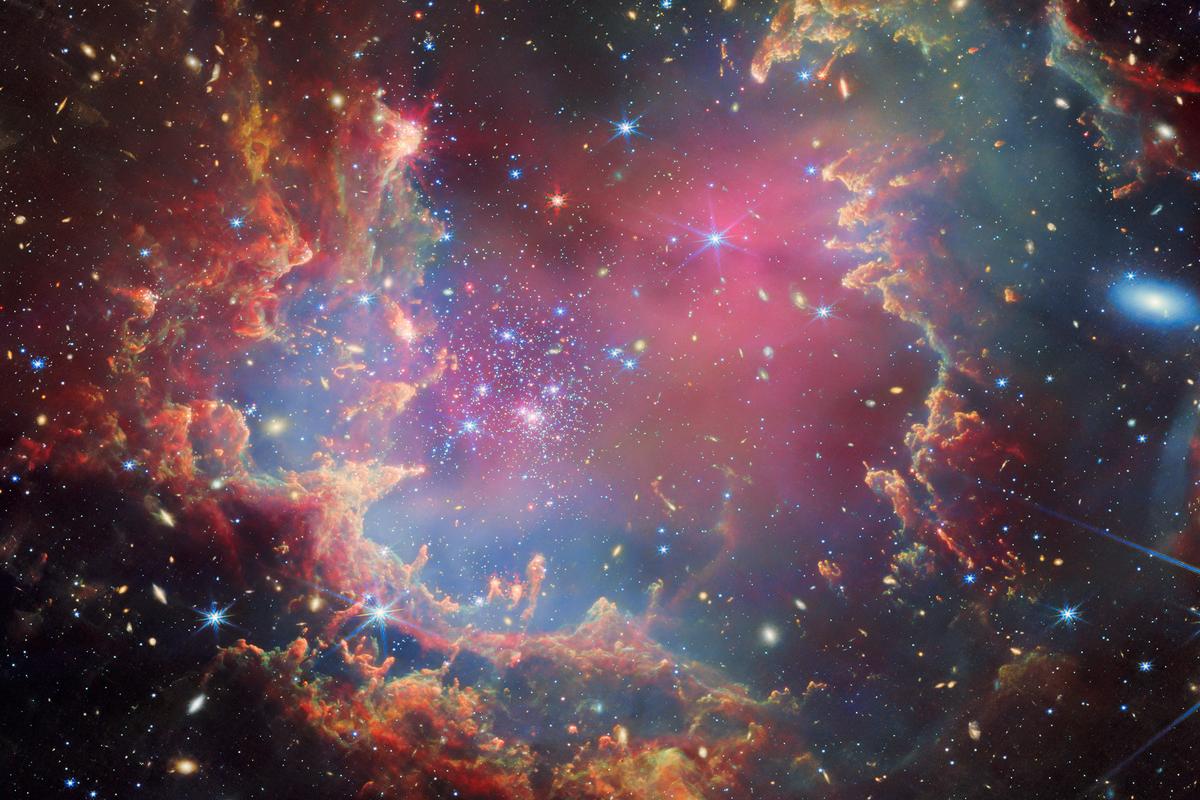
In the story of cosmic history, one of the most important supporting characters is dust.
In the story of cosmic history, one of the most important supporting characters is dust. As clouds of interstellar gas cooled and condensed in the early Universe, dust grains absorbed and re-emitted radiation, eventually forming stars. Later, dust provided the raw material from which planets could form and grow. Dust grains may even have been the surfaces on which the first complex organic molecules formed. Yet, if you ask most cosmologists, they’ll tell you that dust is a sheer nuisance. In astrophysics, ‘nuisance’ is a quasi-technical term. Astrophysicists call any phenomenon that gets in the way of the thing they actually want to study a ‘nuisance’. Dust grains emit polarised light that can mimic subtle signals from the afterglow of the Big Bang (the cosmic microwave background) that cosmologists have spent decades and billions of dollars trying to detect. A cosmologist studies dust not to uncover its role in shaping the cosmos, but to subtract it – the term ‘sweeping under the rug’ couldn’t bemore apt. This dichotomy between ‘signal’ and ‘nuisance’ is found across many sub-fields in astronomy. Astronomers who study a phenomenon called ‘weak lensing’ use the subtle distortions of light caused by gravity to map invisible dark matter. For them, the ordinary matter that makes up everything we can see is a nuisance. Pulsar timing astronomers use rapidly spinning neutron stars called pulsars as extraordinarily precise clocks to detect the passage of gravitational waves through the galaxy. For them, the nuisance is ionised interstellar gas, which scatters and disperses the light from pulsars. Yet one astronomer’s nuisance is another’s treasure. Just as a laser beam reveals the intricate swirls of smoke in a dark room, pulsars illuminate the fine structure of the interstellar medium, the unlit space between galaxies. If you want to study the interstellar medium and its role in shaping our galaxy’s evolution, the light-scattering gas is an invaluable resource. The ESO-operated Very Large Telescope based at the Cerro Paranal site in the Atacama Desert of northern Chile. Photo by Miguel Claro/ESO Whether a phenomenon is a nuisance or something worth studying in its own right clearly depends on the investigator and their interests. But in a discipline as collaborative as astronomy, shared priorities must be developed. Gone are the days of Galileo and other lone scientists in the tower, pointing telescopes built by their own hands wherever curiosity dictates. Modern astronomy is a highly specialised discipline, marked by large collaborations. The tools of the trade – telescopes – are designed, built and maintained by hundreds of scientists and engineers across many institutions. But you can’t just stroll in and ask to use one. Investigators must fiercely compete for time with these advanced instruments. To guide how that access is allocated, the research community has developed a set of shared priorities. Some questions are elevated to the status of ‘Big Questions’ to which all others inevitably become subordinate. But are these Big Questions necessarily the right ones? Who decides where to draw the boundaries between signal and nuisance, or big and small? Fields of enquiry are defined by the questions they seek to answer. If we want to understand modern astrophysics, it is not enough to understand the scientific and mathematical content of its theories. We also need to understand the human forces that shape the questions themselves and cause some questions to be prioritised, and other questions to be viewed as irrelevant or merely means to those bigger ends. To identify the Big Questions that dominate the field, you need look no further than the flagship projects set to shape the discipline for decades. These include the Square Kilometre Array Observatory, the James Webb Space Telescope, the Vera C Rubin Observatory, the Nancy Grace Roman Space Telescope, and the Laser Interferometer Space Antenna. Each of these projects will cost several billion dollars over its lifetime. When we look at the stated science goals of these projects, consistent themes emerge. For example, the Square Kilometre Array Observatory at Jodrell Bank in the UK is a massive radio array that will define the field of radio astronomy for the foreseeable future. Its website contains a list of science goals. On that list, the early Universe, gravitational waves, dark energy and cosmology are all listed before stars, the interstellar medium and the origins of life. The official page for the much-coveredJames Webb Space Telescopesimilarly lists the early Universe – the ‘cosmic dawn’ – before more prosaic matters such as stars, planets and dust. Such priorities are often reflected in media coverage of these projects, which further shape perceptions among young researchers, politicians, funders and the general public about which questions matter most. The boundaries between the big and small questions often fall along the lines between ‘fundamental’ physics and ‘messy’ astrophysics. This is reflected in the language of many cosmologists who study dark matter, for example. For decades, the study ofdark matterhas focused on the largest physical scales – giant clusters of galaxies – where the gravitational effects of dark matter can be directly inferred. On small scales, within and around galaxies, dark matter’s effects become entangled with the complex dynamics of interstellar gas. To use the terminology that is widely adopted by cosmologists: thephysicsof dark matter on small scales is obscured by theastrophysicsof interstellar gas. Implicit in this framing is the idea that astrophysics is messy and complicated, and, ultimately, subordinate to clean, fundamental physics. When the fundamental is elevated above everything else, it’s easy to see why an impressionable young mind might be captivated Young researchers encounter this supposed predominance of physics over astrophysics long before they set foot in a laboratory. Growing up, I loved space, as many children do. My parents bought me an amateur telescope, and I spent many nights in the backyard becoming familiar with the winter night sky (the summer sky was more elusive because it appeared after my bedtime). But, by the time I entered graduate school, I had largely forgotten about my early childhood passion for the heavens. Like many of my peers at the time, I wanted to study theoretical particle physics. Particle physics enjoys a kind of mythical status in popular culture as the apex of the natural sciences. After all, the purported goal ofparticle physicistsis not just a theory of particles, but a theory ofeverything.Of course, such a theory would be a theory of ‘everything’ only in the limited sense that it would describe how all matter behaves on a fundamental (microscopic) level – never mind the fact that such a description would be functionally useless to describe even basic chemical reactions due to the mathematical complexity. But when the fundamental is elevated above everything else, it’s easy to see why an impressionable young mind might be captivated. In the end, I did not study theoretical particle physics as a graduate student. The competition was intense – almost all of my classmates were vying for the few positions available. So, I rekindled my love of astronomy and decided to study astrophysics. But the truth is, at the time, I viewed astrophysics as something of a consolation prize. This hierarchy, which ranks fundamental physics above all else, is a historical contingency. Over the course of the second half of the20th century,astronomy transformed from a distinct discipline into a sub-discipline of physics. Historically, astronomy was a science of mapping, cataloguing and observation. But the successes of mid-century nuclear physics, the rise of physical cosmology and the discovery of dark matter and dark energy began a process that fused the two disciplines. The discovery ofgeneral relativity, which describes gravity as