My friend Greg Clark takes aim at me in the foreword of his new bookTo Have & Have Not: A recent Substack essay by Brad DeLong, titled,Big Trouble in Little Human…
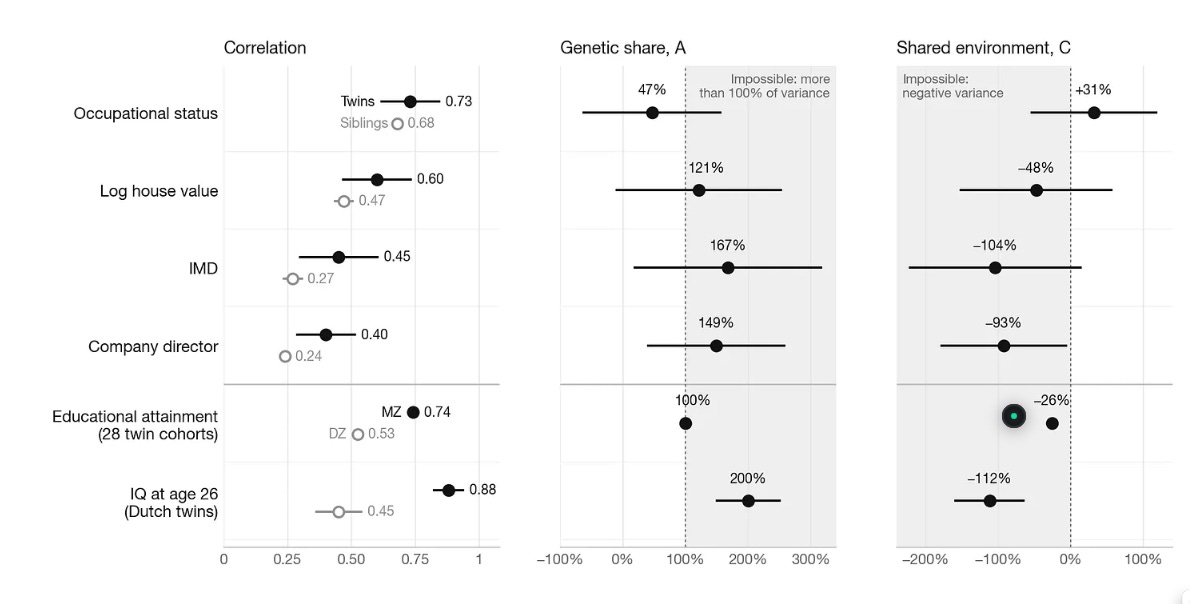
My friend Greg Clark takes aim at me in the foreword of his new bookTo Have & Have Not: A recent Substack essay by Brad DeLong, titled,Big Trouble in Little Human Genetic Difference-Worshipper Land,illustrates nicely the hostility and contempt felt by the academy for anyone who would suggest an important role for direct genetic determination of social outcomes: “[A]ttempts to carve out a large, causal, manipulable “main effect” of genes on complex social outcomes keep reducing, on closer inspection, to approximately zero” (DeLong, 2026). Thus an article in theProceedings of the National Academy of Sciences, which contains the essence of the argument of the book, has been attacked by such prominent behavioral geneticists as Marcus Feldman and Kevin Lala as “scientific racism” (Lala and Feldman, 2024), and “racist pseudoscience” (Lala,Brown, Twyman and Feldman, 2025). Similarly a presentation of the core arguments of the book atGlasgow Universityin 2021 was indefinitely “postponed” by the Dean in response to a letter signed by 110 Glasgow University Faculty condemning the work as pseudo-science and eugenics. A majority of the reviewers at Princeton fell in solidly with the received wisdom on the unimportance of genetics, without seriously engaging with the copious empirical evidence presented that cultural and social causation could not explain the patterns of inheritance observed in England. Chicago University Press considered the manuscript, but ultimately reported that they could not find reviewers willing to review it!… But attempts to carve out a large, causal, manipulable “main effect” of genes on complex social outcomes do keep reducing, on closer inspection, to approximately zero! I understand that Greg does not like that conclusion. But it is one I have reached, and I have heard Greg (and many others) make their best pitch, and fail to throw anything I can regard as possibly over the plate! More important, it is what Sasha Gusev thinks. In his estimation, Greg’s genes-only model of intergenerational human status immobility “for three of the four traits… produces an estimate of [genetic] heritability that is greater than 100% and a negative estimate of the shared environment variance…. These estimates are clearly absurd…” https://theinfinitesimal.substack.com/p/vibe-heritabilityhttps://theinfinitesimal.substack.com The economic historian Gregory Clark has written a book on status persistence, which was the focus of arecent online symposium. Clark has assembled a massive dataset of multigenerational status measurements in England. The project has a particularly British whimsy to it, with much of the data coming from the Guild of One-Name Studies, a largely online society of genealogical hobbyists. After analyzing lineages from >400,000 English people, Clark draws a startling conclusion that “genetics underpins social status in England from 1600–2026” — in other words, people are in the upper class and stay in the upper class because of their genes. Clark goes on to argue that “the vast resources poured into increasing rates of social mobility in modern society through public education, income supports, and social services have achieved nothing in terms of increased mobility”. This is a bold claim, so before going much further, it is worth taking a look at Clark’s data. Here are the parent-child correlations in social status traits, reproduced from an analysis of the data byBenning et al.: Clearly the conventional estimate of social mobility — how similar in status are you to your parents — changed substantially. So how does Clark come to the opposite conclusion? Clark argues that the decrease in familial correlation is a mirage, driven by increases in measurement error. Instead, he proposes to quantify therate of decayin the familial correlation across increasingly distant relatives, from which he infers large and unchanging latent parameters. These parameters, he argues, imply that status is highly heritable and highly genetically correlated between spouses, thus persisting across generations entirely through genetic pathways. Iandothershave previously criticized Clark’s paper for conflating status persistence (through a variety of mechanisms), which his data can observe, with genetic causality that his data cannot identify. I alsonotedthat Clark’s actual parameter estimates are nonsensical. These issues are echoed in some of the symposium articles in novel ways, which I will highlight here. I’ll also comment on the broader discussion in and around the symposium, which I think serves as a microcosm of the nature-nurture discourse. Nikolai Eftedal (himself the author of a fascinatingrecent studyof intergenerational persistence) contributed ashort article, cheekily (by my reading) presented as an effort to “provide defenses against two criticisms [Clark] could face”. Eftedal points out that Clark’s model relies on a highly heritable, latent status phenotype that has extreme properties (“arguably so extreme as to be implausible”) and that his model makes impossible predictions about twins. Specifically, Clark’s model hinges on a very high level of genetic assortative mating, which would necessarily imply that monozygotic and dizygotic twins should exhibit only modestly different levels of phenotypic correlation. In Eftedal’s words: “for most relevant traits and outcomes, this is wrong”. It may seem counterintuitive that a highly heritable phenotype would produce similar correlations between MZ and DZ twins, but it is a direct consequence of the genetic similarity induced by assortative mating. When parents are genetically correlated, DZ twins become more genetically correlated too while MZ twins remain identical, thus bringing the two classes of phenotypic correlations closer together. Classical twin studies, which assume random mating, will in turn estimate a large contribution of the shared environment and a low heritability for status traits (they generally do not). Here’s what that looks like for a highly heritable trait under random mating versus Clark’s spousal genetic correlation (m=0.57): Under Clark’s model, a trait with heritability of 90% would actually appear statistically to have a heritability of 39% in twins. Eftedal attempts to throw Clark a lifeline by suggesting that large non-additive/interaction effects — which make MZ twins more similar but dissipate rapidly across generations — could reconcile the estimates from twin and family data. In hisreply, Clark re-analyzes his dataset to identify sets of twins and siblings and estimate their phenotypic correlations. Among these twins and siblings, he concludes that “there is little sign … of significant non-additive effects”. In other words, he tosses the lifeline right back. It seems that Clark may have missed the point of the exercise. Under assortative mating, it is not sufficient to eyeball the twin similarities, you need to estimate heritabilityafteraccounting for assortment. With a bit of algebra (seeAppendix), we can derive a simple relationship between the correlations in Clark’s twins/siblings and underlying heritabilities while also accounting for the genetic correlation between mates estimated by Clark. Having done so, we can walk down the table of twin correlations from Clark and re-estimate the heritability his model would produce: For three of the four traits, Clark’s parameter produces an estimate of heritability that is greater than 100% and a negative estimate of the shared environment variance. These are observed correlations, which Clark argues are swamped by measurement error, so the out of bounds heritability estimates should actually be even more out of bounds. To be fair, the twin estimates from Clark’s data come with a lot of uncertainty, but we can also apply the same calculation to high quality modern twin studies (cited by Clark in other parts of the text). For educational attainment (Silventoinen et al.) as a representative status trait, the same late