The task of the economist will then be to figure out what out of the nearly infinite pile of words they have immediate access to is worth reading and thinking about, and…
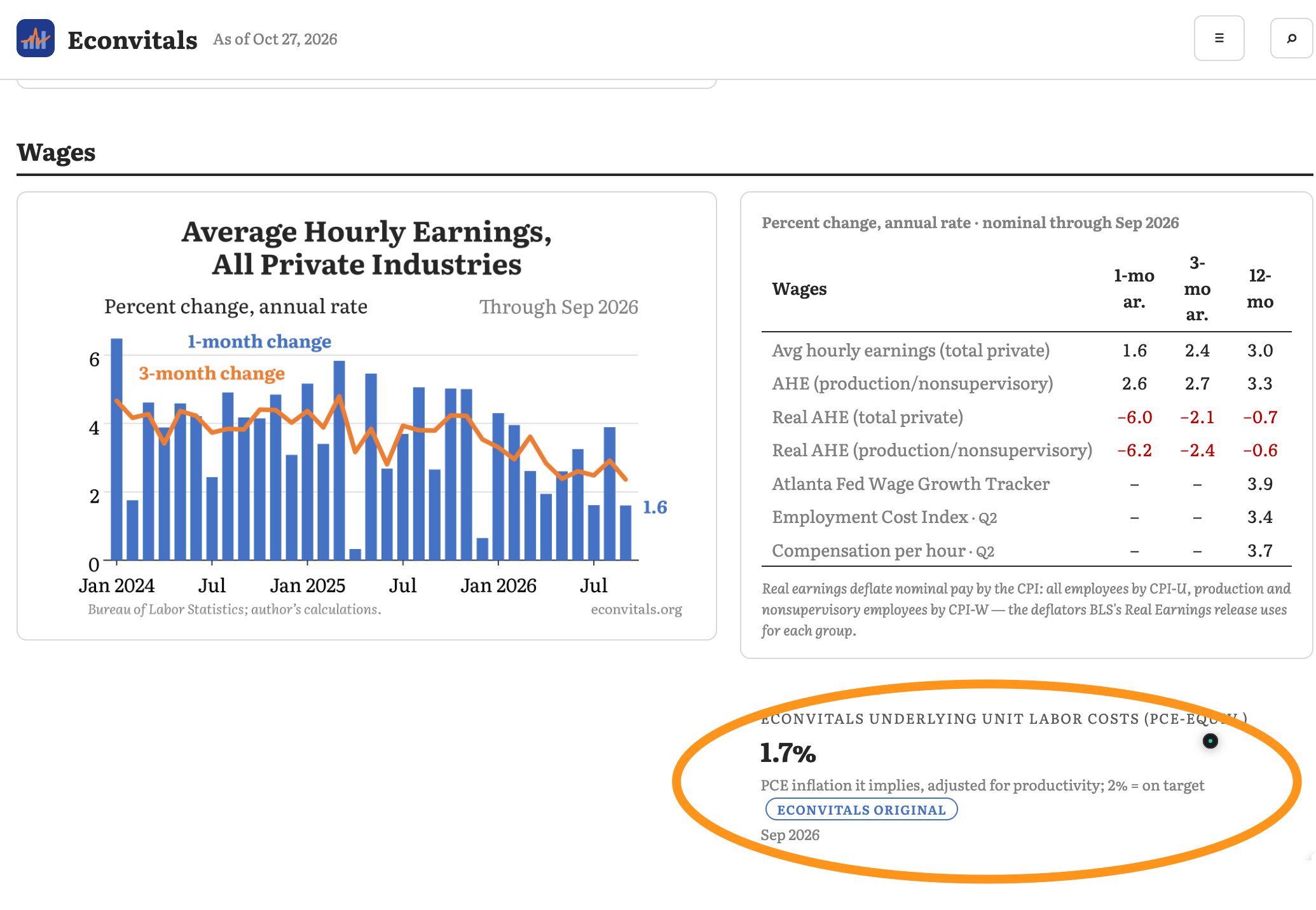
The task of the economist will then be to figure out what out of the nearly infinite pile of words they have immediate access to is worth reading and thinking about, and how to tag the conclusions from one’s own reasoning so that they then get noticed by the people who could benefit from them. One marker of the way things are going: Two days ago there was an email from Jason Furman: Jason Furman: Announcing Econvitals ‘Ilaunched Econvitals, a new macroeconomics system with awebsite…email[s]… aFedspeak trackerand afiscal simulator; and automated posts onX,Bluesky,ThreadsandInstagram…. 500,000 lines of code… which I vibe coded… originally built… to inform myself… written by AI models without my direct edits, though I design and oversee the approach they take…. Occasional posts… will come frombriefings@econvitals.org… Indeed: https://econvitals.org/ and https://jasonfurmanecon.substack.com/: anthropic/claude:What Would It Have Taken to Build Econvitals Before AI? https://econvitals.org/about/before-ai/: ‘The code… [is] a data layer that pulls about 110 sources… a library of about 790 charts, with a system that redraws them… [LLMs writing] daily, weekly and monthly [email] briefings; the site itself, including the Lab and the tools; Fedspeak, which tracks and scores what Fed officials say; and the GDP and PCE estimates and fiscal projections. About a fifth of the code was automated tests…. [A human software] developer produces only about 10 to 50 finished lines [of code] a day. At 25 a day, 484,000 lines is about 84 person-years [of work]… with a plausible range of 50 to 150… How useful is this likely to be? Is this likely to absorb my attention in a good way by containing data transformations and averages that I would spend time calculating myself from FRED http://fred.stlouisfed.org/? Jason has limited ambitions for EconVitals. He does not think it will replace him, at least not yet: Jason Furman: The Fed Is Off Its Own Reaction Function. It Should Tell Us Why https://econvitals.org/posts/2026-10-26-fed-reaction-function/: ‘Welcome to the first occasional post from me, Jason, a human. Almost everything on Econvitals is an automated briefing, but these posts will all be written by me, as are the chart(s) of the day and the opening paragraph of the Morning Note. I’m not sure how often I’ll write these posts (thus the nonspecific “occasional”). My plan is to make them always data oriented but divided between the descriptive and the explanatory with a touch of opinion…. These posts are all copyedited and fact-checked by AI, and all the data analysis is done interactively with AI. Oh, and I suck at titles, so the AI may do those as well… And how much work will it be for Jason and company to keep this thing from drifting into irrelevance or error? Jason may say that hallucination is a solved problem as long as you gate numerical claims through deterministic scripts and as long as you have three different agents watching one another. But he is, I think, wrong.These things do drift without careful attention. What Jason is doing here is very praiseworthy. And it is a marker of the transformations in how we are going to access information that are coming for us with the arrival of the attention info-bio tech mode of production. From my point, the most interesting thing here is that Jason really does believe that the whole system will be a net time and accuracy saver as he produces things like this: Jason Furman: The Fed Is Off Its Own Reaction Function. It Should Tell Us Why https://econvitals.org/posts/2026-10-26-fed-reaction-function/: ‘The Federal Reserve’s Federal Open Market Committee (FOMC)…Summary of Economic Projections(SEP))… have… been a very good guide… [When] it ends up raising rates by less than the dots said it would… in most of those cases that was… [a] response to inflation coming in lower… or unemployment higher…. [But in] the last few years… the Fed has deviated…. Is the Fed badly off course, or is there something different, and more obviously transitory, about this inflation? I actually think the Fed has a good answer to why it is so far off its reaction function—but it should be more explicit about giving us that answer…. [Last] December the Fed expectedcore PCE inflationof 2.5 percent in 2026, and its September projection is 3.4 percent. Under a Taylor rule reaction function that revision alone would justify a 1.35 percentage point hike in the federal funds rate…. That is way more than [we see].… That shortfall of 1.15 percentage points is unusually large…. [Perhaps] the Fed is wiser than the formula. It understands, for example, that some of the inflation is the transitory result of tariffs and the Iran conflict…. I confess, I began this exercise thinking the Fed was way off base—but after quantifying it I end up more sympathetic to its approach…. I like a Taylor-style reaction function even better where the Fed articulates a path and explains that it will deviate from it based on how inflation and unemployment deviate from its forecast…. The people on the FOMC—and the staff who support them—know a lot more than the formula knows, and they should use that information in setting policy. But they should also clearly convey it… And things like this https://econvitals.org/tools/fedspeak/: which is potentially quite useful, but would have been much more work than it has value before the days of the LLM. Ok. What do I have to say about all this? I have two things: First: Measure inflation with the Dallas Fed’s trimmed-mean or the Cleveland Fed’s median PCE, and Jason says that the Fed “sits almost exactly on its reaction function.” Between July 2025 and July 2026, core PCE inflation rose from 2.8 to 3.0 percent. Over the same twelve months the trimmed mean fell from 2.8 to 2.3 percent, and the median fell from 3.5 to 2.7. So the headline question, “Is the Fed off course?”, can be rephrased as: “Are outlier price changes information or noise?” Suppose the big moves in a handful of categories are noise. Then the FOMC is doing what it has done since 2012, and doing it well. Suppose instead they are information, the leading edge of a broader repricing. Then the Fed is about 1.15 percentage points too loose, which puts it among the most dovish readings in its own record. I think honest participants should then come out of it uncomfortable rather than confident. Over 2012-2026 the record does not clearly prefer one way of measuring underlying inflation. The choice is a judgment call, and it is the judgment the FOMC is implicitly making right now. The second thing I would highlight is Table A3. Fit the Fed’s moves to revisions in its own forecasts, and the weights come out at 1.57 on inflation and 0.99 on current unemployment. That is almost exactly John Taylor’s original 1.5 and 1. Fit the same moves to realized data instead, and the weight on trailing core inflation is negative: -0.85 over 2012-2026 and -0.23 since 1990. The FOMC has been reacting to its own forecast of inflation, not to the inflation of the past twelve months. I approve of Jason’s wish that the Fed explain its deviations from its own reaction function, and Waller’s October speech made a good start. Waller lays out three options: The Fed can say nothing, which risks markets pricing in anywhere from zero to five hikes. The Fed can give strong forward guidance, which locks in a path the data may not justify. The Fed can take the “signaling option” in between: signal roughly how far rates are likely to go over some interval, and leave the pace dependent on the data. He sees the SEP playing that role. In September, sixteen of eighteen participants penciled in at least one more hike this year. But Waller’s signal tells us where the Fed is heading. Jason is asking why. The natural next step would have two parts. First, publish the rule-implied rate at every meeting, not just twice a year in the Monetary Policy Report. Second, state how much of the inflation surprise the comm