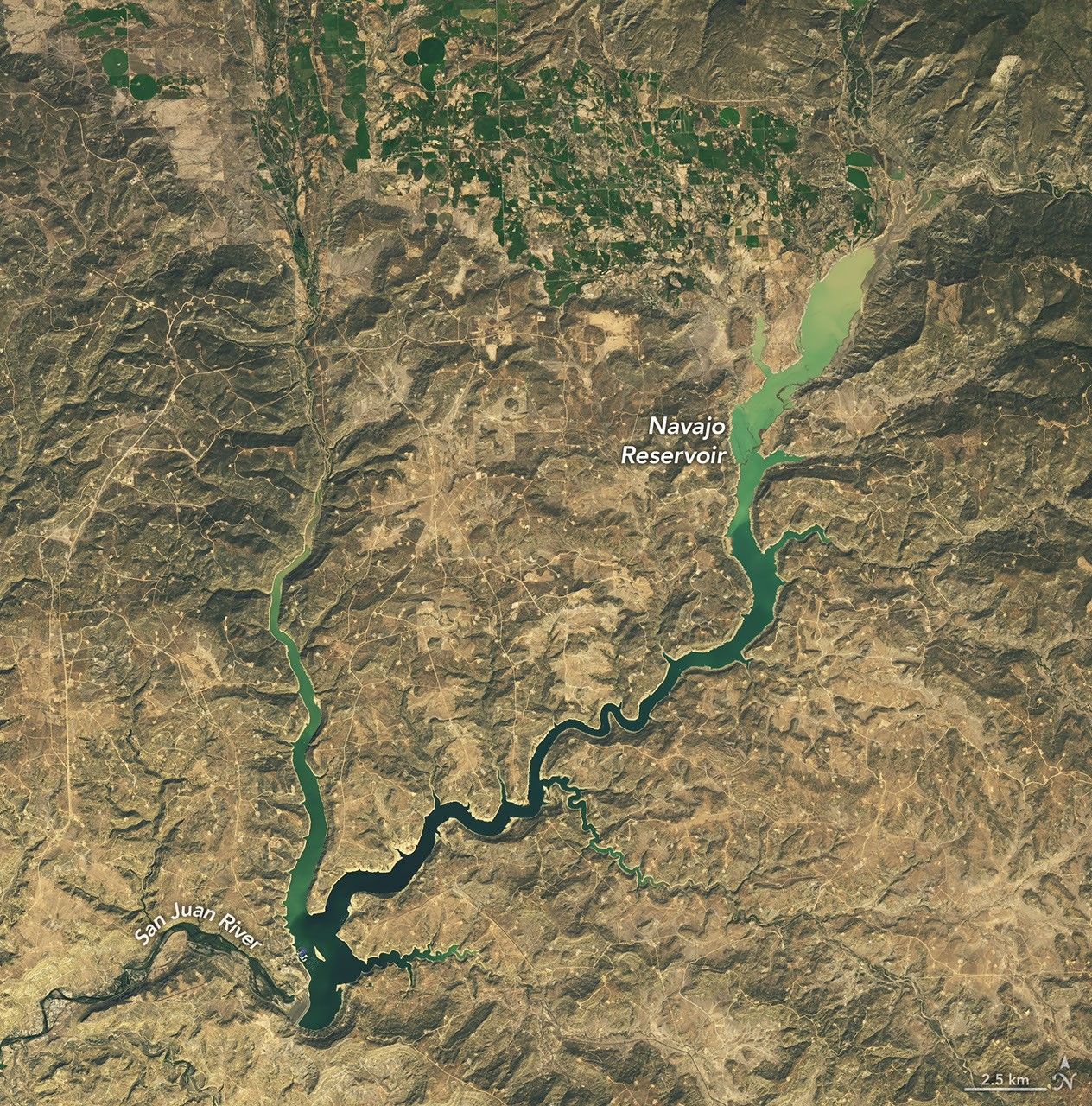
Rounds of heavy rain in the U.S. Southwest flooded rivers and rapidly raised New Mexico’s second-largest reservoir.
Rounds of heavy rain in the U.S. Southwest flooded rivers and rapidly raised New Mexico’s second-largest reservoir. Back-to-back extreme rain events inundated the Four Corners region of the U.S. Southwest in late October and early November 2026. The stormsalleviated short-term droughtconditions in the Southwest but caused river levels to spike to record or near-record levels in places, triggering damaging floods. One effect of the heavy rains detected by satellites was the rapid rise of water levels in Navajo Reservoir. The change is visible in the images above, acquired on September 20 (left) and November 7 (right) with theOLI(Operational Land Imager) onLandsat 9. In that time, the lake in northern New Mexico and southern Colorado rose by nearly 60 feet (18 meters), according todatafrom the U.S. Army Corps of Engineers. (Note that the Bureau of Reclamationdecreased releasesfrom Navajo Dam on September 16 and 17.) On November 7, the reservoir stood at its highest level since August 2019 and at108 percentof the average capacity for that date. That contrasts with September 20, when it held just 60 percent of its average capacity. Due tosnow droughtacross the West in winter 2025-26, the lake saw relatively little growth in the spring, when snowmelt often raises water levels. The San Juan, Piedra, and other rivers swelled withrunoffamid the wet weather. Pagosa Springs, Colorado, a town along the San Juan River about 40 miles (64 kilometers) northeast of the lake, was especially hard-hit by flooding. In the first round of rain,5.05 inches(12.8 centimeters) fell in the town, and on October 23 the river reachedmajor flood stage. After more rain, the river spiked again on November 1, this time nearly to the record level set in 1911 during adevastating flood. Officials issued evacuation orders, and responders rescued dozens of people, according tonews reports, while water inundated streets and damaged property. Heavy rainandfloodinghave been widespread across southwest Colorado, southeast Utah, northern Arizona, and northwest New Mexico in recent weeks. From early September through early November, precipitation totals were 2 to 4 times the average throughout the Four Corners region—an area beset bylong-term droughtthat was exacerbated by snow drought and high temperatures in 2026. Though the downpours posed hazards to communities along many rivers, they did provide drought relief throughout the region. WeeklyU.S. Drought Monitormaps, derived from a suite of satellite data products and ground-based observations, haveindicated improvementsto drought conditions due to the fall storms. The group’sNovember 3 summarynoted that “short-term drought has ended for the Southwest and Great Basin,” although long-term drought persists in places. Wet weather in the Southwest isoften associatedwithEl Niñoevents, when the segment of the jet stream flowing eastward near the equatorial Pacific tends to strengthen. Experts noted that thelow-pressure systemdelivering the heavy rainfall in autumn 2026 was at a low latitude for the time of year and drew energy from unusually high ocean temperatures. El Niño patterns—like the onecurrently underway—can increase the likelihood of moisture-laden storms being steered across the Southwest interior. NASA Earth Observatory images by Michala Garrison, using Landsat data from theU.S. Geological Survey. Story by Lindsey Doermann. Stay up-to-date with the latest content from NASA as we explore the universe and discover more about our home planet. Snow drought and unusually warm temperatures in the Colorado Basin in 2026 helped drive down reservoir water storage in the… Rainfall deficits and high temperatures have created unusually dry conditions and have spurred water shortages on much of the tropical… Drought in the Rio Grande basin contributed to New Mexico’s largest reservoir dwindling to its lowest level in decades. Subscribe to the Earth Observatory and get the Earth in your inbox. NASA's Earth Observatory brings you the Earth, every day, with in-depth stories and stunning imagery. Open access to NASA’s archive of Earth science data