1. Premise: how to frame the problem correctly
The question does not have a simple either/or answer: neither the An Lushan Rebellion nor Europe’s scientific advantage, on their own, explains the Great Divergence, and the two hypotheses operate on different time scales. The first is an eighth-century event; the second is a process that matures between the sixteenth and nineteenth centuries. A thousand years lie between the two, during which China reaches its economic and technological peak (the Song dynasty, 960–1279).
The term “Great Divergence” was made famous by Kenneth Pomeranz (2000), but the problem is older: it is the “Needham question” (why the scientific and industrial revolution did not occur in China, despite its technological primacy up to the fifteenth century) and, in a different form, Max Weber’s question about capitalism and Confucianism. This is therefore a problem with at least three layers: when the divergence begins (dating), what it consists of (income, technology, institutions, knowledge), and why it happens (remote and proximate causes).
Each hypothesis should be assessed against three criteria: chronological coherence (the cause must precede the effect and must not be contradicted by what happens in between), the ability to explain not only why Europe takes off but also why China does not, and testability against the quantitative data available today (historical series for GDP per capita, real wages, urbanization, iron output, printing). By these criteria, the two proposed hypotheses fare very differently: the first is chronologically untenable as a direct cause; the second is necessary but not sufficient, and needs to be reformulated.
2. When the divergence begins: the data
The divergence in per capita income is visible in the data from the sixteenth century and becomes a chasm only after 1800; no available series shows a gap in the eighth century. Maddison’s classic estimates attribute to China a per capita income that is essentially flat for eight centuries, while Western Europe grows slowly from 1500 and then explodes with industrialization.
More recent revisions by Broadberry, Guan, and Li (2018) correct Maddison on a crucial point: China was not flat, but in decline. Chinese GDP per capita peaks under the Northern Song (around 1020–1120, about 1,000 1990 dollars), remains high at the beginning of the Ming, and then steadily falls to about 600 dollars by 1840. England, according to the same reconstructions, overtakes China already between 1400 and 1500, not in 1800: the European “little divergence” (the Netherlands and England versus Italy and Spain) precedes and paves the way for the big one. Data on real wages from Allen and co-authors confirm the picture: in the eighteenth century, a worker in London or Amsterdam earned, in terms of a subsistence consumption basket, three or four times as much as a worker in Beijing or Canton, and about twice as much as in Milan or Florence.
The second chart shows why the divergence was perceived late: in terms of total GDP, China remained the world’s leading economy until 1820, thanks to a population that rose from about 150 million (1700) to more than 380 million (1820). This is demographic growth without growth in per capita income, the so-called “Smithian growth,” which runs up against diminishing returns to land: the central theme of Elvin’s hypothesis (section 5). Two methodological conclusions follow from these data. First, An Lushan cannot be the cause of a divergence that begins seven hundred years later, in a country that in the meantime experienced its peak. Second, the Industrial Revolution (1760-1830) is the accelerator, not the origin: northwestern Europe was already richer per capita than China when Newton published the Principia (1687).
3. Hypothesis 1: the An Lushan Rebellion (755-763)
The An Lushan Rebellion was a first-order catastrophe, but as a cause of the Great Divergence it fails the chronological test: post-Tang China did not enter decline, but rather the most dynamic period of its premodern history. The hypothesis must therefore be rejected in its strong form and, at most, reformulated as a remote cause of an institutional transformation with ambiguous effects.

The facts. In December 755, An Lushan, a general of Sogdian-Turkic origin commanding the northeastern garrisons, rebelled against Emperor Xuanzong. The war lasted eight years, cost the capital Chang’an (the largest city in the world, perhaps one million inhabitants), and left the Tang state a shell: the censuses fell from about 53 million registered taxpayers (754) to 17 million (764). This latter figure should be read with caution: much of the decline reflects a loss of administrative control, not mortality (historical estimates of deaths vary enormously, and the most cautious speak of a few million). But the institutional transformation was real.
What really changed. The rebellion conventionally marks the beginning of the “Tang-Song transition” described by Naitō Konan and later by Denis Twitchett and Mark Elvin:
| Before the rebellion (early Tang) | After the rebellion (late Tang and Song) |
|---|---|
| “Equal-field” system (juntian): land allocated by the state | Private landownership, land market, tenancy |
| In-kind tax and corvée per household | “Two-tax” reform (780): monetary taxation on property |
| Conscript-peasant army (fubing) | Professional armies and regional military governors (jiedushi) |
| Hereditary aristocracy of the great northwestern families | Rise of an examination-selected gentry; imperial examinations as the main route to power |
| Economy centered on the north (Yellow River basin) and the Silk Road | Shift of the center of gravity to the south (Yangzi), maritime trade |
| Religious cosmopolitanism (Buddhism, Manichaeism, Nestorianism) | Persecution of Buddhism (845) and Confucian revival |
These transformations produced the Song “medieval economic revolution” (Elvin, 1973; Shiba Yoshinobu): paper money (1024), movable-type printing (Bi Sheng, ~1040), the compass for navigation, gunpowder in military use, iron production in Kaifeng estimated by Hartwell at over 100,000 tons a year in 1078 (England would reach comparable figures only in 1780), fast-ripening Champa rice, million-inhabitant cities (Kaifeng, Hangzhou). If divergence is measured in income, technology, and urbanization, the century and a half after the rebellion is the opposite of a negative divergence.

Why the hypothesis is still interesting. Three indirect arguments deserve discussion, because they are the ones a supporter of the hypothesis might use.
- Militarization and the lesson of the jiedushi. From the post-755 chaos, the Song drew the conviction that regional military power was the supreme danger. Hence the primacy of the civil over the military, centralization, and distrust of any autonomous local power. This choice made the Chinese state stable but militarily fragile (defeats against the Liao, Jin, and finally the Mongols in 1279) and, above all, removed that competitive fragmentation that many consider the key to European dynamism (section 5).
- The Confucian revival. The anti-cosmopolitan reaction (the anti-Buddhist edict of 845, Han Yu) and the subsequent Neo-Confucian systematization by Zhu Xi (1130–1200) created the orthodoxy that from 1313 became the canon of the imperial examinations. One can argue that an elite selected for centuries on the moral exegesis of the classics was less inclined toward experimental investigation of nature. But this is an effect six hundred years removed, mediated by Yuan and Ming choices that owe nothing to An Lushan.
- The end of the Silk Road as the main axis. The shift toward the south and the sea was in fact an economic advantage. It was not the rebellion, but Ming choices (the end of Zheng He’s voyages in 1433, the haijin maritime prohibitions) that closed China off from the sea.
Verdict. The rebellion is an episode of “path dependence” in Chinese political history, not an economic cause of divergence. Confusing it with the cause means committing the post hoc fallacy: China after 763 did not regress, but changed form, and the form it took was for three centuries the most advanced on the planet. If one is looking for a military-type traumatic event with lasting economic consequences, the more serious candidates are the Mongol conquest (1279), which destroyed the Song urban and fiscal network, and the Ming–Qing transition (1644), not 755.
4. Hypothesis 2: Europe’s scientific advantage
Europe’s scientific advantage is a real but late cause and, in the form proposed in the question, partly reversed: chemistry and thermodynamics are consequences of the Industrial Revolution, not its premises. What matters is not the stock of knowledge in itself, but the type of knowledge (mathematized, experimental, public) and the institutions that produced and disseminated it.
Chinese primacy up to the 15th century. The “Needham question” arises precisely from the fact that China was for centuries more advanced. The table shows the time gap between Chinese invention and European adoption or rediscovery.
| Invention or discovery | China (date) | Europe (date) | Gap |
|---|---|---|---|
| Cast iron (molten iron) | 5th c. BCE | 14th c. | ~1,800 years |
| Paper | 105 CE (Cai Lun) | 12th c. (Spain, Italy) | ~1,000 years |
| Horse collar (draft collar) | 5th c. | 10th c. | ~500 years |
| Woodblock printing | 7th c. (Diamond Sutra, 868) | 15th c. | ~700 years |
| Gunpowder | 9th c. | 13th c. (R. Bacon, 1267) | ~400 years |
| Magnetic compass for navigation | 11th c. (Shen Kuo, 1088) | 12th c. | ~100 years |
| Movable type | ~1040 (Bi Sheng) | ~1450 (Gutenberg) | ~400 years |
| Paper money | 1024 (Sichuan) | 1661 (Sweden) | ~600 years |
| Astronomical clock with escapement | 1092 (Su Song) | 14th c. | ~250 years |
| Numerical method for higher-degree equations | 1247 (Qin Jiushao) | 1819 (Horner) | ~570 years |
| Triangle of binomial coefficients | 1303 (Zhu Shijie, already known to Jia Xian ~1050) | 1527-1654 (Apianus, Pascal) | ~250-500 years |

The turning point: not knowledge, but method. The decisive difference emerges between 1540 and 1700 and concerns not how much was known, but how it was known. Three features distinguish the European scientific revolution:
- Mathematizing nature. Chinese mathematics was algorithmic and extraordinarily powerful (The Nine Chapters, the tianyuan method, Chinese remainder), but not axiomatic-deductive. Euclid’s Elements were translated into Chinese only in 1607 (Xu Guangqi and Matteo Ricci) and remained a curiosity for the literati. Galileo, Kepler, and Newton instead founded a physics in which laws are equations: the Philosophiae Naturalis Principia Mathematica (1687) is the point of no return.
- Experimental method and instruments. Telescope (1608), microscope, Boyle’s air pump (1659), thermometer, barometer: Europe developed a culture of measuring instruments that China, despite having excellent astronomers and engineers, did not institutionalize. Chinese astronomy remained in the service of the imperial calendar: when the Jesuits demonstrated the superior predictive power of European methods (the 1629 eclipse), the Astronomical Bureau hired them, but the knowledge remained confined to the court.
- Public, cumulative knowledge. Scientific societies (Royal Society 1660, Académie des Sciences 1666), journals, priority established through publication, the “Republic of Letters”: Joel Mokyr has shown how this market for ideas, encouraged by political fragmentation that prevented a single, unified censorship, created an epistemic base accessible to engineers and artisans.

The chronological objection (and Mokyr’s reply). The first Industrial Revolution (1760–1830) owed little to formal science. Newcomen’s (1712) and Watt’s (1769) engines were built by mechanics; thermodynamics came later, with Sadi Carnot (1824), who tried to explain why English steam engines worked better than French ones; Lavoisier’s chemistry (1789) arrived when spinning mills and ironworks were already operating. Claiming that Europe took off thanks to chemistry and thermodynamics therefore reverses the causal order for the first phase. Mokyr’s answer (The Gifts of Athena, 2002; A Culture of Growth, 2016) is that what mattered was not theories but the “Industrial Enlightenment”: the belief, shared by Watt as much as Wedgwood, that nature was regular, measurable, and manipulable—and that useful knowledge should be disseminated. Watt collaborated with the chemist Joseph Black; the Lunar Society of Birmingham brought industrialists and scientists together. Formal science became a direct engine of growth only with the second Industrial Revolution (from 1870 onward): German organic chemistry, electrical engineering, Bessemer–Siemens steel. By that point, however, the divergence was already 3 to 1.
Why China did not do the same. Explanations internal to the history of science are three, and not mutually exclusive:
- Lack of a conception of “law of nature.” Needham himself noted that in Chinese cosmology the order of the world is organic harmony, not legislation by a God-as-lawgiver; the European idea of mathematical laws imposed on nature has theological roots (Descartes, Newton) that were absent in China. The argument is suggestive but hard to verify.
- Selection of talent. Justin Yifu Lin (1995) formalized the idea: as long as innovation arises from experience (learning by trial and error), a huge population of artisans gives China an advantage; when innovation requires controlled experiments guided by theory, what matters is the number of trained researchers—and the imperial examination system, which channeled the best minds toward the Confucian classics, reduced the supply of scientists to almost zero. Empirical evidence from Bai and Jia (2016) on the correlation between examination quotas and revolts confirms how much that system absorbed the elites.
- Absence of competition among patrons. Galileo, condemned in Rome, could publish in Leiden; Descartes wrote in the Netherlands; Hobbes in Paris. In a unified empire there is no “elsewhere” for intellectual dissent, and censorship (the Qing literary inquisition, 1772–1793, destroyed thousands of titles) faces no competition.
Verdict. The scientific hypothesis is correct in the long run (from 1870 onward, growth is driven by science) and at the epistemic level (the mathematical-experimental method is a European invention with no equivalent), but it is insufficient as an explanation for the takeoff and must be complemented: the question shifts from “why did Europe know more” to “why did Europe have institutions that turned knowledge into productivity.”
5. Alternative hypotheses
The scholarship of the last fifty years has produced at least seven families of explanations, arrayed along an axis between two poles: those who see the divergence as a late accident (coal, colonies) and those who see it as the outcome of deep, long-standing differences (institutions, culture, demography).
5.1 Energy and colonies (Pomeranz, 2000). According to Pomeranz, up to 1750–1800 the Yangzi Delta and England were comparable economies: the same living standards, the same Malthusian pressure on land, and similarly efficient labor and credit markets. England escaped ecological constraints thanks to two pieces of geographical luck: coal close to manufacturing centers (Newcastle–London) and the “ghost acres” of the American colonies, which supplied cotton, sugar, and timber without consuming English land. China had coal in Shanxi, far from the delta and from navigable waterways. Criticism: Broadberry’s and Allen’s data refute parity in 1750 (London wages were already triple), and the thesis does not explain the “little divergence” within Europe, where Italy had colonies and coal to roughly the same extent as China, yet was overtaken by the Netherlands and England. The lesson about the energy constraint nonetheless stands: without coal, English growth would have stalled around 1830.
5.2 High wages and cheap energy (Allen, 2009). Robert Allen shifts attention from invention to adoption: the steam engine and the mechanical spinning machine were invented and adopted in England because there, and only there, labor was expensive while capital and coal were cheap. Replacing labor with machines was profitable in Manchester and loss-making in Suzhou, where a worker cost a quarter as much. It is an elegant explanation of the where and the when, but it pushes the question upstream: why were English wages high? The answer (Atlantic trade, agricultural productivity, the Black Death, and family structures) leads back to institutional and demographic hypotheses.
5.3 The high-level equilibrium trap (Elvin, 1973). Mark Elvin argued that Ming–Qing China was trapped by its own success: traditional technology (irrigation, double-cropping, seed selection) was so refined that it absorbed all demographic growth while keeping incomes stable, yet the per-capita surplus remained too small to make investment in machinery worthwhile, while labor was abundant and cheap. China was at a “local maximum”: no marginal improvement was profitable, and a major leap required an external rupture. This is the explanation most consistent with the decline in per-capita income documented by Broadberry and with the Qing demographic explosion (from ~150 to ~400 million between 1700 and 1850). Criticism: it does not explain why the Song, with a much smaller population, had not already made the leap; and after 1870 China did not escape the trap even with European technology available—suggesting that the constraint was also institutional.
5.4 Institutions and property rights (North, Acemoglu-Robinson, Greif). The Glorious Revolution of 1688, by constraining the Crown, created a credible commitment to property rights and to public debt; the Italian and Flemish city-states had, from the 12th century onward, developed commercial law, the joint-stock company, bills of exchange, double-entry bookkeeping (Pacioli, 1494). China possessed efficient markets and contract law, but not the autonomous juridical person: the clan (lineage), not the corporation, was the form of enterprise, and mercantile wealth was vulnerable to the arbitrary power of officials and culturally subordinated (in the Confucian hierarchy shi-nong-gong-shang the merchant ranked last). The work of Debin Ma and of Zanden on the “institutional trajectory” shows that the Qing state was light (taxes were about 2–3% of GDP versus 10–15% in Britain) but also incapable: it did not provide infrastructure, commercial justice, or patent protection. A weak state is not a liberal state.
5.5 Political fragmentation and interstate competition (Jones, Diamond, Hoffman, Rosenthal-Wong). This is perhaps the hypothesis that unifies the others. Europe after Rome was never reunified: in 1500 it contained roughly 500 political entities, and by 1800 still about a hundred. Permanent military competition forced states to finance themselves (public debt, banks), to protect merchants (a source of loans), to tolerate innovators (or else watch them emigrate), and it triggered the arms race that Hoffman (2015) considers the driver of Europe’s military advantage. Rosenthal and Wong (2011) add a subtle economic mechanism: endemic war pushed European manufacturing inside city walls, where labor was expensive, encouraging capital-intensive techniques; China’s imperial peace left it in the countryside, where labor was cheap. China paid for peace with technological stagnation; Europe paid for innovation with centuries of war. Jared Diamond gave the argument a geographic foundation (“optimal fragmentation”: jagged coastlines, peninsulas, mountain chains, versus the unifiable plain of northern China), but geography is a predisposition, not a destiny: China too experienced long phases of division, without analogous outcomes.
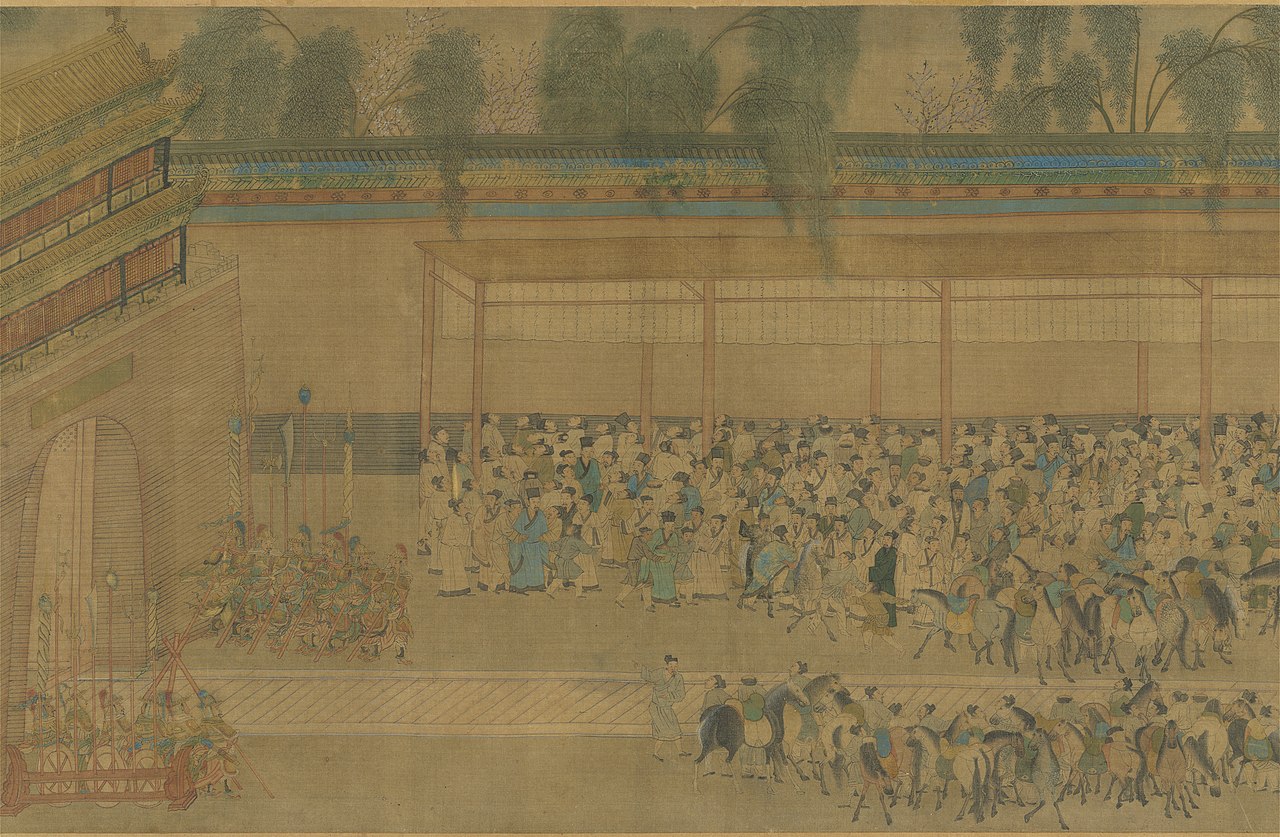
5.6 Culture, religion, examinations (Weber, Landes, Lin, Huff). Weber attributed the work and saving ethic to ascetic Protestantism; Landes (1998) to European culture’s curiosity, openness, and respect for manual labor. The crude versions have been refuted (Confucian China has a formidable work ethic, as shown by growth since 1978), but a refined version remains: not culture in general, but the system for selecting elites. The imperial examinations (institutionalized from 605, fixed canon from 1313, abolished in 1905) were perhaps the greatest mechanism of social mobility in the premodern world, but for thirteen centuries they steered intellectual ambition toward literary-moral learning and a bureaucratic career, not toward commerce or technology. Toby Huff added an institutional argument: the European university, an autonomous corporation with a logic-and-natural-philosophy curriculum, had no equivalent in China, where academies were schools for examination preparation.
5.7 Demography and the family (Hajnal, Voigtländer-Voth, Clark). West of the Hajnal line (Trieste–St. Petersburg), late marriage and permanent celibacy (10–20% of women did not marry) restrained fertility and kept per capita incomes higher; the Black Death (1347–1351), by killing a third of Europeans, raised wages and entrenched this regime. In China, marriage was universal and early, but Lee and Wang (1999) showed that marital fertility was regulated through female infanticide, adoption, and abstinence: the pure Malthusian model is too simplistic. It remains true that China in 1800 had a rural population density unparalleled in Europe, and that this made labor cheap (hypothesis 5.2) and the surplus scant (hypothesis 5.3).
5.8 Ming–Qing political choices. Finally, political contingency: China deliberately turned away from the sea (1433, withdrawal of Zheng He’s fleets, with ships four times larger than Columbus’s caravels; haijin until 1567; the Canton System from 1757), it constrained commercial printing less than Europe did but controlled ideas more, and under the Qing (1644–1912), a dynasty of Manchu conquerors, it prioritized internal stability above all else. A European monarchy could make similar choices (Philip II’s Spain did); the difference is that in Europe one state’s choice did not bind the others. Portugal turned Columbus down, but Castile financed him.
6. Comparative matrix of the hypotheses
No single hypothesis on its own meets all three criteria set out in the premise (chronological consistency, a symmetric explanation for Europe and China, corroboration in the data); the fragmentation–institutions–useful knowledge combination is the one that satisfies the most.
| Hypothesis | Main authors | Period in which it operates | Coherent chronology? | Does it explain why China doesn’t take off? | Support in the data | Verdict |
|---|---|---|---|---|---|---|
| An Lushan Rebellion | (popular thesis; Naitō on the Tang–Song transition) | 755-960 | No: followed by the Song peak | Only indirectly, via centralization and Neo-Confucianism | None on income; strong on institutions | A remote cause of institutional change, not of the divergence |
| Scientific advantage | Needham, Mokyr, Huff | 1540-1700 (method); 1870+ (applied science) | Partial: chemistry and thermodynamics follow the take-off | Yes, if reframed as examinations and the absence of public science | Strong after 1870, weak for 1760-1830 | Necessary, not sufficient; should be reformulated as “useful knowledge” |
| Coal and colonies | Pomeranz | 1750-1850 | Yes, but it presupposes parity in 1750 that is contradicted | No: it explains the English take-off, not Chinese stagnation | Contradicted on wages and GDP per capita | Explains the energy constraint, not the origin |
| High wages, cheap energy | Allen | 1650-1850 | Yes | Yes (adoption not profitable) | Strong on real wages | Explains the “where” and the “when”; pushes the question upstream |
| High-level equilibrium trap | Elvin | 1400-1850 | Yes | Yes | Consistent with the Ming–Qing per capita decline | Strong explanation of stagnation, weak on take-off |
| Institutions and property | North, Acemoglu–Robinson, Greif, Ma | 1200-1850 | Yes | Yes (legal personhood, a light but arbitrary state) | Good: public finance, taxation, contracts | Strong; requires a cause of the institutions themselves |
| Fragmentation and competition among states | Jones, Diamond, Hoffman, Rosenthal–Wong | 500-1900 | Yes | Yes (imperial peace, low-cost rural labor) | Good: number of states, military spending, urbanization | The most unifying; risk of geographic determinism |
| Culture, religion, examinations | Weber, Landes, Lin | 1313-1905 | Yes | Yes (selection of talent) | Weak in crude versions, decent for the examinations | Valid only in the institutional version (examinations) |
| Demography and family | Hajnal, Voigtländer–Voth, Lee–Wang | 1350-1850 | Yes | Partial | Good for Europe, contested for China | A supporting mechanism, not a first cause |
| Ming–Qing policy choices | Landes, Elvin, Rowe | 1433-1842 | Yes | Yes, but as contingency | Good on events | A proximate cause; depends on the lack of competition |
7. Critical synthesis: two time scales, one causal chain
The Great Divergence is best understood as the meeting point between a slow, institutional and epistemic divergence that began between the 12th and 15th centuries, and an energy and technological acceleration concentrated between 1760 and 1870. The two starting hypotheses sit at the two wrong ends of this scale: An Lushan is too early and too political, while chemistry and thermodynamics are too late and too specific.
The most defensible causal chain can be reconstructed in five links, each of which makes the next more likely without determining it:
-
Underlying condition (500–1500): fragmentation versus unity. Europe remained divided, while China was reunified by the Sui (589) and, after every crisis, reunified again. Hence fiscal and military competition in Europe, and peace and a light state in China. An Lushan fits here, but with the opposite sign from what is often hypothesized: the rebellion reinforced the obsession with unity and with the primacy of the civil sphere.
-
Derived institutions (1100–1700). Competition in Europe produced autonomous cities, guilds, universities, public debt, joint-stock companies, and states that negotiated with merchants. In China, unity produced the exam meritocracy, which is both the greatest success and the greatest opportunity cost of Chinese civilization.
-
Epistemic regime (1540–1700). The scientific revolution is not a stock of knowledge but a new way of producing it: mathematization, experiment, publication, competition among patrons. This is where the “scientific” advantage becomes real—but as a culture of useful knowledge, not as chemistry or thermodynamics.
-
Economic trigger (1650–1800). High wages in England and the Netherlands (Atlantic trade, productive agriculture, demographic regime), cheap coal, numerous literate artisans, and patents: only there did adopting machines become profitable. China, in the same period, doubled its population and slid into Elvin’s trap.
-
Acceleration (1800–1914). Science and industry fuse (rings 3 and 4 together): steel, chemistry, electricity, railways—and the military power derived from them imposed the unequal treaties (1842, 1860, 1895) on China. Divergence becomes domination.

Three critical clarifications.
-
China did not “fall behind”: it was overtaken. In absolute terms, China in 1800 was richer, more populous, and more technologically sophisticated than it had been in 1100. What was missing was intensive growth—i.e., growth in per capita income. Using the term “backwardness” projects a nineteenth-century category onto earlier centuries.
-
Divergence was not inevitable. Recent consensus (Broadberry, Mokyr, Vries) rejects both Landes’s European exceptionalism and Pomeranz’s “miracle by chance.” European conditions made takeoff likely but not certain; Chinese conditions made it unlikely but not impossible. The closest counterfactual proof is Japan, which, without colonies and with little coal, imitated the European model within thirty years after 1868, thanks to feudal-competitive institutions more similar to Europe’s than to China’s.
-
Reversibility. The divergence that began in the fifteenth century has largely closed since 1978, when China selectively adopted the institutional and epistemic mechanisms of capitalism (markets, firms, research universities, patents) while maintaining a unitary state. This suggests that the fundamental cause was neither geography nor culture in a strict sense, but the institutional configuration of the relationship among state, knowledge, and enterprise—and that configuration was changeable.
Why it matters
The question posed can therefore be answered as follows: the An Lushan Rebellion is not the cause of the divergence, and the decisive proof is the Song century that followed it; knowledge in mathematics and physics is, but only insofar as it was the expression of an epistemic and institutional regime that Europe built between the 12th and 17th centuries and that China, for reasons linked to its political unity and to its way of selecting elites, did not build. Chemistry and thermodynamics were the dividend of that regime, not its initial capital.
8. Essential bibliography
The data in the charts are approximate historical estimates, drawn from Maddison’s tables and the revisions by Broadberry, Guan and Li; the original series can be consulted at the Maddison Project Database.
- Allen, R. C., The British Industrial Revolution in Global Perspective, Cambridge UP, 2009.
- Allen, R. C., Bassino, J.-P., Ma, D., Moll-Murata, C., van Zanden, J. L., "Wages, Prices, and Living Standards in China, 1738-1925", Economic History Review, 2011.
- Bai, Y., Jia, R., "Elite Recruitment and Political Stability: The Impact of the Abolition of China's Civil Service Exam", Econometrica, 2016.
- Broadberry, S., Guan, H., Li, D. D., "China, Europe, and the Great Divergence: A Study in Historical National Accounting, 980-1850", Journal of Economic History, 2018.
- Diamond, J., Guns, Germs, and Steel, Einaudi, 1997 (Italian ed. 1998).
- Elvin, M., The Pattern of the Chinese Past, Stanford UP, 1973.
- Hoffman, P. T., Why Did Europe Conquer the World?, Princeton UP, 2015.
- Huff, T., The Rise of Early Modern Science: Islam, China and the West, Cambridge UP, 1993.
- Jones, E. L., The European Miracle, Cambridge UP, 1981.
- Landes, D., The Wealth and Poverty of Nations, Garzanti, 1998 (Italian ed. 2000).
- Lee, J., Wang, F., One Quarter of Humanity: Malthusian Mythology and Chinese Realities, Harvard UP, 1999.
- Lin, J. Y., "The Needham Puzzle: Why the Industrial Revolution Did Not Originate in China", Economic Development and Cultural Change, 1995.
- Maddison, A., Contours of the World Economy, 1-2030 AD, Oxford UP, 2007.
- Mokyr, J., A Culture of Growth: The Origins of the Modern Economy, Princeton UP, 2016.
- Needham, J., Science and Civilisation in China, Cambridge UP, 1954-; and The Grand Titration, 1969.
- Pomeranz, K., The Great Divergence, il Mulino, 2000 (Italian ed. 2004).
- Rosenthal, J.-L., Wong, R. B., Before and Beyond Divergence: The Politics of Economic Change in China and Europe, Harvard UP, 2011.
- Twitchett, D. (ed.), The Cambridge History of China, vol. 3: Sui and T'ang China, Cambridge UP, 1979.
- Vries, P., Escaping Poverty: The Origins of Modern Economic Growth, V&R unipress, 2013.
- Weber, M., Confucianism and Taoism (1915), in Sociology of Religion, Edizioni di Comunità, 1982.