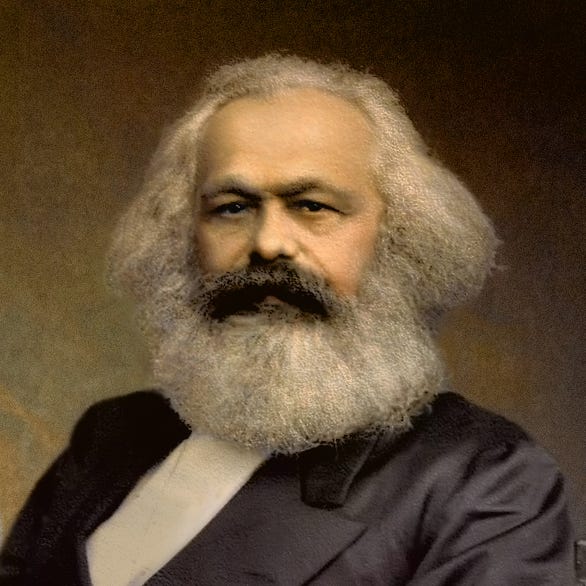
Karl Marx and Friedrich Engels are best known as the intellectual architects of modern communism and co-authors of The Communist Manifesto, published in 1848. Yet a lesser-known chapter of their lives, described in accounts drawn from Tristram Hunt’s biography of Engels, places both men in an arena they spent their careers dissecting: the London financial markets.
In the mid-19th century, Marx and Engels were not only theorists of capitalism; they were also consumers of its financial news and, at times, participants in its speculative machinery. Both followed business reporting closely, reading The Economist and other publications, and they exchanged detailed commentary on market conditions in their correspondence. In one letter from 1852, Engels updated Marx on easing pressures in the money market, rising railway shares, and the spread of speculation—while also warning that deeper trouble might be brewing, pointing to signs such as overstocked markets and strains tied to global trade, including shipments to China and India and the bankruptcy of some local merchants.
Marx’s direct engagement with stock trading began later, in 1864, after he received a substantial bequest of £820 from an admirer—more money, the account notes, than he had earned through writing. He used a portion for household upgrades and family expenses, including improvements to the home, pets for his children, and a vacation. With what remained, Marx tried his hand at stock speculation in Britain’s frothy market for new issues.
Marx described these activities candidly in a letter dated June 25, 1864 to his uncle, Lion Philips. He wrote that he had been speculating in English stocks that were proliferating rapidly, rising to what he considered unjustifiable valuations and then often collapsing. In that same letter, Marx claimed to have earned more than £400 and said he intended to return to trading, arguing that political complexity was creating fresh opportunity. He portrayed risk-taking as worthwhile if it could, as he put it, “relieve” his adversaries of their money.
How that subsequent round of trading turned out remains unclear; the narrative notes there is no surviving record of his later results. It also suggests a familiar possibility among traders: boasting about gains is common, while losses often go unmentioned.
Engels, by contrast, comes across as the more consistently disciplined financial operator. He helped manage his family’s textile enterprise in Manchester and held a seat on the stock exchange. When he retired from business in 1870 at age 49, his holdings were valued at £1.2 million. By the time of his death 25 years later, the portfolio had grown to £2.2 million.
His investments, as described in the account, reflected broad exposure to major Victorian-era industries and financial vehicles: a railway company (London and Northern Railway Co.), a gas utility (South Metropolitan Gas Co.), an infrastructure venture (Channel Tunnel Corp.), and a pooled fund invested in government bonds (Foreign and Colonial Government Trust Co.). In retirement, the income from these assets covered Engels’ expenses and also financed an annual stipend of £380 for Marx—support that helped keep Marx afloat.
The arrangement carried an irony: the two leading critics of capitalism effectively lived, at least in part, as rentiers—drawing income from capital. Engels offered a justification consistent with his worldview, arguing that stock trading did not itself create exploitation but redistributed “surplus value” already extracted from workers.
Why it matters
The story underscores how even capitalism’s sharpest critics were entangled with its financial systems, both intellectually and materially. It also highlights contrasting approaches to risk—Marx’s short-term speculation versus Engels’ long-term diversification—and how investment income shaped the practical conditions under which revolutionary ideas were produced. What to watch next is how biographies and archival research continue to refine these financial details, including the unresolved question of Marx’s later trading outcomes.