Hundreds of billions of dollars are pouring into artificial intelligence—new data centers, advanced chips, and the costly work of training ever-larger models. With that scale of spending, one impact should be almost automatic: more capital per worker. Economists call that “capital deepening,” and it typically boosts output per hour even if the underlying efficiency of the economy is unchanged.
The more contentious question is whether AI is doing something bigger—lifting total factor productivity (TFP), the metric intended to capture how much more output the economy can generate from the same overall bundle of inputs, such as labor and capital. In a recent note, Apollo chief economist Torsten Slok argues that, so far, the productivity data do not show that kind of broad-based efficiency breakthrough.
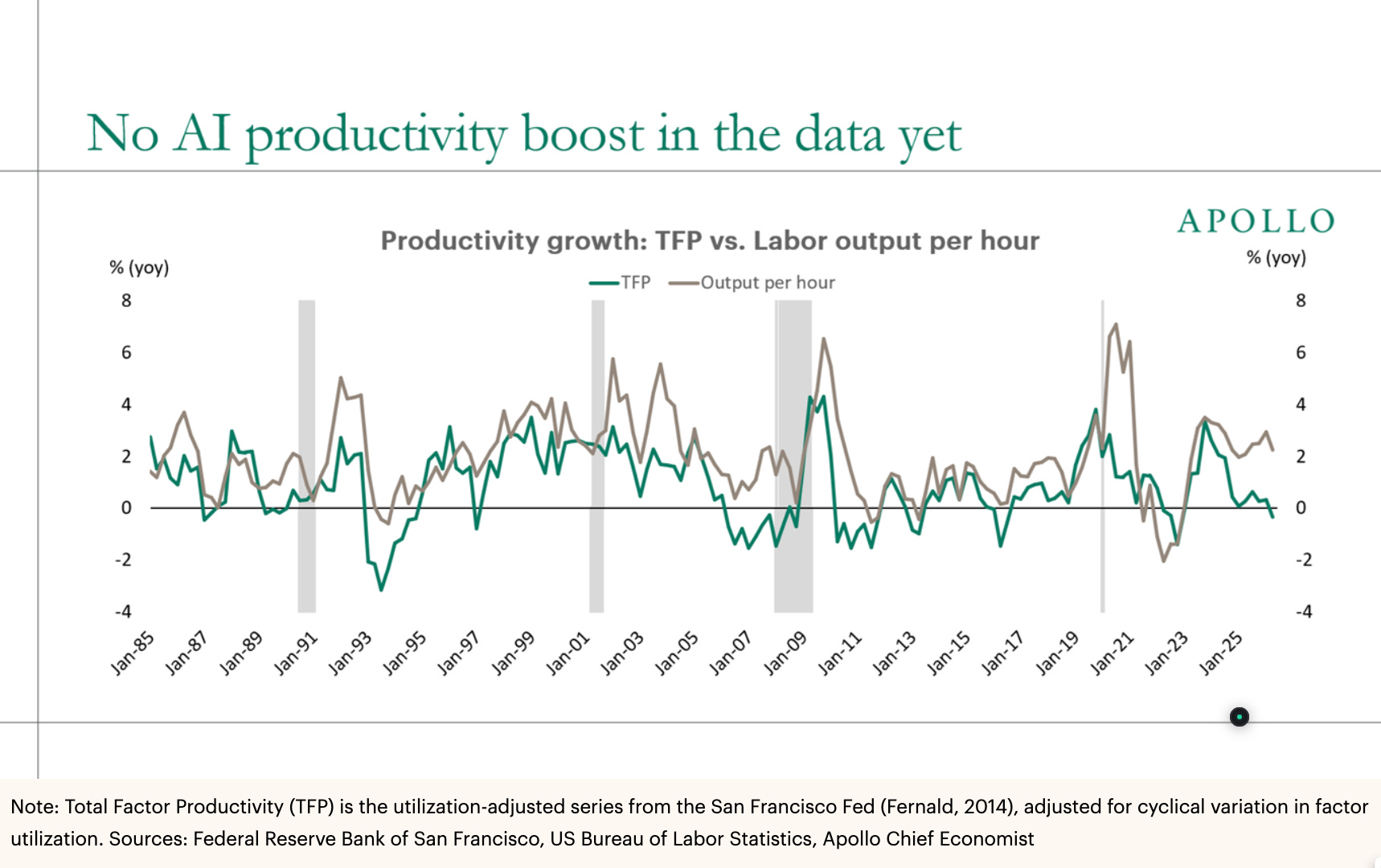
Slok points to utilization-adjusted TFP estimates published by the Federal Reserve Bank of San Francisco. After adjusting for how intensively labor and capital are being used over the business cycle, the series is currently slightly below zero and shows no clear acceleration since the current wave of AI investment began. If AI were already delivering a technology-like shock to efficiency across the economy, proponents would expect that line to be turning decisively upward.
At the same time, another widely cited measure—labor productivity, or output per hour—has been running around 2.5%, comfortably stronger than its average performance since 2005. That divergence has fueled claims that AI is already paying off.
But the combination of solid output-per-hour growth and flat TFP has a straightforward interpretation: the gains look more like capital deepening than a surge in economy-wide efficiency. Put differently, firms may be producing more per worker because they are equipping workers with more or better capital—servers, software, and AI tools—rather than because the economy has learned to produce more with the same inputs overall.
None of this means AI is irrelevant or failing. The boom is already evident in hard-to-miss places, including investment patterns and equity market valuations. It simply suggests that the most stringent productivity test—an unmistakable rise in measured TFP—has not yet been met.
There are also reasons AI’s benefits might not show up cleanly in official statistics. One is user surplus: AI may improve the quality of products and services in ways that are real for consumers but difficult for statistical agencies to translate into higher measured output without extensive—and controversial—quality adjustments. Another is that some AI projects may clear corporate hurdle rates only narrowly, raising output per hour without generating the kind of dramatic efficiency leap that would register as a “supernormal” increase in TFP.
The key takeaway is narrower than the slogan “no signs of AI in the productivity data.” The investment boom appears consistent with AI boosting measured labor productivity via capital deepening, while the data do not yet show AI lifting TFP—the specific channel economists associate with a fundamental step-change in efficiency.
Why it matters
Policymakers, investors, and workers are all watching for evidence that AI can raise long-run growth rather than just reshuffle spending toward new capital. If the payoff remains concentrated in capital deepening or hard-to-measure user benefits, inflation, wages, and fiscal projections could evolve differently than the most optimistic AI narratives imply. The next critical signal to watch is whether utilization-adjusted TFP begins to climb persistently as AI tools diffuse beyond early adopters and into routine business processes.