Industry is born predatory and, over a century and a half of conflict, becomes a great machine of mass emancipation. Today’s technology companies create more wealth with a fraction of the workers. The question is whether they will be able—or be compelled—to do the same.
To answer, we first need to understand why the factory managed it. Not out of vocation: at the start it enriched almost only those who owned it. It managed because it needed millions of people, gathered them under the same roof, and could not just leave. From that dependence workers extracted leverage, and with that leverage they won first the union, then the vote, and finally the welfare state.
This article follows that leverage from beginning to end: how it arises, how much it yields, what breaks it. There is only one measure: the share of national income that goes to labor. It falls in the first industrialization, rises for a century, then falls again from the 1970s onward, when the factory migrates and firms grow that can produce wealth without mass labor. If the argument holds, Big Tech will not emancipate anyone by its own force: the counterweight the factory generated on its own will have to be built.
From the land to the factory
The story begins with an uprooting. Before becoming workers, millions of English people are farm laborers, cottage weavers, artisans; to bring them into the factory, land and craft must no longer be enough to support them.
Enclosures contribute to this. Between 1604 and 1914 Parliament passes over 5,200 enclosure acts, covering 6.8 million acres, a little more than one fifth of England. Historians debate how much they weighed on the exodus from the countryside; but certainly, those who can no longer live off the fields have to look for a wage.
Wages are found in cities, and cities grow without rules. Manchester has fewer than 10,000 inhabitants in 1700 and 108 cotton mills in 1853; in 1851 more than half of Britons live in an urban center.
Inside the factory, time is no longer that of the seasons but that of the clock and the loom, and the ones who keep its pace are often boys: in 1819 more than half of cotton workers are under 19.
Those who lose their jobs have nowhere to return. From 1834 the Poor Law grants assistance only to those who enter the workhouse, and makes its conditions deliberately harsh—families separated, uniforms, heavy labor—so that only those with no alternatives will ask for help. Any wage becomes preferable.
The economist Karl Polanyi read in this phase an attempt to treat labor like any other commodity, and argued that to every such attempt society reacts to protect itself: he called it the “double movement”. Everything that follows is the story of that reaction. At the beginning, however, the reaction is not there—and you can see it in wages.
Sixty years of growth without wages
For the first sixty years, the factory enriches those who own it and barely at all those who work in it. Between 1780 and 1840, output per British worker grows by 46%, real wages by about 12%. The historian Robert Allen has called this gap the “Engels’ pause”.
The difference goes to profits. Their rate doubles, and their share of national income rises from one fifth to more than two fifths, while labor’s share falls from around 60% at the end of the eighteenth century to 45% by 1841. Later estimates by Nicholas Crafts reduce the gap between wages and productivity, but do not eliminate it.
Living conditions track wages, not output. Even in 1870 people work more than 3,000 hours a year, i.e., 60–70 hours a week. In the central parishes of Manchester, Liverpool, and Glasgow, life expectancy falls to around 25 years, according to the historian Simon Szreter, while in England and Wales a male newborn in 1841 has an average of 40 years ahead of him.
The urban figure is disputed: the historian Romola Davenport finds no robust evidence of a collapse. What remains is the testimony of Friedrich Engels, who in 1845 described those neighborhoods in The Condition of the Working Class in England.
The point is that the technology is already all there: steam power, the power loom, the factory. What is missing is someone able to demand its fruits. And that is missing because the law forbids it.
Without the vote and without a union
For half a century the English worker can neither organize nor vote, and the state’s first response to the social question is penal. From 1799, the Combination Acts ban trade unions and collective bargaining; they remain in force until 1824.
Those who cannot negotiate, destroy. Between 1811 and 1816 the Luddites smash looms. They are not enemies of machines as such: they challenge the masters who use them to circumvent wages and the rules of the trade. Parliament punishes the offense with death and deploys 12,000 soldiers against them.
Those who demand the vote fare no better. On 16 August 1819, in Manchester, the cavalry charges 60,000 people assembled to demand reform of Parliament: 18 dead and hundreds wounded, the Peterloo Massacre. And in 1834, ten years after the bans ended, six farm laborers from Tolpuddle are still deported to Australia for having sworn an oath in a mutual-aid society.
The electoral reform of 1832 does not change the picture. It raises the electorate from 400,000 to 650,000, 7% of the population, and the majority of workers remain excluded.
From this exclusion arose Chartism, the first mass workers’ movement. Its Charter called for universal male suffrage, the secret ballot, and salaries for MPs; the petitions of 1839 and 1842 collected 1.25 and more than 3 million signatures. Parliament rejected them, as it did the one in 1848.
The defeat is only apparent: in 1918 five of the Charter’s six points would become law. To understand how a movement defeated three times ended up winning, we need to look at what was meanwhile happening inside the factory.
The factory organizes its opponents
Repression fails because it is the factory itself that produces the force that counters it. Three of its characteristics—useful to the owner for producing—serve workers in organizing.
The first is numbers: the factory needs many hands, and those who are necessary can refuse. The second is concentration: thousands of people under the same roof, on the same schedule and the same pay, take stock of themselves, talk to one another, and discover they share the same interests. The third is rootedness: plants and machinery cannot be moved in a day, and the firm has to deal with those who live there. Together they make the strike a weapon, because without workers the line stops and the owner cannot take it elsewhere.
The historian E. P. Thompson showed that the English working class was not a starting point. It took shape between 1780 and 1832, precisely in the years of the bans, when workers developed an awareness of common interests. Consciousness comes before organization, and organization comes before rights.
The first form of organization is mutual aid. In 1844 in Rochdale, a group of artisans impoverished by machinery opened a cooperative store: this is the origin of the modern cooperative movement. Then came the trade union, which in 1871 the Trade Union Act recognized, expanding its rights up to and including the right to strike.
The results arrive in the pay packet. Between 1840 and 1900 British output per worker rose by 90% and real wages by 123%. For the first time, labor gained more ground than capital, and around 1900 its share of income had returned to the level of the late eighteenth century.
But a union can wrest a raise, not a law. For gains to become rights, the other half of what Chartism demanded is needed: the vote.
The vote and the social question
The vote arrives in stages, and each stage shifts politics. In the United Kingdom, the 1867 reform doubles the electorate, from one to two million, bringing in urban workers. From then on, anyone in government has to compete for their consent: between 1906 and 1914 Liberal governments introduce old-age pensions and insurance against sickness and unemployment, and for the historian G. R. Searle they do so also to fend off the Labour challenge. In 1918 all men over 21 can vote, and women over 30.
The same mechanism works even where those in power are conservatives. In Germany, Bismarck uses both the stick and the carrot. From 1878 to 1890 the Anti-Socialist Laws ban associations, meetings, and newspapers; in those same years sickness insurance (1883), accident insurance (1884), and the old-age pension (1889)—the first in the world—are introduced, also to head off more radical socialist alternatives. Neither one nor the other stops the party: under the bans, Social Democratic votes quadruple, to 1.4 million, and in 1912 the SPD is the largest party in the Reichstag, with 34.8%.
The Church, too, acknowledges that the issue can no longer be dodged. In 1891 the encyclical Rerum novarum recognizes the right to associate and to a sufficient wage: it rejects socialism, but criticizes unrestrained capitalism.
Italy follows the same path later on, and via repression. The Workers’ Party is founded in Genoa in 1892. In May 1898, in Milan, the army fires on the crowd protesting the price of bread: 80 dead according to the government, 400 according to the opposition. The turning point is Giolitti: from 1903 prefects are required to tolerate strikes, the first protections for women and children arrive, and in 1912 the electorate rises from 7% to 23.2% of the population.
The sociologist T. H. Marshall summarized this trajectory in three stages: civil rights in the eighteenth century, political rights in the nineteenth, social rights in the twentieth. The order is not accidental, because each right served to win the next. Yet even as workers thus enter the state, the factory changes beneath their feet.
The assembly line: more alienation, more power
At the beginning of the twentieth century, factory work is broken down and measured. In 1911 Frederick Taylor publishes The Principles of Scientific Management: every task must be studied, measured, and prescribed by management. In 1913 Henry Ford applies the same logic at Highland Park with the moving assembly line, and the time needed to assemble a Model T falls from 12 and a half hours to 93 minutes.
The price is paid by those on the line. It is what Marx had called alienation: the worker no longer controls either the product or the pace, and many simply leave. To add 100 men to Ford’s workforce, it has to hire 963. To keep them, in January 1914 it more than doubles wages: this is the “five dollar day”, 5 dollars for eight hours instead of 2.34 for nine.
That wage reveals a fourth characteristic of the factory, adding to the three of the nineteenth century. Mass production needs mass consumption: an industry that assembles a car in an hour and a half must find buyers, and the only sufficiently numerous buyers are wage earners. From being a mere cost, the wage becomes a market as well.
Meanwhile, the discipline that isolates the individual places thousands of people in exactly the same condition, and a new kind of organization emerges—no longer craft-based but factory-based. Workers’ councils appear spontaneously in Russia in 1905, where they are called soviets, and they reappear in 1918 in the German revolution, launched by workers and soldiers. In 1919–20, in Turin, the factory councils promoted by Antonio Gramsci’s “Ordine Nuovo” are elected directly by the workers, following the Russian model.
The Taylorist factory is thus, at one and the same time, the most authoritarian place in the economy and a school of collective organization. Which of the two faces prevails is not decided by technology. It is decided by politics—and the proof arrives immediately.
Wars, revolutions, and dictatorships
Between 1914 and 1945 the ruling classes first need the masses, then fear them; and the greatest gains come in both cases.
The need comes with the Great War, which mobilizes millions of workers and peasants and sends them home with a debt to be collected. In 1919 the Treaty of Versailles establishes the International Labour Organization, on the premise that lasting peace requires social justice; its Hours of Work Convention sets the principle of eight hours a day and 48 a week. In the same year, Italian metalworkers win the 48-hour week.
The fear comes with the Russian revolution and with what resembles it. In Italy it is the Biennio Rosso: in September 1920 about 500,000 workers occupy the factories, and the General Confederation of Labour has two million members. Here the response is not reform but squadrist violence, backed by industrialists and large landowners, and then the regime.
Fascism is the counterproof of the entire argument. The factory remains the same, with its thousands of workers concentrated and indispensable; but in 1925 the Pact of the Vidoni Palace abolishes independent trade unions and in 1926 the law bans strikes. Once the freedom to organize is removed, leverage no longer works: by 1929 the wage share of income had returned to its 1913 level. In Germany the free unions are dissolved on 2 May 1933; Stalin’s Soviet Union also industrializes without free unions. The factory, therefore, is not democratic by nature: it becomes so where those who work in it can associate, strike, and vote.
Where those freedoms endure, the crisis produces the opposite outcome. In the United States the Great Depression leads to the Wagner Act of 1935, which guarantees the right to organize and compels firms to bargain, and in 1938 to the Fair Labor Standards Act: a minimum wage, a 44-hour weekly cap, and a ban on “oppressive” child labor. In 1954, almost 35% of workers were union members.
The Second World War repeats the trade-off of the First, on a larger scale. In 1942, with the conflict ongoing, the Beveridge Report identifies five “giants” to be brought down — want, disease, ignorance, squalor, idleness — and from it arise Britain’s National Health Service and social insurance. Republican Italy writes the pact into the Constitution: the Republic is “founded on labour”, Article 39 guarantees trade-union freedom, and Article 40 the right to strike.
In the background, finally, is the Cold War. According to political scientists Herbert Obinger and Carina Schmitt, competition between the two blocs drives the expansion of the welfare state on both sides of the Iron Curtain: as long as an alternative exists, the West has an interest in showing it can distribute. In 1945 all the conditions are in place, and for the first time they operate together.
The postwar compromise
In the thirty years after 1945, the factory, the union, and the state find an unprecedented balance: wages grow along with productivity. In the United States, between 1948 and 1979, productivity rises by 112.5% and the hourly pay of the typical worker by 90.2%, according to the Economic Policy Institute.
The equilibrium rests on the factory, which has never been so large. In the United States, manufacturing employs 32% of non-agricultural workers in 1953; between 1961 and 1969 it adds 4 million jobs, 27% more, and in 1979 it reaches 19.6 million workers. In Italy, the transition is compressed into twenty years. Employment in industry rises from 6.29 million in 1951 to 7.89 million in 1961, from 32.1% to 40.4% of total employment, and in 1971 stands at 44%; agriculture meanwhile falls from 42.2% in 1951 to 29% in 1961. For those arriving from the fields, it is a leap: in the 1950s a job on a Fiat assembly line is a privileged placement.
Where there is the big factory, there is the union. In the United Kingdom, membership rises from 5.2 million in 1926 to 13.2 million in 1979, 54% of employees, and collective bargaining then covers over 70% of workers.
Along with wages, time is redistributed. In Germany, annual hours worked fall from 3,284 in 1870 to 1,354 in 2017, almost 60% less; in the United Kingdom the decline is about 40%, and the drop accelerates between 1913 and 1938, in the years of the eight-hour day.
Even in this period, however, growth does not redistribute on its own: it does so when someone forces it to. Miracle-era Italy shows this well. Between 1951 and 1963, output rises by 95% and profits by 86%, while the purchasing power of wage earners remains “virtually stagnant,” according to Treccani. Between 1948 and 1954, the repression of strikes costs the lives of 75 workers. A 2026 reconstruction shows that income inequality increases throughout the entire miracle and reaches its peak in 1969. It declines after the Hot Autumn, which brings the metalworkers’ contract with the 40-hour week and, in 1970, the Workers’ Statute.
Where leverage is stronger, finally, it becomes a right written into the rules of the firm. In Germany, codetermination assigns workers half the seats on the supervisory board: from 1951 in coal and steel, and from 1976 in all companies with more than 2,000 employees.
The compromise therefore has four material foundations and one political one. The factory needs many hands, concentrates them in one place, is rooted in a territory, and also lives off the consumption of those who work there; and all of this takes place in democracies where people can associate and vote. It is an incomplete and conflict-ridden emancipation, but a mass one. To measure its scale—and its duration—there is an indicator that runs through this entire history.
The thermometer: wages and profits as a share of national income
The indicator is the division of national income between those who work and those who own. If the lever works, wages keep pace with productivity and labor’s share holds steady or rises; if it breaks, the difference goes to profits.
The first way to read it is to compare wages and productivity across the four phases of this story.
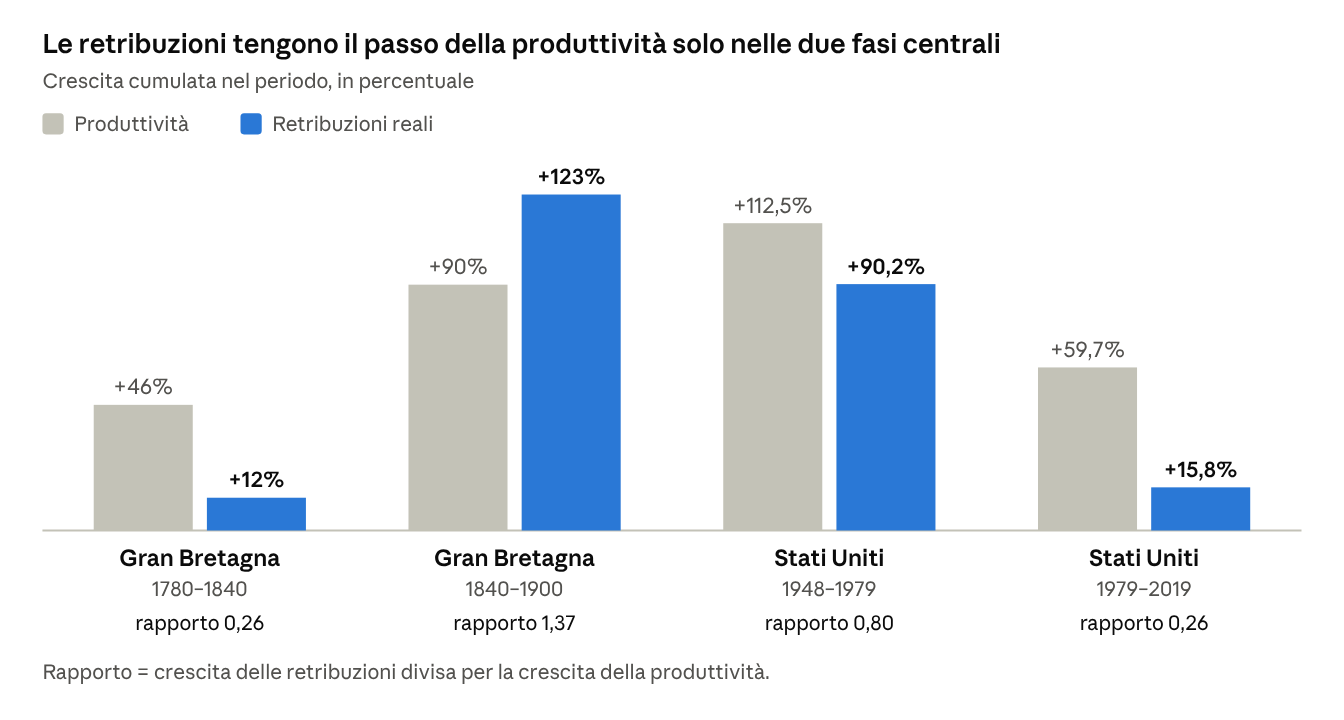
Source: Great Britain: Allen (2009), output per worker and real wages · United States: Economic Policy Institute (2019), net productivity and hourly compensation of non-supervisory workers · 4 periods.
The relationship flips twice. Wages lag behind during the first industrialization, grow faster than productivity in the late 19th century, track it closely in the postwar period, and then start losing ground again after 1979. The series are not homogeneous—output per worker for Great Britain, net hourly productivity for the United States—and the comparison is meaningful in terms of order of magnitude, not down to the decimal.
The second way is to look directly at income shares. For the United Kingdom there are estimates going back to the beginning. According to Robert Allen, labor’s share goes from about 60% at the end of the 18th century to 45% in 1841, while the profit share doubles, from 20 to over 40%; only around 1900 does labor return to its starting level. The 20th century completes the reversal: in Thomas Piketty’s data for the United Kingdom and France, capital receives about 40% of income in the 19th century and 20–25% or less for much of the following century, before rising again above 25% in recent decades.
For the 20th century there is the official U.S. series, which starts in 1929 and makes it possible to isolate manufacturing wages.
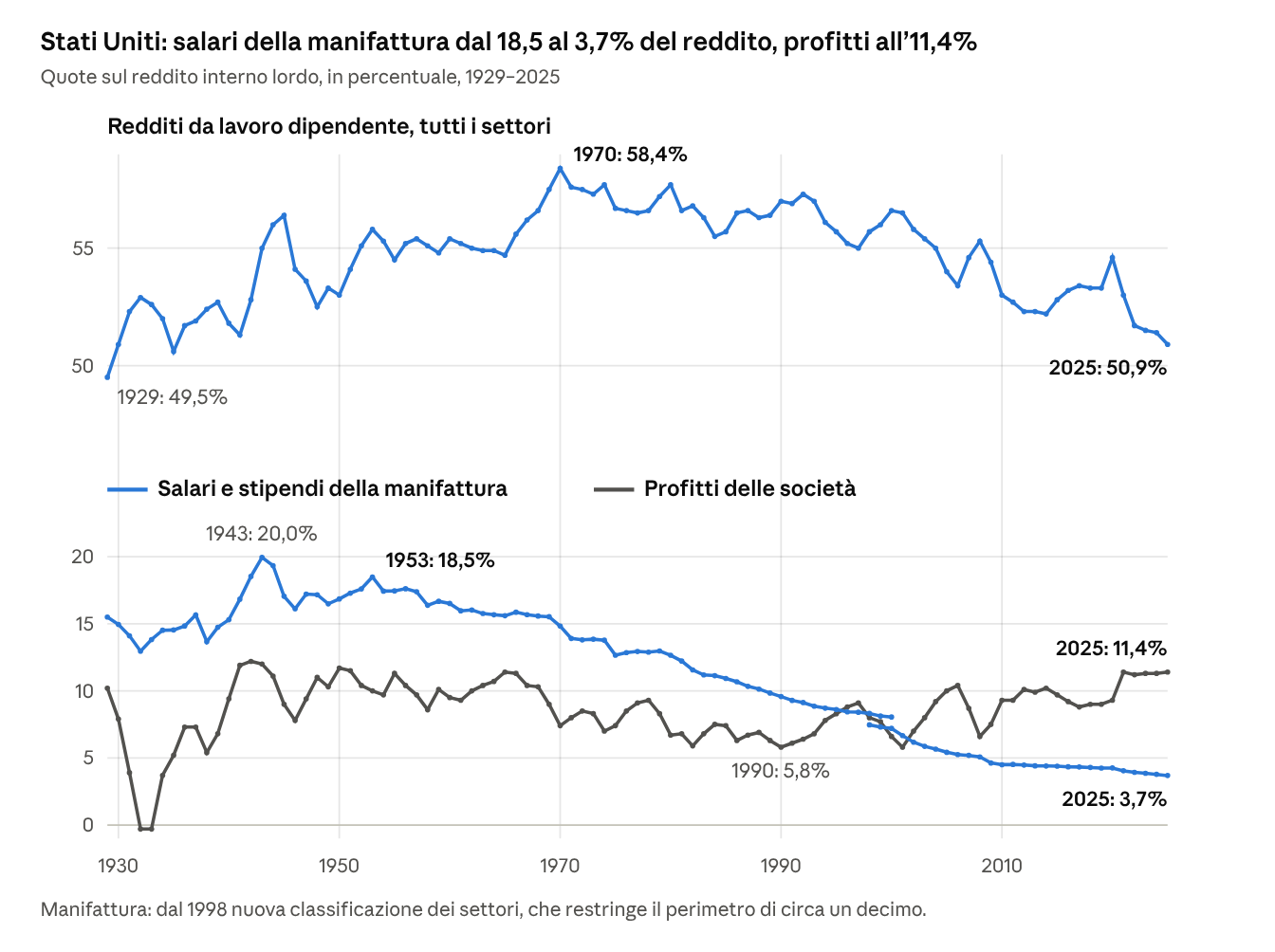
Source: Bureau of Economic Analysis via FRED: shares of gross domestic income (series A4002E1A156NBEA and A445RE1A156NBEA); manufacturing wages (A552RC1A027NBEA up to 2000, N552RC1A027NBEA from 1998) divided by gross domestic income (GDIA) · annual data 1929–2025.
The curves show three things. The employee labor share rises until 1970 and since then has lost 7.5 points: the 2025 level is the lowest since 1935. Corporate profits move in the opposite direction and, from their 1990 low, have almost doubled their weight. But it is the third curve that is most telling. In 1953, manufacturing wages and salaries, including clerical staff, by themselves amount to almost twice corporate profits; since 2002 they have been worth less, and today one third. The series do not add up to one hundred: the remainder consists of self-employment income, rents, interest, depreciation, and taxes.
For other countries, the comparison stops here at the overall labor share, and starts in 1970, when the data become comparable.
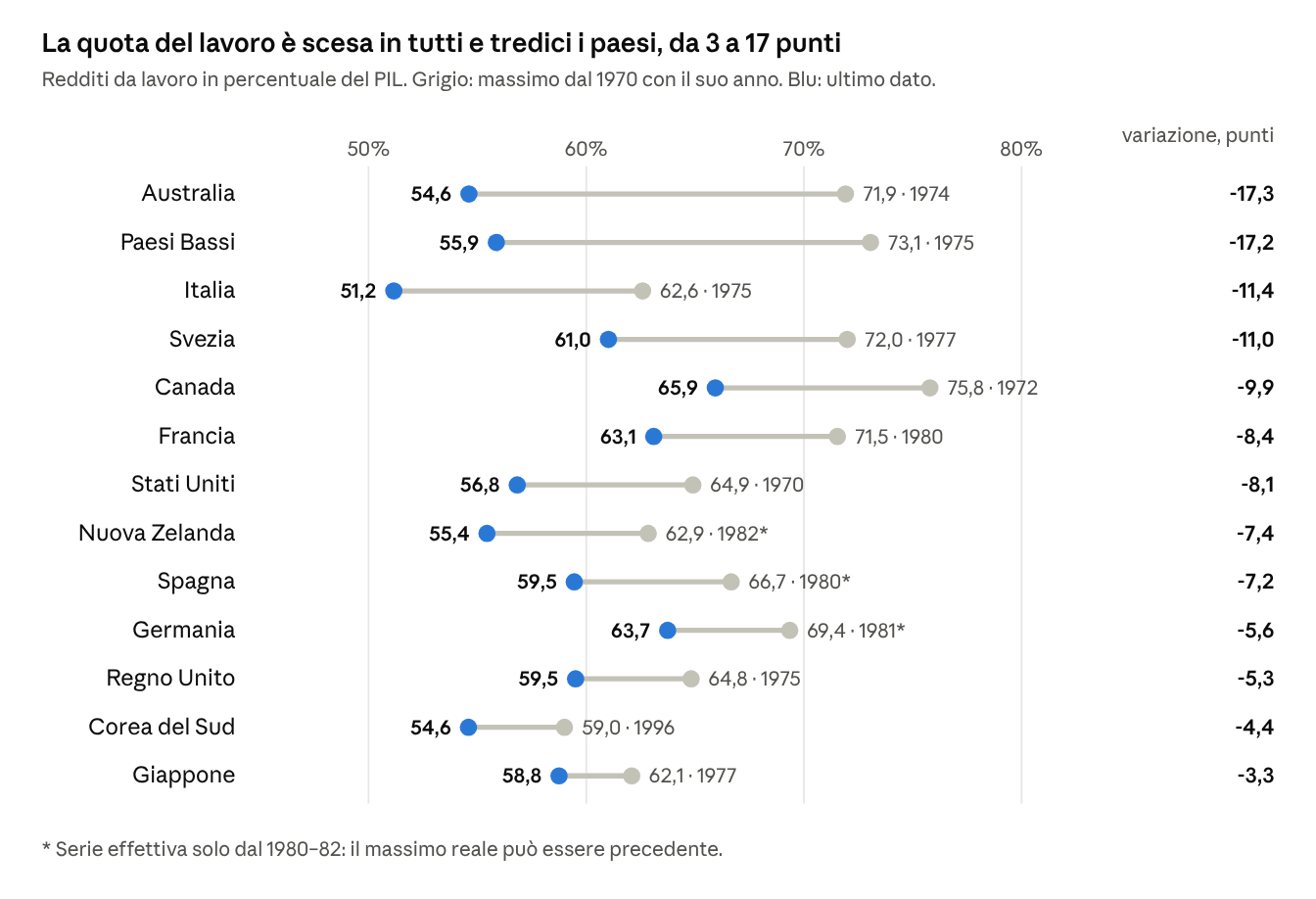
Source: Penn World Table 11.0 via FRED, labor income share of GDP at current prices · 13 countries, peak from 1970 and 2023.
The peak falls almost everywhere between 1970 and 1982, at the height of industrial employment and union power. The exception proves the rule: in South Korea, industrialized under a dictatorship, labor’s share is 40.2% in 1974 and reaches its peak only in 1996, at 59%. In between comes the summer of 1987, when the announcement of presidential elections is followed by over three thousand strikes and protests in three months, and in a year and a half more than 3,400 unions are formed.
After the peak, the decline is general. The measure includes an estimate of the labor income of the self-employed, and levels are not fully comparable across countries; changes are. In 2017 the IMF estimated that in advanced economies labor’s share was almost four points below its 1970 level, attributing about half of the drop to technology and another quarter to global integration. In industry the fall is sharper: in US manufacturing, labor’s share of value added drops from 62% in 1967 to 41% in 2012. And the phenomenon is now worldwide: according to the International Labour Organization, workers receive 52.3% of global income, 1.6 points less than in 2004, the equivalent of $2.4 trillion a year.
One caution is required: for the economist Matthew Rognlie, the long-run increase in capital’s share, net of depreciation, comes from housing more than from corporate profits. The direction of the movement, however, is not in dispute, nor is its timing: in almost all countries the curve bends between the 1970s and the early 1980s. What happens in those years?
The break
What happens is that the compromise breaks down, due to political choices before technical reasons. In thirty years, capital regains the mobility that the factory had taken away from it, and labor loses its leverage.
The first blow is the crisis of the 1970s. The oil shock brings inflation and unemployment together and calls the postwar equilibrium into question. The governments of Margaret Thatcher and Ronald Reagan emerge by restoring freedom to capital and taking it away from unions. In October 1979 London abolishes controls on capital movements: from that moment, investors can choose where to invest. In August 1981 Reagan fires more than 11,000 striking air traffic controllers, and the signal reaches private firms: in the following ten years they permanently replace strikers in one dispute out of seven, whereas before it happened in one out of seventy or eighty.
In Italy, the turning point has a date: 14 October 1980. After 35 days of the Mirafiori shutdown, Fiat managers and white-collar staff march in Turin against the picket lines; three days later the unions sign an agreement that withdraws the layoffs but leaves 22,000 workers on zero-hours wage supplementation (cassa integrazione). In 1984 the government cuts the wage indexation mechanism (scala mobile); in 1985 the referendum confirms the cut with 54.3%; in 1992 wage indexation is abolished.
The second blow is the fall of the Wall, which removes at once both the political rival and the economic boundary. In the 1990s China, India and the former Soviet bloc enter the world economy, and the global labour force rises from 1.46 to 2.93 billion people. Economist Richard Freeman calls it “the great doubling.” Because the newcomers bring many hands and little capital, the capital available per worker falls to 61% of its previous level: labour becomes abundant, capital scarce—and free to choose.
On 11 December 2001 China joins the World Trade Organization, and the picture is complete. Of the four conditions that had empowered the Western worker, three give way at the same time: the factory is no longer rooted, because it can move; it no longer needs his arms, because it can find them elsewhere at a fraction of the cost; and it no longer concentrates them in one place. The fourth—the worker as customer—survives in a paradoxical form: the market remains in the West, production does not. The effects are seen first of all where the factory was born.
Deindustrialization, from the United Kingdom to the “China shock”
The United Kingdom is the first country to industrialize and the first to dismantle. Manufacturing employment peaks in 1966 with 8.6 million workers; today sector employment is 2.3 million.
The decline begins before Margaret Thatcher, but under her it becomes a collapse: between 1979 and 1983 employment falls from 7.05 to 5.35 million—1.7 million jobs in four years. Historian Jim Tomlinson describes it as an unintended consequence of the economic policy of her first government, whose blame is later attributed to the behaviour of workers and unions.
Coal tells the same story in extreme form. There are one million miners in 1922 and 231,000 at the beginning of the 1980s. After the 1984–85 strike, lost by the miners, in 1992 the government announces the closure of 31 of the 50 remaining pits; the last deep mine closes in 2015. In 1994 the former mining village of Grimethorpe is the poorest in the country.
With factories and mines goes the organization that was born there: British trade unionism halves, from 13.2 to 6.6 million members, 22.4% of employees.
In the United States the curve is the same, shifted by thirteen years. The peak was in June 1979: 19.6 million employees, 22% of nonfarm employment. Today it is 12.8 million, 8.1%, and after 1979 manufacturing never again, in any recovery, regains the jobs lost in the preceding recession.
China’s entry into world trade accelerates the decline. David Autor and his co-authors estimate about one million jobs lost in U.S. manufacturing between 1999 and 2011; across the entire economy it reaches up to 2.4 million, a figure the authors themselves consider an upper bound. The most serious fact, however, is another: in the affected areas, wages and labor-force participation remain depressed for at least a decade. Alternative jobs, quite simply, do not arrive.
And along with the jobs goes the bargaining power of those who remain. Between 1979 and 2019 U.S. productivity rises by 59.7% and typical workers’ pay by 15.8%; unionization falls from 20.1% in 1983 to 10% in 2025, and to 5.9% in the private sector.
Nor are the countries that had defended their industry better immune. German manufacturing lost 177,000 jobs in 2025, and the auto industry is at its lowest employment since 2005. Italy remains the EU’s second-largest manufacturing base, but labor captures less and less of it: its share of income has fallen by more than eleven points since 1975, as seen in the cross-country comparison, and real gross wages have declined by 6.6% in 35 years, according to the Parliamentary Budget Office.
The factories that closed in Manchester, Detroit, and Turin have not disappeared, though. They have changed address.
The factory that emigrated: who benefited
Factories go where labor costs less, and it is the wage gap that moves them. In 2012, according to the Bureau of Labor Statistics surveys, an hour of labor in manufacturing costs $45.79 in Germany, $35.67 in the United States, and $34.18 in Italy; $6.36 in Mexico and $2.10 in the Philippines.
In this sense, the formula that the rich exist because the poor exist contains a precise truth: the $100 phone is possible because the people assembling it earn little. In 2025 the base pay of an iPhone assembly-line worker at Foxconn in China is $295 a month, the legal minimum.
Low wages, however, explain margins more than prices. For the iPhone 4, at a price of $549, a 2011 study attributes 58.5% to Apple’s gross profit and 1.8% to direct labor in China. And according to Fairphone’s CEO, raising assemblers’ pay to a decent level would cost just over a dollar per device. Most of the value does not remain where production takes place: it goes to whoever owns the design, the brand, and the sales network.
This is the pattern that Immanuel Wallerstein—and, with him, Giovanni Arrighi—described as the division of labor between core and periphery: in the core, activities with high capital and skill intensity; in the periphery, low-wage ones.
The pattern, however, is not zero-sum, and it is not static. In China, over 800 million people have escaped poverty in forty years, and the country now produces 28% of global manufacturing value added. Christoph Lakner and Branko Milanović’s “elephant curve” shows who gained between 1988 and 2008: incomes for the global middle class rose by 70–80% and those of the richest 1% by about 60%, while around the 80th–85th percentile they remained flat. Seven out of ten of those people live in the old rich countries and, as Milanović himself notes, sit in the lower half of their countries’ distributions. A later revision softens the curve’s shape but confirms convergence among poor countries.
Nor does the periphery remain such forever: the theory itself allows that a country can move up. South Korea, where in 2012 an hour of industrial labor cost $20.72—ten times the Philippines—now spends on research almost 5% of GDP. And according to industry estimates, an hour of work in China’s private manufacturing sector now costs about $6.69, more than the $5.56 of a Mexican worker in their first job.
Offshoring has therefore improved the lives of those who took in the factories, but within a relationship that remains unequal: production goes where wages are low; value returns to where ownership and consumers are. More than “the rich exist because the poor exist,” the accurate formula is asymmetric interdependence. Asian workers and owners of capital everywhere have benefited; Western factory workers—who had been the beneficiaries of the old factory system—have lost out. The question remains whether this loss was inevitable.
Could it have been avoided?
Partly yes and partly no—and the key is to distinguish the two parts. A first clue comes from comparing countries.
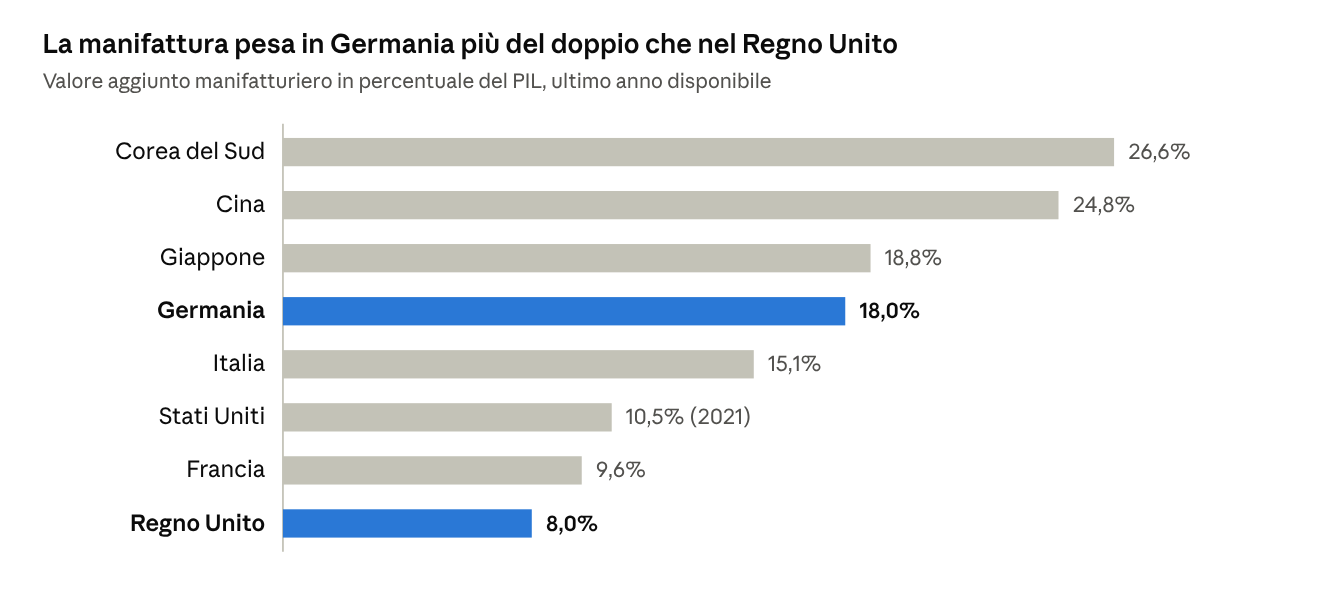
Source: World Bank, indicator NV.IND.MANF.ZS · 8 countries, 2024 (United States: 2021).
Deindustrialization has not affected everyone in the same way: among major economies, manufacturing’s share ranges from one to three. If an economic law were at work, it would have acted everywhere with the same force; here, choices mattered too.
The unavoidable part is the price of success. In advanced countries, the share of workers employed in manufacturing falls from 28% in 1970 to 18% in 1994, before China’s rise, and an IMF study attributes more than 60% of the decline to productivity, which in industry grows more than in services: fewer workers are needed to produce more. Economists Colin Clark and Jean Fourastié had already foreseen this in the 1940s with the three-sector model, according to which a mature economy shifts labor from agriculture to industry and then to services, up to 70% of employment.
The avoidable part concerns timing, places, and social costs—and the United Kingdom itself shows it. Between 1958 and 1967 the mines halved their workforce in agreement with the unions, with public programs for alternative employment; in the 1980s closures were imposed and the alternatives were missing. Politics makes the difference, and it shows up in spending. In the years of the “China shock,” from 2001 to 2008, Denmark spent between 1.3 and 1.9% of GDP on active labor market policies—training and job-placement services; the United Kingdom stopped at 0.3–0.5% and the United States at 0.1–0.2%. The U.S. program for workers hit by foreign trade assisted almost 100,000 people a year: it expired in 2022 and Congress did not renew it.
On top of inadequate worker retraining came a second mistake: believing it was possible to keep research at home while letting factories leave. For Harvard economists Gary Pisano and Willy Shih, production nurtures a shared pool of capabilities on which the ability to innovate depends; when the factory moves abroad, the damage is “almost irreversible.” Innovation follows plants, not the other way around.
Those who invested in skills did, in fact, keep more industry. Germany spends 3.1% of GDP on research and South Korea almost 5%; Italy is at 1.38%, versus a European average of 2.2%. This is not proof of causality, but the hint is consistent with the chart.
Industrial policy alone, however, is not enough. France, far more interventionist, has lost almost as much industry as the United Kingdom, notes an analysis by the London School of Economics, and the German model itself is struggling today. And arriving late is costly: the two “Chips Acts,” the American and the European, allocate just over $50 billion each to bring semiconductors back home—that is, to rebuild what had been allowed to leave.
The answer, then, is twofold. The decline in industrial employment was to a large extent inevitable; the hollowing-out of entire regions and the loss of advanced production were not. Training workers before the shock and retaining the most knowledge-intensive factories would have changed a great deal. It would not have changed, however, the nature of the companies that in the meantime have taken the factory’s place at the top of the economy.
Big Tech: wealth without mass employment
The large digital platforms are the heirs of heavy industry in terms of wealth and power, not jobs. They generate unprecedented value with very few direct employees: Nvidia is worth about $5.65 trillion and has 42,000 employees—$134 million in market cap per worker.
| Company | Market cap, $bn | Employees | Market cap per employee, $m |
|---|---|---|---|
| Nvidia | 5,650 | 42,000 | 134.5 |
| Apple | 4,870 | 166,000 | 29.3 |
| Alphabet | 4,160 | 190,820 | 21.8 |
| Microsoft | 3,840 | 228,000 | 16.8 |
| Amazon | 2,710 | 1,576,000 | 1.7 |
| Meta | 1,850 | 78,865 | 23.5 |
Market caps as of 5 October 2026, rounded; employees from the latest annual reports.
The comparison with the factory has become a classic. In 1990, Detroit’s three automakers had $250 billion in revenue with 1.2 million employees; in 2014, Silicon Valley’s three largest companies had the same revenue with 137,000 people. The comparison is imperfect, because by 1990 Detroit was already in decline and the platforms rely on external suppliers for production: Apple claims 450,000 jobs at U.S. suppliers. But the order of magnitude remains.
This closes the circle opened by the thermometer. Economists call these companies “superstar firms,” and according to David Autor and co-authors labor’s share of income falls precisely because sales concentrate in a few highly productive firms that employ little labor.
Now compare platforms with the four conditions that had made the factory democratic. They do not need many hands. They do not concentrate workers: they scatter them among suppliers, contractors, and collaborators. They are not rooted, because software does not have the weight of a blast furnace. The fourth condition remains, the need for customers; but the platform’s customer does not need a high wage—attention is enough. Value is extracted from their data: it is what the scholar Shoshana Zuboff called “surveillance capitalism”, the large-scale collection and sale of personal data. It is a new form of alienation: the worker did not control what they produced; the user does not control what is collected about them.
Command, too, is concentrated. Mark Zuckerberg controls 61% of Meta’s voting rights with about 13% of the capital, thanks to multi-vote shares; in industrial Germany, half of the seats on the supervisory board belong to workers. And wealth follows command: seven of the ten largest fortunes in the world in 2026 come from technology, totaling over $2.1 trillion.
Artificial intelligence pushes in the same direction, more forcefully. Amazon, Microsoft, Alphabet, and Meta forecast about $725 billion in investment in 2026, versus 410 in 2025, largely for computing centers: it is investment in machines, not people. The IMF estimates that nearly 40% of global employment is exposed to AI, and about 60% in advanced countries; half of those jobs could benefit, while the other half risks lower wages and fewer hires. “In most scenarios,” writes Kristalina Georgieva, AI will worsen inequality. The first signs are there: in the United States, employment among 22–25-year-olds in the most exposed occupations has fallen by 13% in relative terms.
Amazon is the exception that proves the rule. It is the only major platform with a mass workforce, and it is precisely there that automation is advancing: internal documents revealed by the New York Times indicate a goal of avoiding over 600,000 hires by 2033 thanks to robots. The company disputes the account.
The difference from the factory lies entirely here. Industry needed the masses as producers; the platform needs them above all as users. And whoever is not necessary to production cannot stop it: the user does not go on strike. Before drawing conclusions, however, this reading needs to be tested against its strongest objections.
Objections
The objections are serious, and it is worth taking them in the order this story itself suggests.
The first is historical: even the factory started out badly. The “Engels pause” lasted sixty years, then wages caught up; we might be in the same phase, and the benefits will arrive. It is possible. But wages recovered because the factory gave workers leverage, and today that leverage is missing: waiting is not enough.
The second is empirical: the link between productivity and wages has not actually been broken. Anna Stansbury and Lawrence Summers find that in the United States higher productivity still leads to higher pay, and that what holds wages back are other factors, not technology in itself. This is an argument that corrects technological pessimism, but it strengthens the underlying thesis: if the brake is not technology, it must be sought in power relations and in the rules.
The third concerns job quality. Digital technology creates good employment: in the European Union, IT specialists number 10.3 million, 5% of those employed versus 3% in 2011, and they report pay and job quality above average. That is true—and that is precisely the point: they are 5%. In 1971, Italian industry employed 44% of workers.
The fourth shifts the yardstick: the benefits do not flow only through the paycheck. Research, maps, and communication are free for billions of people, and wage statistics do not capture that. But a free service improves life without giving power: it does not pay the rent and it does not sit at the bargaining table.
The last two have already surfaced. Globalization has emancipated people elsewhere, and deindustrialization is largely the child of productivity—that is, of success. Both are true, and both leave the same question open: who paid the bill, and whether they had to pay it alone.
None of these objections denies that technology can emancipate. They shift the question: not whether, but who and what will make it possible.
Conclusion: counterweights must be built
Big Tech will not emancipate the masses by its own force. After all, the factory did not either: it took unions, laws, the vote, and a century of conflict. The difference is that the factory produced its own counterweight, because it brought together millions of indispensable workers and could not leave. The digital economy does not: its counterweight, if it comes, will be an entirely political construction.
The story told so far indicates at least where to look for it, because each of the lost conditions has a possible substitute. In place of the need for hands, training before the shock and not after: in the 2000s Denmark spent on active labour-market policies about ten times more than the United States, relative to GDP. In place of embeddedness, keeping advanced production at home, because skills follow the plants; Italy starts from behind here, with research at 1.38% of GDP and IT specialists at 4% of those employed, third from last in the Union. In place of physical concentration, forms of representation that can reach dispersed work: German co-determination shows that workers’ voice can be written into a firm’s rules. And against the concentration of control, market constraints, through antitrust, and corporate-governance constraints, where today a founder can decide alone.
None of these measures is new: organization, rules, and voting are the same tools that made industry democratic, adapted to an economy that no longer needs everyone. It took industry more than a century to become an instrument of emancipation. The open question is how much time there is this time.
Essential timeline
The dates marking the birth, use, and breakdown of workers’ leverage.
| Year | Country | Milestone |
|---|---|---|
| 1799–1824 | United Kingdom | Combination Acts: trade unions and collective bargaining banned |
| 1833 | United Kingdom | Factory Act: no factory work under age 9, 9 hours a day up to age 13, first four inspectors |
| 1867 | United Kingdom | Second Reform Act: the vote extended to urban workers, electorate from one to two million |
| 1871 | United Kingdom | Trade Union Act: union rights expanded up to the right to strike |
| 1883–1889 | Germany | Bismarck’s social insurance: sickness (1883), accidents (1884), old age (1889) |
| 1906–1914 | United Kingdom | Liberal welfare reforms: old-age pensions, insurance against sickness and unemployment |
| 1912 | Italy | Electoral reform: voters from 7% to 23.2% of the population |
| 1914 | United States | Ford’s “Five dollar day”: from $2.34 for 9 hours to $5 for 8 hours |
| 1918 | United Kingdom | Vote to all men over 21 and women over 30 |
| 1919 | International | The International Labour Organization is founded; Hours of Work (Industry) Convention: principle of 8 hours a day and 48 a week |
| 1925–1926 | Italy | Pact of the Vidoni Palace and the ban on strikes: end of free trade unions |
| 1935 | United States | Wagner Act: right to organize and duty to bargain |
| 1938 | United States | Fair Labor Standards Act: minimum wage, 44-hour weekly cap, ban on “oppressive” child labor |
| 1942 | United Kingdom | Beveridge Report: foundation of the National Health Service and social insurance |
| 1948 | Italy | Constitution: Republic “founded on labor,” trade-union freedom, right to strike |
| 1951–1976 | Germany | Codetermination: half of the supervisory board to workers, in coal and steel (1951) and in companies with over 2,000 employees (1976) |
| 1969–1970 | Italy | Metalworkers’ contract with the 40-hour workweek; Workers’ Statute, Law 300 |
| 1979 | United Kingdom | Exchange controls on capital movements abolished |
| 1980 | Italy | March of the Forty Thousand in Turin: 22,000 Fiat workers on zero-hours wage supplementation (cassa integrazione) |
| 1981 | United States | Reagan fires over 11,000 striking air traffic controllers |
| 1984–1992 | Italy | Sliding wage scale: cut (1984), referendum (1985), abolition (1992) |
| 2001 | China | Accession to the World Trade Organization |
Sources
Pages consulted on 11 October 2026.
- Early industrialisation: Allen, “Engels’ pause”; Crafts, working paper 1268, Warwick; UK Parliament, enclosures; Campop, University of Cambridge; Wikipedia, History of Manchester; Wikipedia, child labour in the Industrial Revolution; National Archives, Poor Law 1834; Wikipedia, The Great Transformation; Our World in Data, working hours; ONS, life expectancy; Razzell and Spence; Davenport.
- United Kingdom, rights and trade unions: Wikipedia: Combination Act 1799, Luddite, Peterloo Massacre, Tolpuddle Martyrs, Reform Act 1832, Representation of the People Act 1918, The Making of the English Working Class, Rochdale Pioneers, Trade Union Act 1871, Liberal welfare reforms, T. H. Marshall, Beveridge Report; UK Parliament: the 1832 reform, Chartism, subsequent reforms; National Archives, Factory Act 1833; Economics Observatory.
- Germany: Wikipedia: Anti-Socialist Laws, 1912 election, German Labour Front, codetermination; Social Security Administration; Bundesagentur für Arbeit; Clean Energy Wire.
- Italy: Wikipedia: Italian Socialist Party, Milan riots of 1898, Giolittian era, 1912 electoral law, FIOM, factory councils, Biennio Rosso, Pact of the Vidoni Palace, leggi fascistissime, March of the Forty Thousand, scala mobile; Constitution, Quirinale; Istat; Treccani, “The Italian economic miracle”; Gabbuti and Rappa; MuseoTorino; Panorama; Brocardi; L'Espresso on the UPB analysis.
- United States: Wikipedia: The Principles of Scientific Management, Assembly line, Labor unions in the United States, 1981 air traffic controllers’ strike; The Henry Ford; NLRB, Wagner Act; Department of Labor, FLSA; Economic Policy Institute; BLS, manufacturing 1979–2019; BLS, unions 2025; Cleveland Fed; Autor, Dorn and Hanson; Cato Institute; Stansbury and Summers; Department of Labor, TAA.
- International history and globalisation: ILO, history; Wikipedia: 1919 Hours of Work Convention, Workers' council, Rerum novarum, exchange controls in the United Kingdom, China and the WTO, 1984–85 miners’ strike; Obinger and Schmitt; Freeman, “The Great Doubling”; Shaw 1983; Tomlinson; Enginuity on ONS data; Yorkshire Post; LSE.
- Wages and profits as a share of income: Warshawsky on Piketty, Mercatus; FRED, BEA data: employee compensation, corporate profits, manufacturing wages up to 2000 and since 1998, gross domestic income; FRED, Penn World Table 11.0: United States, Canada, Japan, South Korea, Australia, New Zealand, Germany, France, United Kingdom, Italy, Spain, Sweden, Netherlands; IMF, labour share; Kehrig and Vincent; Gulf News on the ILO report; Brookings on Rognlie; Korea Times; libcom.org.
- Offshored manufacturing and cross-country comparisons: Destatis on BLS data; GoodElectronics on Fairphone; Kraemer, Linden and Dedrick; Wikipedia: World-systems theory, The Elephant Curve, Three-sector model; Milanović, VoxEU; Brookings, Kharas and Seidel; World Bank on China; World Bank, manufacturing value added (% of GDP); Cargoson; Tetakawi; IMF, Rowthorn and Ramaswamy; OECD, active labour market policies; Pisano and Shih; Eurostat, research and development; Eustat; CEPA.
- Big Tech and artificial intelligence: Nvidia, 10-K; Amazon, 10-K; Meta, 10-K; MakerStations; InvestingCube; BD+C on Schwab; Techdirt; AOL; Autor et al.; Wikipedia, Surveillance capitalism; PRI; Scripps News on Forbes; Yahoo Finance; IMF, Georgieva; Stanford SIEPR; MIT Sloan Management Review Middle East; Eurofound; Eurofound, press release; Eurostat via BCCI.